What is a lease amendment? Changing a lease mid-term

A lease amendment is a written change to a lease that both the property owner and the tenant have already signed. It edits one or more terms, such as the day rent is due, the rent amount or the people who live in the home, and everything else in the lease stays as it was. Both sides sign the amendment, and it is kept with the lease. In the worked example below, moving a $1,800 rent from the 1st to the 5th of the month creates a one-time bridge charge of $240 for the 4 days in between.
This page covers what a lease amendment is, what it is usually used for, how it differs from an addendum, what one usually includes, the general steps, a worked example and the mistakes that cause problems. It is general information and is not legal or tax advice. Rules vary by state and city. Check your local law or an attorney.
What is a lease amendment?
A signed lease is a contract, so neither side can change it alone. A lease amendment is how the two sides agree to change it while the lease is running. It names the lease it changes, says which clause is replaced or edited, gives the new wording and the date the change starts, and states that the rest of the lease stays in force. Once both sides sign it, the amendment becomes part of the lease.
Many leases include a clause saying changes must be in writing and signed by both parties. Even where a lease is silent, a signed amendment is the clearest record of what was agreed and when.
What a lease amendment is used for
Amendments cover changes that come up in the middle of a term. Common ones include:
- Moving the rent due date. A tenant paid on the 3rd may ask to pay on the 5th. The amendment sets the new date and how the gap between the old and new dates is charged.
- Changing the rent mid-lease. In a fixed-term lease the rent usually stays the same until the term ends. A mid-lease change generally needs the lease to allow it or both sides to agree, and rent increase notice rules can still apply. The guide to a rent increase notice covers the notice side.
- Adding or removing an occupant or a tenant. A partner moves in, or one roommate moves out and the others stay. Adding a person to the lease usually means they sign it too. When a tenant hands the whole lease to someone else, that is usually a lease assignment, and when a tenant rents part of the home to someone, that is usually a sublease.
- Changing a fee or a service. Adding a parking space, changing who pays a utility, or updating the late fee terms. The entry on a late rent notice shows how late fee terms are used in practice.
- Changing the end date. Moving the end date out by a few months is often called a lease extension, and it is usually signed in the same way.
Lease amendment vs lease addendum
The two words are often used loosely, and many people treat them as the same thing. A common way to tell them apart:
- An amendment changes a term that is already in the lease, such as the due date or the rent, and usually replaces the old wording.
- An addendum adds a new section that the lease did not cover, such as rules for a pet or a parking space. A pet addendum is a common example.
Both need the signatures of everyone who signed the lease. The guide to a lease addendum covers addenda in more detail.
What a lease amendment usually includes
- The names of the property owner and every tenant on the lease, and the property address.
- The date of the original lease it changes, so it is clear which lease it belongs to.
- Each clause being changed, the old wording or a reference to it, and the new wording.
- The date the change takes effect, and any one-time charge or credit that comes with it.
- A statement that all other terms of the lease stay the same.
- The signature and date of each person who signed the lease.
An attorney can draft or review the wording, especially for changes to rent, occupants or the end date.
How a lease amendment usually works
- Agree on the change. One side asks, and both agree on the new term and when it starts.
- Check the lease and local rules. Some changes, such as a mid-lease rent increase, may need a clause in the lease or a set notice period.
- Write it down. Put the change, the start date and any one-time charge in a short document.
- Sign it. Everyone who signed the lease signs the amendment. A person being added usually signs the lease as well, and some owners ask a co-signer to sign too.
- File it and update the records. Keep the amendment with the lease, give each person a copy, and update the rent ledger from the date the change starts.
A worked example: moving the rent due date
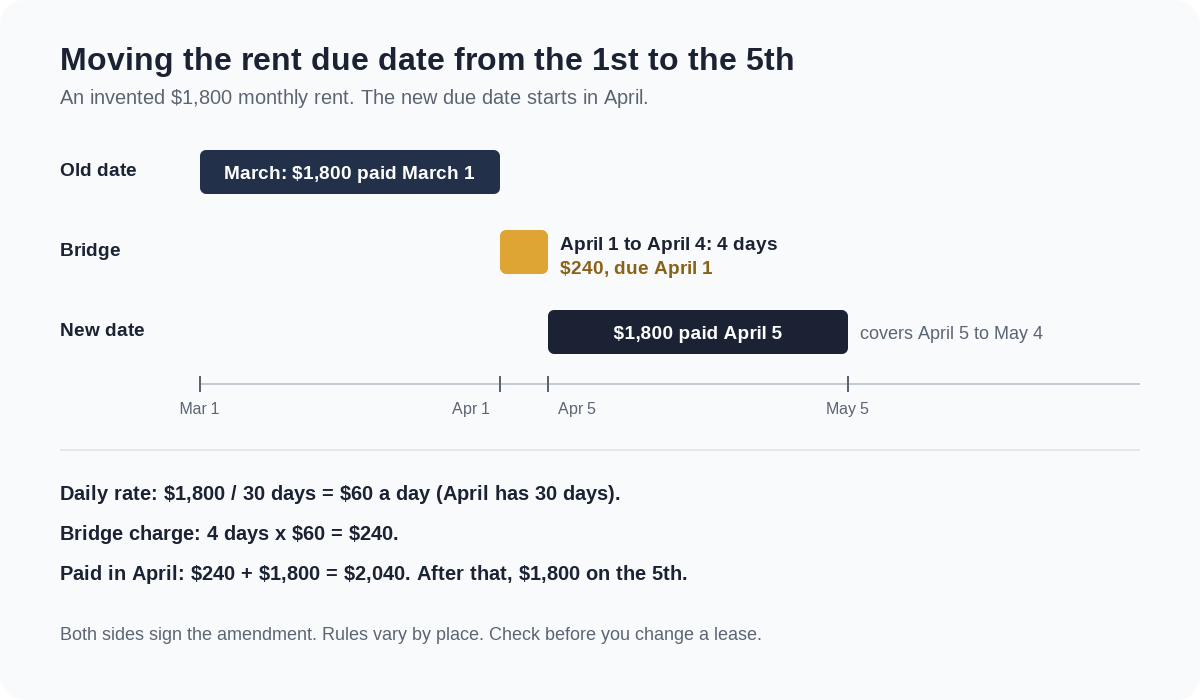
All the figures here are made up. A tenant pays $1,800 a month, due on the 1st, on a lease that runs to the end of the year. The tenant's pay now arrives on the 3rd, so the tenant asks to pay on the 5th. Both sides sign an amendment that moves the due date from the 1st to the 5th, starting in April. From then on, each payment covers the 5th of one month through the 4th of the next.
The March payment covers March in full. The first payment on the new date, April 5, covers April 5 to May 4. That leaves April 1 to April 4 uncovered, so the amendment adds a one-time bridge charge for those 4 days, due on April 1. Using the site's prorated rent calculator, with April's 30 days:
- Daily rate: $1,800 / 30 days = $60.00 a day
- Bridge charge for April 1 to April 4: 4 days x $60 = $240
- Paid in April: $240 on April 1 plus $1,800 on April 5 = $2,040
After April, the tenant pays $1,800 on the 5th of each month. The amendment also says how the final payment works, so the last payment covers the days from the 5th to the lease end date. The entry on prorated rent explains how partial periods are usually worked out.
The late fee terms move with the due date. If the lease had a 5-day grace period counted from the 1st, the amendment should say it now counts from the 5th. The late fee calculator shows how a grace period and a fee work together.
Mistakes that cause problems
- Leaving it verbal. A change agreed in conversation is hard to prove later. Put it in writing and have everyone sign.
- Missing a signature. If two tenants signed the lease, both sign the amendment. One signature can leave the change open to dispute.
- Leaving the start date vague. Say exactly when the change starts and how any gap or overlap is charged.
- Forgetting the knock-on terms. A new due date can shift the grace period, and a new occupant can affect the security deposit terms.
- Using an amendment for a new term. When the lease is ending and both sides want another year, a lease renewal is usually the cleaner route.
Frequently asked questions
What is a lease amendment?
It is a written document, signed by the property owner and every tenant on the lease, that changes one or more terms of the existing lease. The rest of the lease stays in force.
What is the difference between a lease amendment and a lease addendum?
An amendment usually changes a term already in the lease, such as the rent due date. An addendum usually adds a new section, such as pet rules. Many people use the two words loosely, and both need everyone's signature.
Can a property owner change a lease without the tenant agreeing?
Generally, no. A signed lease binds both sides, so a change usually needs both to agree in writing. Some leases allow certain changes with notice, and rules vary by place, so check the lease and local law.
How do you change the rent due date in a lease?
Both sides sign an amendment that sets the new due date and says how the days in between are charged. In the example, moving $1,800 rent from the 1st to the 5th adds a one-time bridge charge of 4 days x $60 = $240.
Does a lease amendment need to be notarized?
Usually not, though some leases or places have their own requirements. What matters most is that everyone who signed the lease signs and dates the amendment and keeps a copy.
Keep each change on the lease it belongs to
An amendment works when it sits with the lease it changes. In KeyRing, you create a lease for each unit and attach documents to it, such as a signed addendum. You add one-off and recurring charges to a lease, such as pet rent, parking or a repair, and credits when you need them. Each lease keeps its rent charges, payments and balance, and each month's rent invoices are drafted for you to approve before they are sent. See what KeyRing does or how plans are priced.
Free calculators and templates
- Late fee calculatorA rent late fee as a flat amount or a percentage, with a grace period.
- Rent statement templateA tenant's charges, payments and balance for a period, from the opening balance to what is due now.
Browse all rental property calculators, free templates and the glossary.
From the blog
- What is a lease addendum? Common addenda and how to add oneA lease addendum adds new terms to a signed lease, such as a pet or a parking space. How it differs from an amendment, common addenda and how to add one.
- What is a sublease? What property owners should put in writingA sublease is a tenant renting their home to someone else for part of the lease. How it differs from an assignment, who owes the rent and what goes in writing.
- Lessor vs lessee: who is who in a leaseThe lessor grants the right to use a property and the lessee pays for it. Who is who in a rental lease, what each side usually owes, and sublessors.