What is a lease renewal? Keeping a tenancy going past its end date

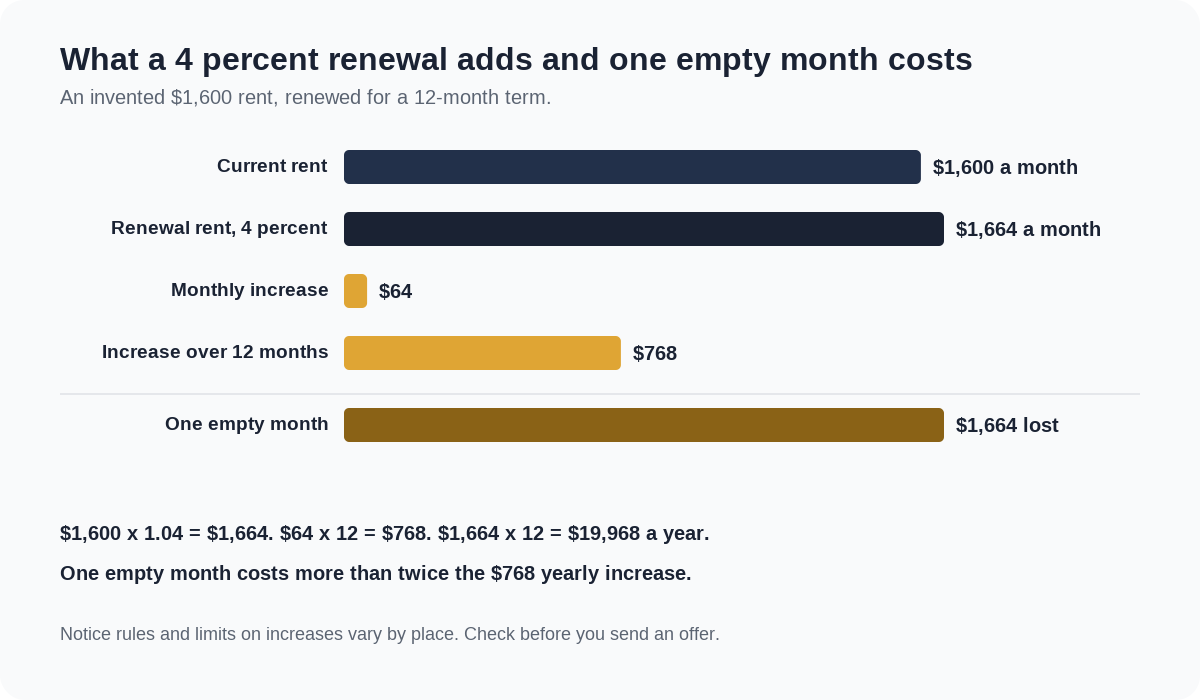
A lease renewal is an agreement between a property owner and a tenant to keep a tenancy going after the current lease ends. Most renewals set a new term, often another year, and many come with a rent change. Renewing a good tenant usually costs far less than finding a new one, so the decision is worth starting well before the end date. In the worked example below, a tenant paying $1,600 a month renews for a year at a 4 percent increase, and the new rent comes to $1,664.
This page covers what a lease renewal is, how it differs from an extension, a month-to-month rollover and a holdover, when to start the conversation, how rent changes at renewal, a worked example and the mistakes that cause problems. It is general information and is not legal or tax advice. Rules vary by state and city. Check your local law or an attorney.
What is a lease renewal?
A fixed-term lease has an end date. A lease renewal is the owner and the tenant agreeing, before that date, that the tenant will stay on. Usually that means a fresh term, such as 12 months, on terms both sides accept. The tenant keeps the same home, and the security deposit normally carries over to the new term.
A renewal is usually done in one of two ways:
- A new lease. Both sides sign a full new lease for the next term. This is a good time to bring the lease up to date with current clauses and the new rent.
- A renewal addendum. Both sides sign a short document that keeps the current lease and changes only the end date, the rent and any listed terms. The guide to a lease addendum covers how those documents work.
Some leases also contain an automatic renewal clause, which renews the lease for another term unless one side gives notice by a set date. Some places limit or set conditions on those clauses, so check the local rule before relying on one.
Renewal, extension, month-to-month and holdover
These four outcomes all keep a tenant in the home after the original end date, and each works differently.
- Renewal. A new term, often a full year, usually with a fresh signature and sometimes a new rent.
- Extension. A shorter add-on to the current lease, such as two or three extra months, often used when a tenant needs time before a move or the owner plans to sell. The other terms usually stay the same.
- Month-to-month rollover. Many leases say that if neither side acts, the tenancy continues month to month on the same terms. Either side can then end it with notice. The guide to a month-to-month lease explains how that arrangement works.
- Holdover. The tenant stays after the lease ends with no agreement in place. What happens next depends on the lease and local law. The guide to a holdover tenant covers the common outcomes.
When neither side wants to continue, the tenancy ends instead. The entry on lease termination covers how a lease ends, and the entry on a notice to vacate covers the written notice that usually goes with a move-out.
When to start a lease renewal
Start early. Many owners raise the renewal 60 to 90 days before the end date, which gives the tenant time to decide and the owner time to find a new tenant if the answer is no. Some places require written notice of a rent increase a set number of days ahead, and the required time can be longer for larger increases or longer tenancies. Check the rule where the property is before you send anything.
A typical renewal follows a few general steps:
- Review the tenancy. Look at the payment history, any open repair requests and the condition of the unit.
- Check the market. Comparable rents nearby show whether the current rent is low, high or about right. The guide to rental comps explains how to gather them.
- Decide on terms. Choose the rent, the term length and any changes to the lease.
- Send a written offer. Give the tenant the new terms and a date to reply. A rent increase notice covers what to include when the rent goes up.
- Sign and file. Both sides sign the new lease or the renewal addendum, and each keeps a copy.
Rent changes at renewal
Renewal is the usual point for a rent change, since the rent in a fixed-term lease generally stays the same until the term ends. An owner might raise the rent to follow the market, keep it flat to hold on to a reliable tenant, or offer a one-time discount in exchange for a longer term. The guide to a rent concession covers that last option.
Some cities and states cap how much rent can rise each year or require a reason for certain increases. The entry on rent stabilization explains how those limits generally work. A rent increase should also never be used to retaliate against a tenant or to discriminate, which is prohibited in most places.
A worked example: a renewal at a 4 percent increase
All the figures here are made up. A tenant has rented a home for $1,600 a month on a one-year lease that ends on June 30. Comparable homes nearby rent for a little more, and the tenant has paid on time all year. About 75 days before the end date, the owner offers a 12-month renewal at a 4 percent increase.
Using the site's rent increase calculator:
- New monthly rent: $1,600 x 1.04 = $1,664
- Monthly increase: $1,664 minus $1,600 = $64
- Increase over the new 12-month term: $64 x 12 = $768
- New annual rent: $1,664 x 12 = $19,968
The owner also weighs the other outcome. If a larger increase pushed the tenant to leave and the unit sat empty for one month at the new rent, that one empty month would cost $1,664, more than twice the $768 the increase brings in over a full year. The vacancy rate entry shows how empty months add up across a portfolio. The tenant accepts the 4 percent offer, both sides sign a renewal addendum, and the new rent starts on July 1.
A rent roll that lists each unit's rent and lease end date makes it easier to see which renewals are coming up and plan offers in good time.
Mistakes that cause problems
- Starting too late. A renewal raised a week before the end date leaves little time to agree, and the tenancy may roll over or become a holdover by default.
- Missing a notice rule. Sending a rent increase without the notice time the local rules require can delay the new rent.
- Leaving it verbal. A renewal agreed in conversation is hard to prove later. Put the new end date and rent in writing and have both sides sign.
- Forgetting the deposit. If the rent rises, check whether the lease or local rules allow or limit a deposit increase. The security deposit entry covers the general rules.
- Pricing without comps. An increase well above the market can cost a good tenant and leave the unit empty.
Frequently asked questions
What does a lease renewal mean?
It means the owner and the tenant agree to keep the tenancy going after the current lease ends, usually for a new term. The renewal can keep the same terms or change some of them, such as the rent.
What is the difference between a lease renewal and a lease extension?
A renewal usually starts a new term, often another full year, with a fresh signature. An extension adds a shorter period to the current lease, such as a few months, and usually keeps the other terms the same.
How early should an owner offer a lease renewal?
Many owners start 60 to 90 days before the end date. Some places require written notice of a rent increase a set time in advance, so check local rules before you send an offer.
What happens if a lease ends and nobody renews it?
It depends on the lease and local law. Many leases roll over to month to month on the same terms. If the tenant stays with no agreement in place, the tenant may be treated as a holdover.
Can the rent go up at renewal?
In most places, yes, with proper written notice. Some cities and states cap annual increases. In the example, a 4 percent increase takes the rent from $1,600 to $1,664, which adds $768 over a 12-month term.
Plan each renewal before the lease ends
A renewal goes smoothly when you see the end date coming. KeyRing sends automatic lease-expiry reminders by email and push to you and the tenant 30 days before the end date, so the renewal conversation starts on time. You can attach the notice and the renewal to the lease they belong to, and each month's rent invoices are drafted for you to approve before they are sent, so you can check the amount before it goes to the tenant. See what KeyRing does or how plans are priced.
Free calculators and templates
- Rent increase calculatorA new rent from a percentage or dollar increase, with the yearly difference.
- Rent roll templateEvery unit, lease, rent and balance in a property on one page, as of one date.
Browse all rental property calculators, free templates and the glossary.
From the blog
- How much notice for a rent increase? Rent increase notice rulesHow much notice to give before a rent increase: typical periods, month-to-month and fixed-term leases, what to put in the notice, a sample and a timeline.
- What is a month-to-month lease? How it works and how to end oneA month-to-month lease renews each month until either side gives written notice. How notice and rent increases work, pros and cons, and sample lease language.
- What is a holdover tenant? Your options when a lease ends and the tenant staysA holdover tenant stays in a rental after the lease ends without a new agreement. See your options, what holdover rent can look like and how to avoid one.