What is a security deposit? How rental deposits work

A security deposit is money a tenant pays at the start of a lease that the property owner holds as protection against unpaid rent, damage beyond normal wear and tear and other amounts the tenant owes under the lease. It still belongs to the tenant while the owner holds it. When the tenancy ends, the owner returns the deposit, minus any lawful deductions, usually with an itemized list of what was kept and why.
This page covers what a security deposit is, what it can and cannot be used for, how much owners usually ask, how the deposit is held, what happens at move-out, a worked example with deductions and interest, how a deposit compares with last month's rent and pet deposits, and the mistakes that lead to disputes. It is general information and is not legal or tax advice. Security deposits are one of the most regulated parts of renting, and the limits, deadlines and paperwork differ from place to place. Rules vary by state and city. Check your local law or an attorney.
What is a security deposit?
A security deposit is a sum of money, usually collected when the lease is signed or before the keys are handed over, that secures the tenant's promises in the lease. If the tenant leaves owing rent or leaves damage behind, the owner can use the deposit to cover it. If nothing is owed, the full deposit goes back to the tenant.
Because the money is the tenant's until a deduction is made, many states treat it as held in trust. That is why deposit rules focus on three things: how much can be collected, where it is kept and how and when it must be returned.
What a security deposit can cover
Deposit rules usually allow deductions for:
- Unpaid rent and other charges the lease makes the tenant responsible for, such as a utility bill in the tenant's name that the owner had to pay.
- Damage beyond normal wear and tear, such as a broken window, holes in a wall or a burn in a countertop.
- Cleaning needed to return the unit to the condition it was in at move-in, apart from ordinary wear.
- Other costs the lease names, where the law allows it, such as replacing keys the tenant did not return.
Deductions generally cannot cover normal wear and tear: faded paint, light scuffs, carpet worn by ordinary walking or loose door handles from years of use. The line between wear and damage is where most deposit disputes start. The normal wear and tear vs damage guide goes through common examples room by room.
How much is a security deposit?
Owners often set the deposit as a share or a multiple of one month's rent, for example one month's rent. Many states and some cities cap the amount, often as a multiple of the monthly rent, and some set a different cap for furnished units, for tenants with pets or for older tenants. Some places have no cap. Check the limit where the property is before you write the number into the lease.
Whatever amount you choose, apply the same rule to every applicant for the same unit, and write it into the lease and the move-in paperwork. If you change the deposit for a reason such as a pet, keep the reason in the file. Fair housing rules apply to deposits as much as to rent. If an applicant falls short of your written standard, some owners accept a co-signer under the same rule for everyone.
Holding the deposit
- A separate account. Some states require deposits to be kept in a separate bank account, sometimes in a bank in the same state, and some require you to tell the tenant where it is held. Even where it is not required, a separate account keeps the money apart from rent and operating cash.
- Interest. Some states and cities require owners to pay interest on deposits, at a rate set by law or tied to the account. The security deposit interest calculator estimates simple interest at a rate you enter.
- A receipt. Give the tenant a written receipt for the deposit. A rent receipt can record the deposit as its own line.
- The books. A refundable deposit is a liability while you hold it: money you owe back. It is generally not income when you receive it, and the part you keep for unpaid rent or damage generally becomes income when you keep it. Confirm the tax treatment with a tax professional.
At move-out
- Inspect the unit with the move-in condition record beside you. Photos and a signed checklist from move-in are the strongest evidence of what changed. A rental inspection checklist gives you the room by room structure.
- Price each deduction from invoices, receipts or reasonable estimates, and keep the paperwork.
- Send the itemized statement and the refund to the tenant's forwarding address within the deadline your state or city sets. Deadlines are usually counted in days from the end of the tenancy or the day the tenant returns the keys, and they vary widely. The guide to mail for a previous tenant covers forwarding addresses.
- Keep the record of what was sent and when. Missing a deadline or skipping the itemized list can cost an owner the right to keep any of the deposit, and in some places adds a penalty.
A worked example
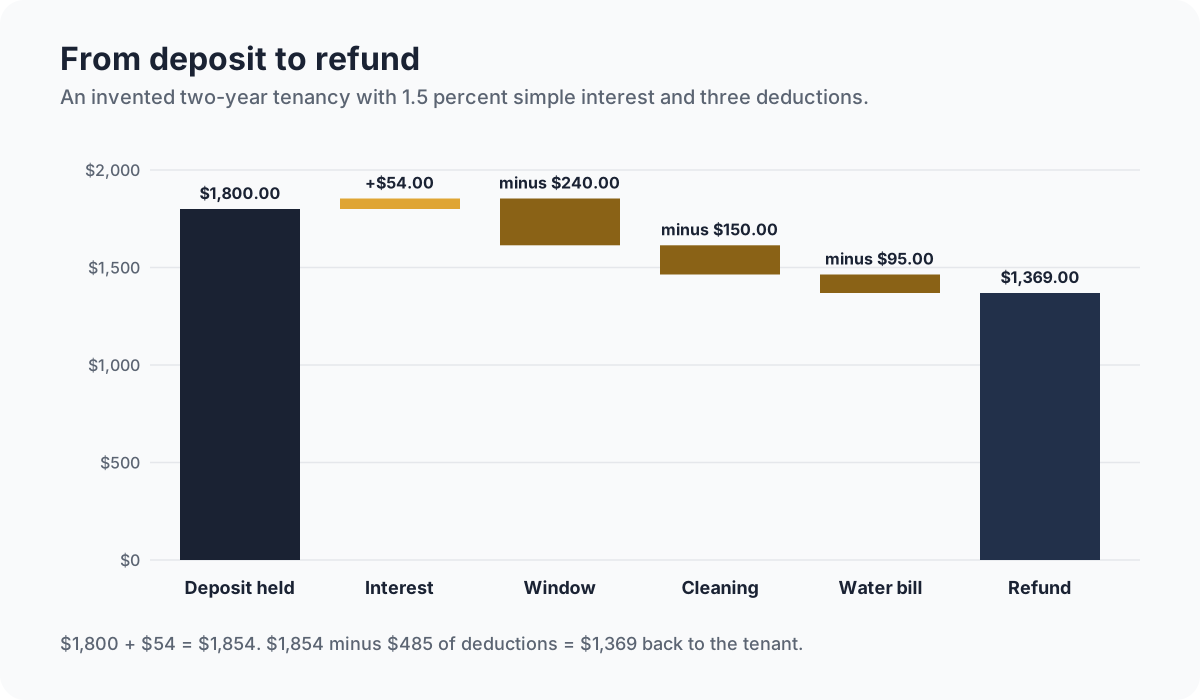
All the figures here are made up for this example, including the interest rate. A tenant pays a security deposit of $1,800 on August 1, 2024, and moves out on August 1, 2026, after two years. A local rule in this example requires simple interest of 1.5 percent a year.
- Days held: August 1, 2024 to August 1, 2026 is 365 + 365 = 730 days
- Interest: $1,800 x 1.5 percent x 730 / 365 = $54.00
- Deposit plus interest: $1,800 + $54 = $1,854.00
At the move-out inspection, the owner finds a broken bedroom window and a refrigerator and closets left full of belongings and trash, and the tenant left the final water bill unpaid, which the lease made the tenant's responsibility. Worn carpet in the hallway is normal wear and tear, so it is not deducted.
| Item | Amount |
|---|---|
| Deposit held | $1,800.00 |
| Interest credited | $54.00 |
| Replace broken bedroom window, per invoice | minus $240.00 |
| Remove belongings and trash, clean refrigerator and closets | minus $150.00 |
| Final water bill paid for the tenant | minus $95.00 |
| Refund to the tenant | $1,369.00 |
The deductions total $240 + $150 + $95 = $485, and the refund is $1,854 minus $485 = $1,369. The owner sends the statement, copies of the window invoice and the water bill, and the refund to the tenant's forwarding address before the local deadline.
Security deposit vs last month's rent vs pet deposit
| Security deposit | Last month's rent paid in advance | Pet deposit | Pet fee | |
|---|---|---|---|---|
| What it is for | Unpaid rent, damage, other lease charges | Rent for the final month | Damage caused by a pet | A charge for having a pet |
| Refundable? | Yes, minus lawful deductions | Used as the final month's rent | Yes, minus lawful deductions | Usually no |
| Counts toward a local deposit cap? | Yes | Often, depending on local rules | Often, depending on local rules | Depends on local rules |
Calling money "last month's rent" generally limits it to that use. If the tenant then damages the unit, it may not be available for repairs. The pet rent vs pet deposit vs pet fee guide covers the pet side in more detail. Many places treat service and support animals differently, and generally do not allow a pet deposit or fee for them.
Common security deposit mistakes
- No move-in record. Without dated photos and a signed checklist, it is hard to show that damage happened during the tenancy.
- Deducting for normal wear and tear. Repainting after years of ordinary living or replacing carpet at the end of its life is generally the owner's cost.
- Missing the return deadline. Put the deadline on your calendar the day the tenant gives notice.
- No itemized list. Send a written, itemized statement with receipts or estimates, even when you keep only a small amount.
- Mixing the deposit with operating money. Keep it in its own account where required, and track it on its own ledger everywhere else.
- Collecting more than the cap. Count every refundable amount the local rules count, including any prepaid last month's rent or pet deposit.
Frequently asked questions
What is a security deposit in simple terms?
A security deposit is money a tenant pays at the start of a lease that the owner holds in case the tenant leaves owing rent or causes damage. When the tenant moves out, the owner returns it, minus any lawful deductions.
How much can an owner charge for a security deposit?
It depends on where the property is. Many states and some cities cap deposits, often as a multiple of the monthly rent, and some have no cap. Rules vary by state and city. Check your local law or an attorney.
What can be deducted from a security deposit?
Usually unpaid rent, damage beyond normal wear and tear, cleaning needed to return the unit to its move-in condition and other charges the lease names where the law allows. Normal wear and tear generally cannot be deducted.
How long does an owner have to return a security deposit?
Each state sets its own deadline, and some cities add rules. Deadlines are usually counted in days from the end of the tenancy, and missing one can cost the owner the right to keep any of the deposit. Check the rule where the property is.
Is a security deposit taxable income?
A refundable security deposit is generally not income when you receive it, because you may have to return it. The part you keep for unpaid rent or damage is generally income in the year you keep it. Confirm the treatment with a tax professional.
Track every deposit to the dollar
A deposit is easier to return on time when its record is complete. In KeyRing, each lease keeps a deposit ledger: what was received, deductions, interest credited to the tenant, refunds, the balance held and the date it is due back. Deposits stay out of your income. See what KeyRing does or how plans are priced.
Free calculators and templates
- Security deposit interest calculatorSimple interest on a deposit between two dates at your rate.
- Rental inspection checklistA room by room check of an occupied rental, with the repairs it turns up.
- Rent receipt templateA printable rent receipt, two to a page, and a CSV log for every payment you receive.
Browse all rental property calculators, free templates and the glossary.
From the blog
- What is normal wear and tear? How it differs from damageNormal wear and tear is the decline that comes from ordinary use. See how it differs from damage, common examples and how to work out a fair deposit deduction.
- Pet rent vs pet deposit vs pet fee: what each one covers and how to charge itPet rent is monthly, a pet deposit is refundable and a pet fee is a one-time charge. How each works, what to check locally and a worked example.
- Mail for a previous tenant: what a property owner should do with itMail for a previous tenant? Leave it sealed, mark it "Not at this address" and return it. What to do with packages, official mail and forwarding at move-out.
- What are certified funds? How they work for rent and move-in moneyCertified funds are payments backed by a bank or issuer: cashier's checks, certified checks, money orders and wires. How they work for rent, with an example.