What is a co-signer on a lease? What co-signers agree to

A co-signer is a person who signs a lease along with the tenant and, by signing, agrees to be responsible for the rent and the other obligations in the lease if the tenant does not meet them. A co-signer usually does not live in the unit. Owners often ask for one when an applicant has a short credit history, an income below the owner's written screening standard or no rental history, and a parent, relative or friend with stronger finances signs to back the lease.
This page covers what a co-signer is, what a co-signer agrees to, how a co-signer differs from a guarantor and a co-tenant, when owners ask for one, how a co-signer is usually screened, a worked example, how the obligation ends and the mistakes that cause trouble later. It is general information and is not legal or tax advice. What a co-signer owes depends on the documents they sign and on the law where the property is. Rules vary by state and city. Check your local law or an attorney.
What is a co-signer?
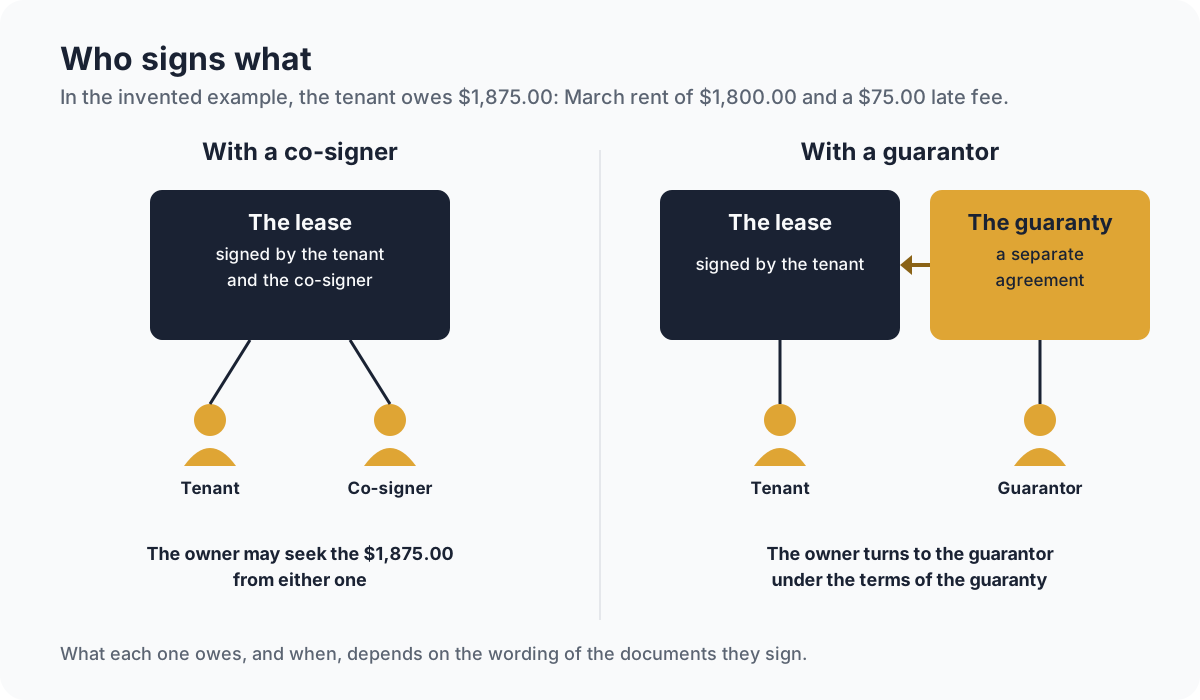
On a lease, a co-signer signs the lease itself, next to the tenant, or a co-signer agreement that becomes part of the lease. That signature usually makes the co-signer responsible for the lease along with the tenant. Many leases make the tenant and co-signer "jointly and severally" liable, which means the owner can seek the full amount owed from either of them, or from both, until it is paid.
The co-signer generally gets no right to live in the unit. They take on the tenant's money obligations, and sometimes other duties, without moving in. The term is also used for loans, where a co-signer backs a borrower's debt in the same way, and the idea is the same: a second person stands behind the promise to pay.
Some people use co-signer and cosigner interchangeably, and some lease forms call the role a co-signor or a guarantor. What the signed document says matters more than the label at the top.
What a co-signer agrees to
The co-signer agreement sets the scope. Common terms include:
- Unpaid rent for the lease term, including any month the tenant misses.
- Late fees and returned payment fees the lease allows.
- Damage beyond normal wear and tear that the security deposit does not cover.
- Costs the lease shifts to the tenant, such as certain utilities or, where the law allows, collection costs.
- Renewals and extensions, if the agreement says the obligation continues when the lease is renewed or goes month to month.
Some agreements cap what the co-signer owes, for example at a set number of months of rent, and some limit it to the first lease term. Read the wording before you sign as an owner or a co-signer, and have an attorney review the form you use.
Co-signer vs guarantor vs co-tenant
| Co-signer | Guarantor | Co-tenant | |
|---|---|---|---|
| What they sign | The lease itself, or an agreement made part of it | A separate guaranty agreement | The lease itself |
| Lives in the unit? | Usually no | Usually no | Yes |
| When the owner can seek payment | Often as soon as rent is unpaid | Often after the tenant fails to pay, depending on the guaranty | As soon as rent is unpaid |
| Right to occupy | Usually none | None | Yes |
The practical difference between a co-signer and a guarantor depends on the documents. Many guaranty agreements also let the owner go straight to the guarantor once rent is late, and some co-signer clauses limit what the co-signer owes. The guarantor guide compares the two in detail. A co-tenant, by contrast, is a full tenant: they live in the unit, share the lease and usually share joint and several liability with the other tenants.
When owners ask for a co-signer
- Thin or new credit. A student or a first-time renter may have little credit history to review.
- Income below the screening standard. The applicant earns less than the owner's written income rule for the unit.
- No rental history. There are no past owners to contact for a reference.
- A past problem the owner is willing to look past, if a co-signer stands behind the new lease.
Write down when you accept a co-signer and what a co-signer must show, then apply the same rule to every applicant for the same unit. Fair housing rules apply to co-signer requirements as much as to rent and deposits, and some states and cities restrict how income, credit or source of income can be used in screening. Check the rules where the property is.
How co-signers are usually screened
Owners usually screen a co-signer the way they screen a tenant, often with a higher bar because the co-signer is also paying their own housing:
- Identity and contact details, so the co-signer can be reached if the tenant falls behind.
- Income, often compared with the rent by a multiple the owner sets.
- Credit, with the co-signer's written consent to a credit check.
- Where they live. Some owners ask that a co-signer live in the same state, which can make collection simpler if it is ever needed.
The rent-to-income ratio calculator shows how the rent compares with an applicant's or a co-signer's monthly income.
A worked example
All the figures here are made up for this example, including the owner's screening rules. A unit rents for $1,800 a month. The owner's written standard asks a tenant to earn at least 3 times the rent, and a co-signer at least 4 times the rent.
- Tenant standard: 3 x $1,800 = $5,400 a month
- Applicant's income: $4,200 a month, or $4,200 / $1,800 = 2.33 times the rent, rounded, below the standard
- The applicant's rent-to-income ratio: $1,800 / $4,200 = 42.9 percent, rounded
- Co-signer standard: 4 x $1,800 = $7,200 a month
- The applicant's parent earns $7,500 a month, which meets the co-signer standard
The owner approves the lease with the parent as co-signer, and both sign. In March, the tenant misses the rent. The lease allows a $75 late fee once the grace period ends.
| Item | Amount |
|---|---|
| March rent | $1,800.00 |
| Late fee, per lease | $75.00 |
| Owed | $1,875.00 |
The owner contacts the tenant first and, when the balance is still unpaid, sends the co-signer a written notice with a statement of the account. Under joint and several liability, the owner may seek the full $1,800 + $75 = $1,875 from the co-signer. A rent statement showing the charges, payments and balance gives the co-signer the same numbers the tenant sees. Some states and cities cap late fees or set when they apply, so check the rule where the property is.
How a co-signer's obligation ends
- The lease ends and is paid in full. With no renewal and nothing owed, the co-signer's obligation usually ends with the tenancy.
- A renewal or a new lease. Whether the co-signer stays on depends on the agreement. Some carry over to renewals and extensions, and some end with the first term. Many owners ask the co-signer to sign again on renewal, to make it clear.
- A release. The owner can agree in writing to release a co-signer, for example once the tenant has a record of paying on time or their income has risen. A lease addendum is one way to record it.
- A change of tenant. If a tenant subleases or assigns the lease, the co-signer's position depends on the documents and on whether the owner consented. The sublease guide covers how subleases work.
A co-signer cannot usually withdraw on their own partway through a lease. Signing is a commitment for the term the agreement covers.
Common co-signer mistakes
- Using a vague form. Spell out what the co-signer covers, for how long and whether it continues on renewal.
- Skipping the co-signer's screening. A co-signer who cannot pay adds paperwork without adding protection.
- Applying rules unevenly. Ask for a co-signer under the same written standard for every applicant.
- Losing touch. Keep the co-signer's current address and contact details, and send them notices the agreement calls for.
- Assuming the co-signer can move in. A co-signer who wants to live in the unit needs to be added to the lease as a tenant.
Frequently asked questions
What is a co-signer on a lease in simple terms?
A co-signer is a person who signs the lease with the tenant and agrees to pay the rent and other lease costs if the tenant does not. They usually do not live in the unit.
What is the difference between a co-signer and a guarantor?
A co-signer usually signs the lease itself, and a guarantor usually signs a separate guaranty agreement that backs the lease. In practice, what each one owes, and when, depends on the wording of the documents they sign.
Is a co-signer responsible for the whole lease?
Often, yes. Many co-signer agreements make the co-signer jointly and severally liable with the tenant, so the owner can seek the full amount owed from either one. Some agreements cap what the co-signer owes or limit it to the first lease term.
Can a co-signer be removed from a lease?
Usually only with the owner's written agreement, for example on renewal or once the tenant qualifies alone. A co-signer cannot usually withdraw on their own partway through the term the agreement covers.
Can an owner require a co-signer?
Many owners ask for a co-signer when an applicant does not meet their written screening standard. Apply the same rule to every applicant, and check local rules on screening and source of income. Rules vary by state and city. Check your local law or an attorney.
Keep each lease's charges, payments and documents together
When a co-signer is involved, a clear record of what was billed and paid matters. In KeyRing, each lease keeps its rent charges, payments and balance, you can record cash and check payments, including partial ones, and overdue invoices are flagged automatically. Each month's rent invoices are drafted for you to approve before they are sent, and each tenant gets a PDF invoice by email. See what KeyRing does or how plans are priced.
Free calculators and templates
- Rent to income ratio calculatorRent as a share of gross income, and the income needed at your target.
- Rent statement templateA tenant's charges, payments and balance for a period, from the opening balance to what is due now.
Browse all rental property calculators, free templates and the glossary.
From the blog
- What is a guarantor? Guarantor vs co-signer on a leaseA guarantor promises to pay the rent if the tenant does not. How a guarantor differs from a co-signer, who usually qualifies and what a guaranty covers.
- What is a sublease? What property owners should put in writingA sublease is a tenant renting their home to someone else for part of the lease. How it differs from an assignment, who owes the rent and what goes in writing.
- What is a lease addendum? Common addenda and how to add oneA lease addendum adds new terms to a signed lease, such as a pet or a parking space. How it differs from an amendment, common addenda and how to add one.