What is prorated rent? How to work out a partial month

Prorated rent is the share of a month's rent a tenant pays for the days they actually occupy the unit in a partial month. It comes up when a lease starts or ends partway through a month. A tenant who moves in on December 12 into a unit that rents for $1,800 a month pays for 20 days of December, about $1,161.29, and the full rent from January on.
This page covers what prorated rent is, when it applies, the three common ways to work it out, a move-in and a move-out example, how to show it on the ledger and the mistakes that lead to disputes. It is general information and is not legal or tax advice. Some states and cities set rules on proration and on what can be collected at move-in. Rules vary by state and city. Check your local law or an attorney.
What is prorated rent?
Rent is usually charged by the month. Tenants rarely move on the 1st, though, so the first or last month of a lease is often a partial one. Prorating turns the monthly rent into a daily rate and charges only for the days the tenant has the unit:
Prorated rent = daily rate x days occupied
The daily rate depends on the method the lease uses, and the three methods give slightly different answers for the same dates. The prorated rent calculator works out the first two for any date.
When rent is prorated
- A mid-month move-in. The tenant pays for the move-in day through the last day of the month, then the full rent from the next 1st.
- A mid-month move-out. The tenant pays from the 1st through the move-out day, often when both sides agree on an earlier end date or a month-to-month tenancy ends partway through a month.
- Moving the rent due date. A tenant whose rent is due on the 15th who switches to the 1st pays a prorated amount to bridge the gap.
Many leases set rent for the full month whatever the move-out day, and whether a partial last month is prorated depends on the lease and on local rules. Check what your lease says before you work out a charge.
Three ways to work out the daily rate
| Method | Daily rate | Same rate every month? | $1,800 rent, December |
|---|---|---|---|
| Actual days | Monthly rent / days in that month | No | $1,800 / 31 = $58.06 |
| 30-day month | Monthly rent / 30 | Yes | $1,800 / 30 = $60.00 |
| 365-day year | Monthly rent x 12 / 365 | Yes | $1,800 x 12 / 365 = $59.18 |
- Actual days follows the calendar: 31 days in December, 30 in November, 28 in February and 29 in a leap-year February. It is the method many owners use when the lease names none.
- 30-day month keeps the daily rate the same all year. It charges a little more for a partial month with 31 days and a little less in February.
- 365-day year spreads a year of rent over every day of the year, so every day costs the same in every month.
The daily rates above are rounded for display. Work out the charge from the unrounded rate and round once at the end.
A move-in example: December 12
A tenant signs a lease on an invented one-bedroom unit at $1,800 a month, with rent due on the 1st. They move in on December 12, 2026. All the figures are made up for this example.
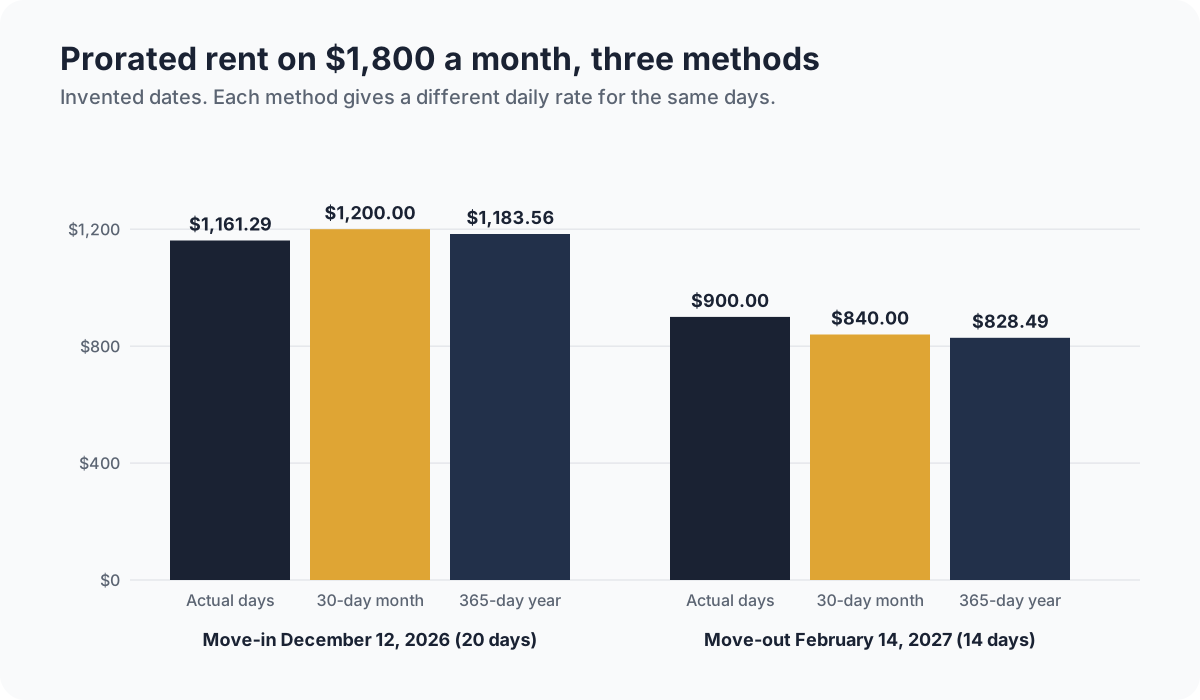
December has 31 days. Counting both the move-in day and December 31, the tenant occupies the unit for 31 - 12 + 1 = 20 days.
- Actual days: $1,800 / 31 = $58.0645 a day, and 20 x $58.0645 = $1,161.29.
- 30-day month: $1,800 / 30 = $60.00 a day, and 20 x $60.00 = $1,200.00.
- 365-day year: $1,800 x 12 / 365 = $59.1781 a day, and 20 x $59.1781 = $1,183.56.
The three methods are $38.71 apart at most for the same 20 days. Whichever the lease names, the tenant pays the full $1,800 from January 1.
Some owners collect the prorated rent and the first full month together at signing. Here that would be $1,161.29 + $1,800 = $2,961.29, plus the security deposit. Whether you can ask for both up front, and how much you can collect before move-in, can depend on local rules.
A move-out example: February 14
A different tenant at the same rent agrees in writing to end their tenancy on February 14, 2027. February 2027 has 28 days, so from February 1 through the move-out day the tenant occupies the unit for 14 days.
- Actual days: $1,800 / 28 = $64.2857 a day, and 14 x $64.2857 = $900.00, exactly half the rent for exactly half the month.
- 30-day month: $1,800 / 30 = $60.00 a day, and 14 x $60.00 = $840.00.
- 365-day year: 14 x $59.1781 = $828.49.
In February the order flips. The 30-day and 365-day methods charge less than the actual-days method, because February is shorter than an average month.
Before the last month, settle the details the move-out needs: the move-out checklist covers the walk-through, and the guide to mail for a previous tenant covers the forwarding address.
Which method should you use?
Use the method your lease names. If your lease is silent, pick one, write it into your lease for the next tenancy and use it for every tenant, so two people moving in on the same date pay the same. Some states and cities set how a partial month is charged, so check the rules where the property is.
Say the method in the move-in paperwork as well. A tenant who sees "$1,800 / 31 x 20 days = $1,161.29" on the first invoice knows how the figure was reached. The move-in checklist is a good place to confirm the move-in date both sides agree on.
Prorated rent on the ledger
Post a prorated month as its own charge, with the dates and the method in the description, such as "Rent, December 12 to 31 (20 days, actual days)". The rent ledger template has a line for it, and the rent ledger vs tenant ledger guide walks through a ledger that starts with a prorated month. If you send invoices, the rental invoice template shows a prorated first month on its own line.
A tenant who stays past the end date is a different case. Rent for those days depends on the lease and local law, and the holdover tenant guide covers it.
Common prorated rent mistakes
- Counting days wrong. December 12 through 31 is 20 days, counting both ends. Subtracting 31 - 12 = 19 leaves out a day.
- Rounding the daily rate first. $58.06 x 20 = $1,161.20, which is 9 cents short of $1,161.29. Round once, at the end.
- Mixing methods. Using actual days for one tenant and a 30-day month for another invites questions. Pick one and write it down.
- Charging more than a month. With the 30-day method, 31 days at $60.00 comes to $1,860, more than the rent. Cap a full month at the monthly rent.
- No written date. Agree the move-in or move-out date in writing, so the number of days is clear to both sides.
Frequently asked questions
What is prorated rent in simple terms?
Prorated rent is rent for part of a month. It is the daily rate times the number of days the tenant has the unit, charged when a lease starts or ends partway through a month.
How do you calculate prorated rent?
Divide the monthly rent by the days in the period to get a daily rate, then multiply by the days occupied. With the actual-days method, a December 12 move-in at $1,800 a month is $1,800 / 31 x 20 = $1,161.29.
Is the move-in day included in prorated rent?
Usually, yes: the tenant pays for the day they get the keys. The examples here count both the first and the last day. Follow what your lease says.
Which method is most common?
Many owners use the actual days in the month, and others use a 30-day month for a steady daily rate. Use the method your lease names, and check whether local rules set one.
Do you have to prorate the last month's rent?
It depends on the lease and on local rules. Many leases charge the full month whatever the move-out day, and some local rules require a partial month to be prorated. Rules vary by state and city. Check your local law or an attorney.
Keep every lease and rent payment in one place
Prorated rent is one line on a ledger that runs for the whole tenancy. KeyRing keeps each lease, rent due date and payment together, records each tenant's rent charges and payments as they happen, and drafts each month's rent invoices for you to approve before they go out. Tenants pay online by bank or card. See what KeyRing does or how plans are priced.
Free calculators and templates
- Prorated rent calculatorRent for a partial first or last month, by actual days or a 30-day month.
- Rent ledger templateTrack one tenant's charges, payments and running balance, in a spreadsheet or on paper.
- Move-in checklistThe condition of every room on move-in day, signed by you and the tenant.
- Move-out checklistEach room at move-out next to move-in, with damage and repair costs totalled.
- Rental invoice templateA printable rent invoice with line items and a total, and a CSV log of every invoice you send.
Browse all rental property calculators, free templates and the glossary.
From the blog
- Rent ledger vs tenant ledger: what to track and whyA lease ledger, or tenant ledger, records one lease's charges, payments and balance. A rent ledger can cover a whole property. See both with worked examples.
- Mail for a previous tenant: what a property owner should do with itMail for a previous tenant? Leave it sealed, mark it "Not at this address" and return it. What to do with packages, official mail and forwarding at move-out.
- What is a month-to-month lease? How it works and how to end oneA month-to-month lease renews each month until either side gives written notice. How notice and rent increases work, pros and cons, and sample lease language.
- What is a holdover tenant? Your options when a lease ends and the tenant staysA holdover tenant stays in a rental after the lease ends without a new agreement. See your options, what holdover rent can look like and how to avoid one.