What is a lease addendum? Common addenda and how to add one
By Jenna Whitfield -

A lease addendum is a separate document that adds new terms to a lease. It becomes part of the lease once the property owner and the tenant both sign it. Common examples are a pet addendum that lets a tenant keep a dog, a parking addendum for an assigned space and a disclosure the law asks the owner to give with the lease.
This guide covers what a lease addendum is, how it differs from a lease amendment, the addenda property owners use most, how to add one at signing or partway through a lease, a worked example and the mistakes to avoid. It is general information and is not legal advice. Rules vary by state and city. Check your local law or an attorney.
What is a lease addendum?
A lease sets the main terms of a tenancy: the parties, the unit, the rent, the dates and the rules. An addendum attaches to that lease and adds something it does not cover yet. The lease itself stays as it was, and the addendum sits beside it as one more page of the same agreement.
An addendum can be signed with the lease on day one or added later. Many owners keep a set of standard addenda, such as a pet addendum and a parking addendum, and attach the ones that apply to each tenancy. Added later, an addendum records something the owner and the tenant agreed to after the lease began, such as a new pet or a parking space that came free.
Lease addendum vs lease amendment
The two words are often used for the same thing. Many owners and attorneys draw the line this way:
| Lease addendum | Lease amendment | |
|---|---|---|
| What it does | Adds a new term the lease does not cover | Changes or removes a term the lease already has |
| Example | A pet addendum for a tenant who adopts a dog | Changing the rent due date from the 1st to the 5th |
| When it is signed | At signing or partway through the lease | Partway through the lease |
| What stays the same | Every term of the original lease | Every term the amendment does not change |
| Who signs | The property owner and every tenant on the lease | The property owner and every tenant on the lease |
A lease extension, which moves the end date, and a lease renewal, which starts a new term, are close cousins. Some owners write them as amendments and some as new leases. Whatever the title says, what the signed document says is what counts, so have an attorney review the forms you use.
Common lease addenda
- Pet addendum. Lists each pet, the pet rent, deposit or fee, the rules for the pet and who pays for damage. The pet rent, deposit and fee guide covers the three charges and the local limits on them.
- Parking addendum. Assigns a space or a garage, sets any monthly charge and says what happens to vehicles parked in the wrong place.
- Smoke-free addendum. Says where smoking is allowed, if anywhere, on the property.
- Utilities addendum. Says which utilities the tenant pays, which the owner pays and how any shared bill is split.
- Renters insurance addendum. Says whether the tenant must carry renters insurance and how much cover the lease asks for.
- Rules addendum. Attaches building or HOA rules, such as quiet hours, trash days or pool rules, so the tenant has them in writing.
- Subletting consent. Records the owner's written consent to a sublet, with the subtenant's name and the dates. The sublease guide covers what that consent should say.
- Rent concession addendum. Records a free month or a discount and the conditions on it, as the rent concession guide explains.
- Required disclosures. Some disclosures are set by federal, state or local law, such as the lead-based paint disclosure for most housing built before 1978. Which ones apply depends on the property and where it is.
When to add an addendum
At signing. Attach every addendum that applies before the tenant signs, and list them in the lease by title, so the tenant knows the full agreement from day one.
Partway through the lease. A signed lease binds both sides, so a new term usually needs both sides to agree. If a tenant asks to keep a pet, the owner can agree on terms and both sign a pet addendum. If the owner wants a new rule, such as a smoke-free building, the tenant signs only if they agree, or the rule waits for the next lease term. A tenant who adds a pet or an occupant without the consent the lease asks for may be breaking the lease, and the lease violation notice guide covers how to put that in writing.
At renewal. A renewal is a natural time to add terms, since both sides are signing again. The month-to-month lease guide covers how changes work when a lease rolls over from month to month.
How to add an addendum to a lease
- Name the lease it belongs to. Give the owner's and every tenant's name, the property address and unit, and the date of the original lease.
- Say what it adds. Write the new term in plain words: the pet, the space, the charge, the rule.
- Give the amounts and dates. Say what each new charge is, when it is due and the date the addendum takes effect.
- Keep the rest of the lease in place. Say that every other term of the lease stays the same.
- Say which document controls. Say that if the addendum and the lease conflict on the new term, the addendum controls.
- Sign and date it. The owner and every adult tenant on the lease sign and date it. If the lease has a guarantor, check whether the guaranty covers the new term, and ask the guarantor to sign too if it does.
- Give everyone a copy and file it with the lease. Put the signed addendum with the signed lease, and add any new charge to the rent ledger from the date it starts.
A worked example: a pet and a parking space
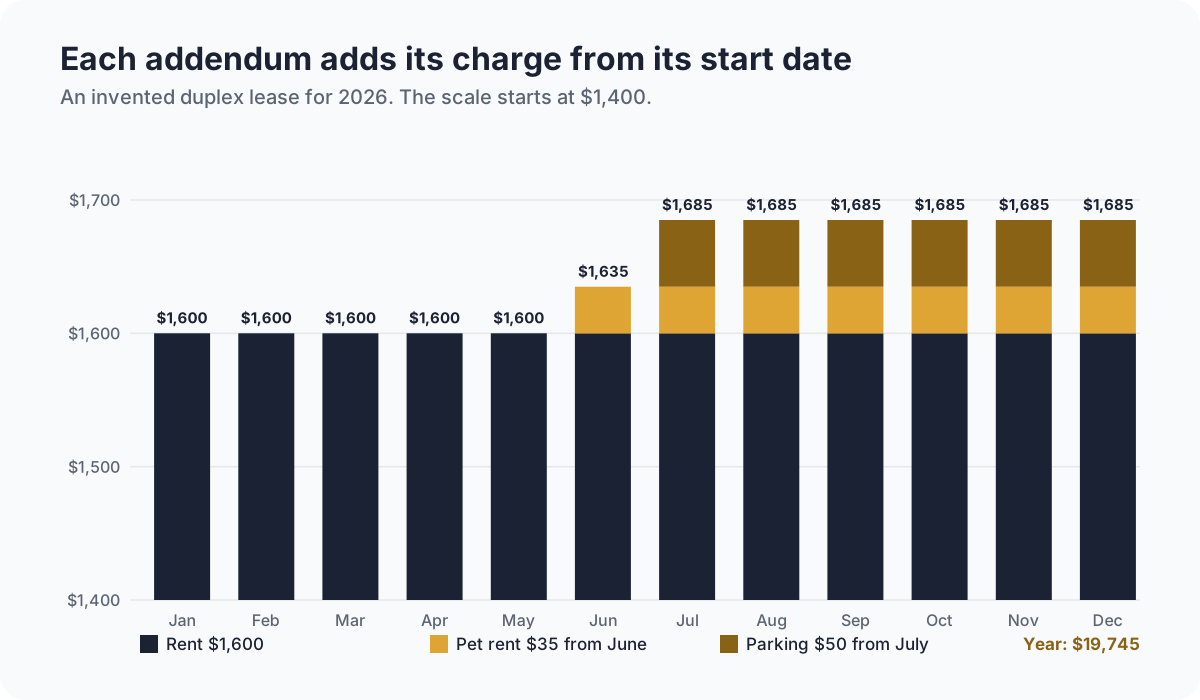
A tenant rents an invented unit in a duplex for $1,600 a month on a one-year lease from January 1 to December 31, 2026. All the figures are made up for this example.
In May the tenant asks to adopt a dog. The owner agrees, and both sign a pet addendum that starts June 1, with pet rent of $35 a month and a refundable pet deposit of $300. In June a parking space comes free, and both sign a parking addendum that starts July 1 at $50 a month.
| Months | Rent | Pet rent | Parking | Monthly total |
|---|---|---|---|---|
| January to May | $1,600 | - | - | $1,600 |
| June | $1,600 | $35 | - | $1,635 |
| July to December | $1,600 | $35 | $50 | $1,685 |
- January to May: 5 x $1,600 = $8,000.
- June: $1,600 + $35 = $1,635.
- July to December: 6 x ($1,600 + $35 + $50) = 6 x $1,685 = $10,110.
- Total for the year: $8,000 + $1,635 + $10,110 = $19,745.
- The same total by charge: rent 12 x $1,600 = $19,200, pet rent 7 x $35 = $245 and parking 6 x $50 = $300, so $19,200 + $245 + $300 = $19,745.
The $300 pet deposit is held apart from the rent, the same way as the security deposit, and is settled at move-out under the terms in the addendum. The lease end date stays December 31: neither addendum changes it.
Common lease addendum mistakes
- Leaving a tenant off. Every adult on the lease should sign, since each one is bound by the lease.
- No start date. Without one, it is unclear when a new charge is due.
- Conflicting terms. An addendum that allows a pet the lease bans, without saying which document controls, leaves room for a dispute.
- A one-sided change. Adding a term partway through the lease without the tenant's signature may leave it unenforceable. Rules vary by state and city. Check your local law or an attorney.
- Charges the lease does not set. Every charge on the ledger should trace to the lease or a signed addendum.
- Lost paperwork. An addendum kept apart from the lease is easy to miss at move-out, when its terms often matter most.
Frequently asked questions
What is a lease addendum in simple terms?
A lease addendum is an extra page that adds new terms to a lease, such as a pet or a parking space. Once the property owner and the tenant sign it, it is part of the lease.
What is the difference between a lease addendum and a lease amendment?
An addendum usually adds a term the lease does not cover yet. An amendment usually changes or removes a term the lease already has. Many people use the two words for the same thing, so read what the document says.
Does a lease addendum need to be signed by both parties?
Yes, in most cases. The property owner and every adult tenant on the lease sign and date it, and each keeps a copy.
Can a property owner add an addendum in the middle of a lease?
Usually only with the tenant's agreement, since the signed lease binds both sides until it ends. Local rules can also limit what an addendum may add. Rules vary by state and city. Check your local law or an attorney.
Does a lease addendum change the lease end date?
Only if it says so. In the example, the pet and parking addenda add charges from June and July, and the lease still ends on December 31.
Keep each addendum with its lease
An addendum works when it sits with the lease it changes. In KeyRing, you create a lease for each unit and attach documents to it, such as a signed addendum. You add one-off and recurring charges to a lease, such as pet rent, parking or a repair, and credits when you need them, and KeyRing drafts each month's rent invoices for you to approve before they go out. See what KeyRing does or how plans are priced.
Free calculators and templates
- Rent ledger templateTrack one tenant's charges, payments and running balance, in a spreadsheet or on paper.
- Move-in checklistThe condition of every room on move-in day, signed by you and the tenant.
Browse all rental property calculators and free templates.