What is a lease assignment? Who takes over and who stays liable

A lease assignment is when a tenant hands the rest of their lease to a new tenant. The new tenant, called the assignee, moves in, pays the rent and takes on the lease terms for the time left. The original tenant, called the assignor, moves out. What surprises many people is who stays responsible: unless the owner signs a release, the original tenant can often still be liable if the new tenant stops paying. In the worked example below, a $1,500 lease assigned on September 18 splits that month's rent into $850 and $650, and leaves $13,500 of future rent the original tenant may still answer for.
This page covers what a lease assignment is, how it compares with a sublease, who stays liable, how owner consent clauses usually work, a worked rent split example and what owners record when a lease changes hands. It is general information and is not legal or tax advice. Rules vary by state and city. Check your local law or an attorney.
What is a lease assignment?
A lease is a contract between the owner, the lessor, and the tenant, the lessee. In an assignment, the tenant transfers their whole remaining interest in that lease to someone else. The new tenant steps into the original tenant's place for every month left on the term, with the same rent, rules and end date.
A few points shape how it works in general:
- It covers the whole remaining term. An assignment passes on all of the time left. A tenant who wants to keep some of it, or come back later, is usually looking at a sublease.
- The new tenant deals with the owner. After the assignment, the new tenant pays rent to the owner and the owner handles repairs and notices with them.
- The original tenant may stay on the hook. Many leases, and the law in many places, keep the original tenant liable for the rent and damage unless the owner agrees to release them.
- Most leases require the owner's consent. A lease usually says whether, and how, it can be assigned.
Lease assignment vs sublease
The two are easy to mix up. Both let someone else live in the home before the lease ends, and they differ in who holds the lease afterward.
A sublease keeps the original tenant on the lease. The original tenant rents the home, or part of it, to a subtenant for some of the remaining time, collects rent from the subtenant and keeps paying the owner. The subtenant's agreement is with the original tenant. The guide to what a sublease is covers this in detail.
An assignment moves the lease itself. The new tenant takes over the whole remaining term, pays the owner directly and deals with the owner on everything the lease covers. The original tenant steps out of the home, though often keeps a backup liability.
In short: a subtenant answers to the original tenant; an assignee answers to the owner.
Who stays liable after an assignment
This is the part that matters most for both tenants.
- The new tenant becomes responsible for the rent and lease terms from the assignment date, because they now hold the lease.
- The original tenant usually stays responsible as a kind of backup. If the new tenant stops paying or damages the home, the owner can often look to the original tenant for what is owed under the lease. That liability generally lasts until the lease ends.
- A release ends it. If the owner signs a written release, sometimes called a novation, the original tenant is free of the lease from that date. Owners usually only agree after checking the new tenant the same way they check any applicant.
Anyone who guaranteed the original lease is a separate question. A co-signer or guarantor signed for the original tenant, and whether that promise carries over to an assignee depends on the wording and local law. Many owners ask the new tenant for their own co-signer or guarantor when one is needed.
Owner consent clauses
Most residential leases say something about assignment. The common versions are:
- No assignment without written consent. The most common clause. The tenant asks, the owner reviews the new tenant and says yes or no in writing.
- Consent not to be unreasonably withheld. The owner can still say no, but needs a fair reason, such as the new tenant failing the usual income or rental history checks. Some places read this standard into leases by law.
- No assignment at all. Some leases forbid it outright. Local law sometimes limits how strictly that is enforced.
- Silence. If the lease says nothing, many places allow assignment by default.
An assignment made without a required consent can usually be treated as a lease violation. Whatever the clause says, the safest way to handle a request is in writing, with a signed assignment agreement that names both tenants, the assignment date, who holds the security deposit and whether the original tenant is released.
A worked example: splitting the month and the risk
All the figures here are made up. A tenant has a 12-month lease at $1,500 a month that runs to June 30. In early September they take a job in another city and ask to assign the lease. The owner checks the new tenant, agrees in writing and sets the assignment date as September 18. The owner does not sign a release.
September has 30 days, and the owner splits it by the actual days each tenant holds the lease. The prorated rent calculator gives the same figures.
- Daily rate: $1,500 / 30 = $50.00
- Original tenant, September 1 to 17: 17 x $50 = $850
- New tenant, September 18 to 30: 13 x $50 = $650
- Together: $850 + $650 = $1,500, the full month's rent
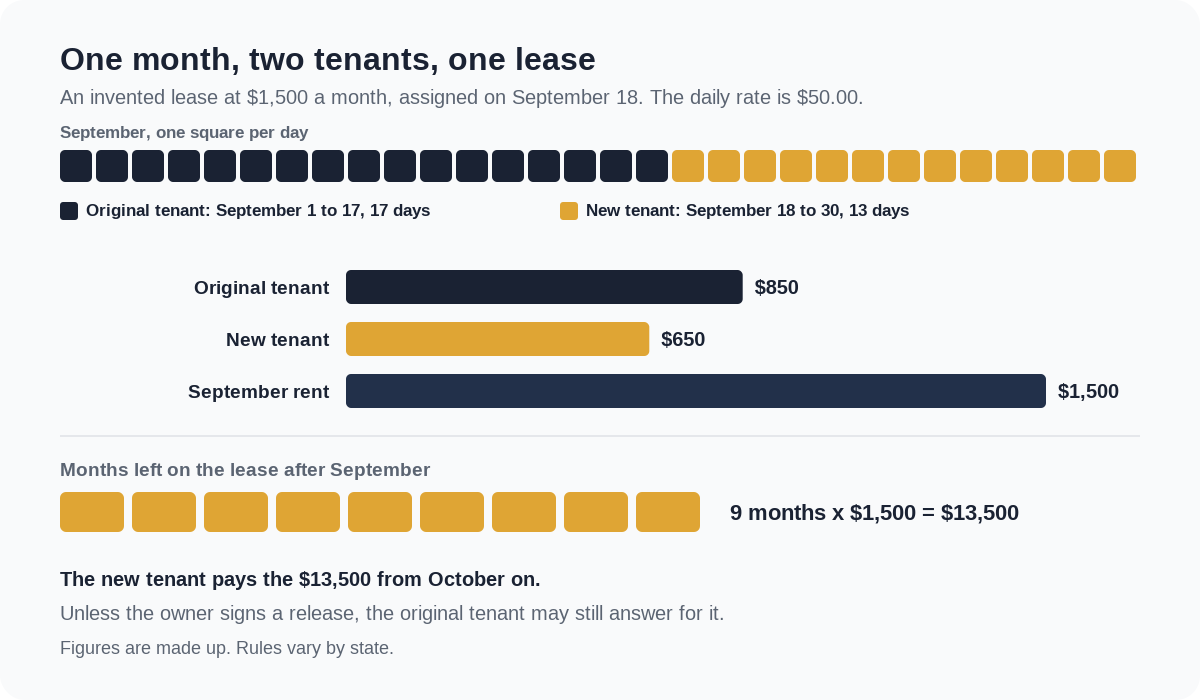
From October through June there are 9 months left: 9 x $1,500 = $13,500. The new tenant owes that rent. Because there is no release, the original tenant may still be liable for any of it the new tenant leaves unpaid.
The $1,500 security deposit stays with the owner. In this example the two tenants agree that the new tenant pays the original tenant $1,500 for it, and the owner records the deposit as held for the new tenant from September 18. On a rent ledger, September shows two charges, $850 to the original tenant and $650 to the new one, so both can see the month was paid in full.
What owners record when a lease is assigned
A clear paper trail protects everyone if a question comes up later.
- The signed assignment agreement and the owner's written consent.
- Whether the original tenant was released, and the release itself if there is one.
- The new tenant's application and the checks you ran.
- The split month, with each tenant's share of the rent on the ledger.
- Who holds the security deposit and how it was settled between the tenants.
- A move-in inspection for the new tenant, so damage from before the assignment is easy to tell apart.
If a tenant only wants to leave for a while, or the owner prefers a different arrangement, a sublease, a new lease with the new tenant, or a short tenancy at will after the lease ends are other paths local law may allow.
Frequently asked questions
What is a lease assignment in simple terms?
It is a tenant handing the rest of their lease to a new tenant. The new tenant moves in, pays the rent to the owner and follows the lease for the time left. Most leases need the owner's written consent first.
What is the difference between a lease assignment and a sublease?
A sublease keeps the original tenant on the lease, renting to a subtenant who pays them. An assignment moves the whole remaining lease to a new tenant, who then pays and deals with the owner directly.
Is the original tenant still liable after a lease assignment?
Often, yes. In many places the original tenant stays liable for unpaid rent and damage until the lease ends, unless the owner signs a written release. In the example on this page, that backup liability covers $13,500 of future rent.
Can an owner refuse a lease assignment?
It depends on the lease and local law. Many leases require written consent, some say consent cannot be unreasonably withheld, and some forbid assignment. A fair reason to refuse is usually a new tenant who does not pass the owner's normal checks.
How is rent split when a lease is assigned mid-month?
Most owners split by the days each tenant holds the lease. In the example, $1,500 / 30 = $50.00 a day, so the original tenant pays $850 for 17 days and the new tenant $650 for 13 days.
Keep a clear payment history for every lease
An assignment is easier to follow when every charge and payment is already on the right lease. In KeyRing, each lease keeps its rent charges, payments and balance, you can record cash and check payments, including partial ones, and overdue invoices are flagged automatically. Each month's rent invoices are drafted for you to approve before they are sent, and each tenant gets a PDF invoice by email. See what KeyRing does or how plans are priced.
Free calculators and templates
Browse all rental property calculators, free templates and the glossary.
From the blog
- What is a sublease? What property owners should put in writingA sublease is a tenant renting their home to someone else for part of the lease. How it differs from an assignment, who owes the rent and what goes in writing.
- Lessor vs lessee: who is who in a leaseThe lessor grants the right to use a property and the lessee pays for it. Who is who in a rental lease, what each side usually owes, and sublessors.
- What is a guarantor? Guarantor vs co-signer on a leaseA guarantor promises to pay the rent if the tenant does not. How a guarantor differs from a co-signer, who usually qualifies and what a guaranty covers.