How much notice for a rent increase? Rent increase notice rules
By Jenna Whitfield -

A rent increase notice is a written notice telling a tenant that the rent will go up, by how much and from what date. How much notice you give depends on where the property is, the kind of tenancy and sometimes the size of the increase. The safe habit is simple: put it in writing, deliver it well ahead of the date and keep a copy.
This guide covers typical notice periods, month-to-month and fixed-term leases, what can change the count, what a notice should say, a sample you can adapt and a worked timeline. It is general information and is not legal advice. Rules vary by state and city. Check your local law or an attorney.
How much notice do you need to give for a rent increase?
It depends on your state and city. For a month-to-month tenancy, many states require at least 30 days of written notice before a rent increase, and some require 60 or 90 days, often for larger increases or for tenants who have stayed longer. Some cities add rules of their own. Because the periods differ, this guide gives no state-by-state table: check your state's rental law, your city's rules and your lease before you pick a date.
A few points come up in many places:
- Written notice is the safest record. Many states require the notice in writing. Where they do not, a written notice still shows what you told the tenant and when.
- The period runs to the date the new rent starts, so count back from that date.
- A bigger increase can need a longer notice. Some states and cities set a longer period once an increase passes a set percentage.
- The lease can add to the rules. A lease can promise more notice than the law asks for, and that promise counts too.
Month-to-month and fixed-term leases
- Month-to-month. The rent can usually change with proper written notice, timed so the new rent starts at the beginning of a rental period.
- Fixed-term lease. The rent generally stays as the lease states until the term ends, unless the lease itself allows an increase during the term. Most owners plan the increase for the renewal and give notice well before the lease ends, so the tenant can decide whether to renew at the new rent.
- After the lease ends. A tenant who stays on after the term may become a month-to-month tenant, and the month-to-month notice rules then apply. The holdover tenant guide covers how that happens and your options.
What can change the notice period
- How you deliver it. Some states say how a notice must be delivered, and some add days when it is mailed. Hand delivery, or a delivery method your lease and state allow, keeps the count simple.
- Rent control and rent caps. A few states and some cities limit how much rent can rise in a year for many rentals, and some have rent stabilization rules with their own notice requirements.
- Subsidized housing. Rentals under a housing assistance program usually follow the program's own rules for rent changes, so check with the housing authority or program first.
- Timing after a complaint. In many states an increase soon after a tenant reports a repair or makes a complaint can be treated as retaliation. Base the increase on the market and your costs, and keep a record of why you set the amount.
- Fair housing. An increase has to apply on the same basis to every tenant, whatever their race, religion, disability, family status or any other protected trait.
What to put in a rent increase notice
- The tenant's name, the property address and the unit.
- The date of the notice and how you delivered it.
- The current rent and the new rent, as monthly amounts.
- The date the new rent starts.
- Anything else that changes with it, such as a new due date or a change to a recurring charge.
- A name and a phone number or email for questions.
- Your name and signature.
A sample rent increase notice
Adapt this to your state's rules and your lease:
Notice of rent increase
To: [tenant name], [property address and unit]
Date of this notice: [date]. Delivered by: [in person, mail or email, as your state and lease allow].
Your monthly rent will change from [current rent] to [new rent], starting [date the new rent starts]. All other terms of your tenancy stay the same.
If you have questions, contact [name] at [phone or email].
[Your name and signature]
Before you send it, check that the time between delivery and the start date meets the period your state, your city and your lease set.
A worked timeline
A tenant in an invented fourplex pays $1,600 a month on a month-to-month tenancy. You plan a 5% increase starting March 1. The new rent is $1,600 x 1.05 = $1,680, an increase of $80 a month or $960 over 12 months. The rent increase calculator runs that math for any rent.
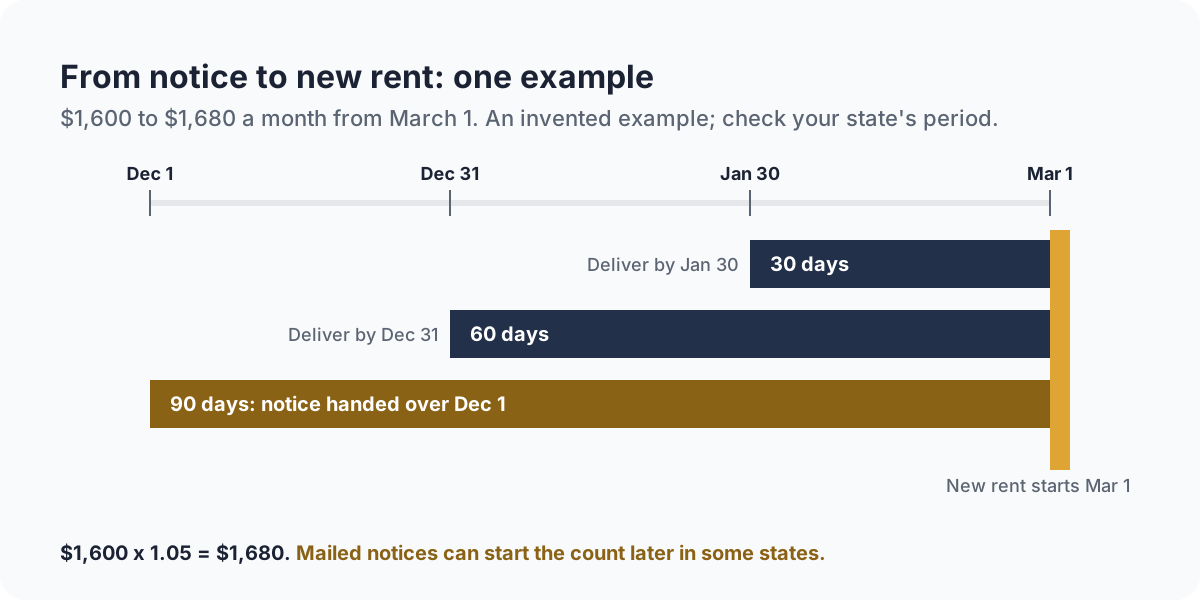
The arithmetic, counting back from March 1 in a year when February has 28 days: 28 days back is February 1, and 2 more is January 30, which is 30 days. Another 30 days back is December 31, at 60 days, and another 30 is December 1, at 90 days. A notice handed to the tenant on December 1 meets a 30, 60 or 90-day period. Had you mailed it, some states would start the count later, so leave a few extra days.
Good practice for every rent increase
- Give more than the minimum when you can. A tenant with more warning can budget for the new rent or plan a move, and an early notice leaves room if a delivery goes wrong.
- Talk first for a good tenant. A short conversation before the notice often keeps a renewal on track. A smaller increase or a one-time credit at renewal is a common way to keep a tenant; the rent concession guide covers how renewal concessions work.
- Deliver it the way you deliver other notices, and keep a copy with the date and method. The notice of entry guide covers the same habits for entering a rental.
- Update your records so the first bill at the new rent is right, and keep the signed renewal or the notice with the lease.
- Weigh the bigger picture at renewal. Some owners use the end of a lease to decide whether to keep the property. The capital gains tax calculator estimates the tax on selling a rental.
Frequently asked questions
How much notice do you need to give for a rent increase?
It depends on your state and city and the kind of tenancy. For a month-to-month tenancy, many states require at least 30 days of written notice, and some require 60 or 90 days, often for larger increases or longer tenancies. Rules vary by state and city. Check your local law or an attorney.
Can I raise the rent during a fixed-term lease?
Generally the rent stays as the lease states until the term ends, unless the lease itself allows an increase during the term. Most owners plan the increase for the renewal and give notice before the lease ends.
Does a rent increase notice have to be in writing?
Many states require written notice, and a written notice is the best record in every state. Deliver it in a way your state and lease allow, and keep a copy with the date and method.
How much can I raise the rent?
Where no rent control or rent cap applies, the market and your lease usually set the limit. A few states and some cities cap yearly increases for many rentals. Check the rules where the property is before you set the amount.
What if the tenant does not agree to the increase?
A month-to-month tenant who disagrees can usually give notice and move out before the new rent starts. A tenant on a fixed-term lease can decline to renew at the new rent. If the tenant stays and pays the old rent, ask for the difference in writing and check your state's rules before you take the next step.
Keep renewals and notices with the lease
Rent increases are easiest when you see the lease end coming. In KeyRing, automatic lease-expiry reminders by email and push give you that warning, and you can attach the notice and the renewal to the lease they belong to. Each month's rent invoices are drafted for you to approve before they are sent, so you can check the amount before it goes to the tenant. See what KeyRing does or how plans are priced.