What is a late rent notice? The reminder when rent is past due

A late rent notice is a written reminder from a property owner that rent is past due. It states how much is owed, any late fee the lease allows and the date by which the owner would like payment. Most late rent notices are informal: they come before any formal notice to quit, and many tenants pay as soon as they get one. In the worked example below, a tenant who is 6 days late on $1,500 of rent owes a $75 late fee, pays part of the balance, then clears it.
This page covers what a late rent notice is, how grace periods and late fees work, what a notice usually includes, how to handle partial payments, what comes after it and a worked example. It is general information and is not legal or tax advice. Rules vary by state and city. Check your local law or an attorney.
What is a late rent notice?
A late rent notice tells a tenant that rent was not received by the due date, or by the end of the grace period, and states what is now owed. Its purpose is to collect the rent and keep a record that the tenant was told.
A late rent notice is a reminder. In most places it does not end the tenancy and does not start a court case. If rent stays unpaid, the owner may later serve a formal notice to quit, sometimes called a pay rent or quit notice, which has its own local rules on form, timing and delivery. Keeping the two separate helps: a friendly reminder can go out early, while a formal notice follows the steps local law sets.
Grace periods and late fees
Most leases set a due date, usually the 1st of the month, and many add a grace period: a few days after the due date when rent is still accepted without a late fee. Some places require a minimum grace period; others leave it to the lease.
A late fee is the charge the lease sets for rent paid after the grace period. Leases commonly use one of these:
- A flat fee, such as a set dollar amount once the grace period has passed.
- A percentage of the rent, such as a stated percent of the monthly rent.
- A daily fee, a small amount for each day late after the grace period, often with a maximum.
Many places cap late fees or require them to be reasonable, and a fee that is not written in the lease is often not collectable at all. The site's late fee calculator works out a fee from the lease terms you enter; it applies no state rule, so check the local limit yourself.
What a late rent notice usually includes
There is no single required format for an informal reminder, though a clear notice usually includes:
- The tenant's name and the property address.
- The rent period that is late, such as the month.
- The amount of rent owed and any late fee the lease allows, listed separately.
- The total now due and how to pay it.
- A date by which the owner asks for payment.
- The owner's name and contact details and the date of the notice.
Keep the tone factual and polite. Many late payments come from a missed transfer, a returned bank payment or a short-term problem, and a calm reminder is more likely to get a reply. If a bank payment bounced, the ACH return codes entry explains what the code on the return means. Avoid threats, and avoid stating consequences the law may not allow.
Partial payments
A tenant who cannot pay in full may offer part of the rent. Taking a partial payment is common, but in some places accepting money after a formal notice can affect whether that notice still stands. Before taking part of the rent once a formal notice is out, check with an attorney.
When you do take a partial payment, record the amount and date, give the tenant a rent receipt and keep the remaining balance on the ledger. A rent ledger that shows each charge, fee and payment makes the balance easy to explain. Some tenants split rent across roommates; the post on split rent payments covers that case.
What comes after a late rent notice
Most late rent is paid after a reminder. When it is not, the owner usually has a few general options:
- Agree a payment plan in writing, with dates and amounts, and record each payment.
- Serve a formal notice, such as a pay rent or quit notice, following local rules.
- Talk to an attorney before taking any further step.
If a tenancy does end over unpaid rent, a court process is required to remove a tenant. Owners should not change the locks, shut off utilities or remove a tenant's belongings to force a move-out; that kind of self-help is prohibited in most places. The eviction entry explains the general court stages. For problems other than rent, such as an unauthorized pet, the post on the lease violation notice covers the matching first step.
A worked example: a late fee and a partial payment
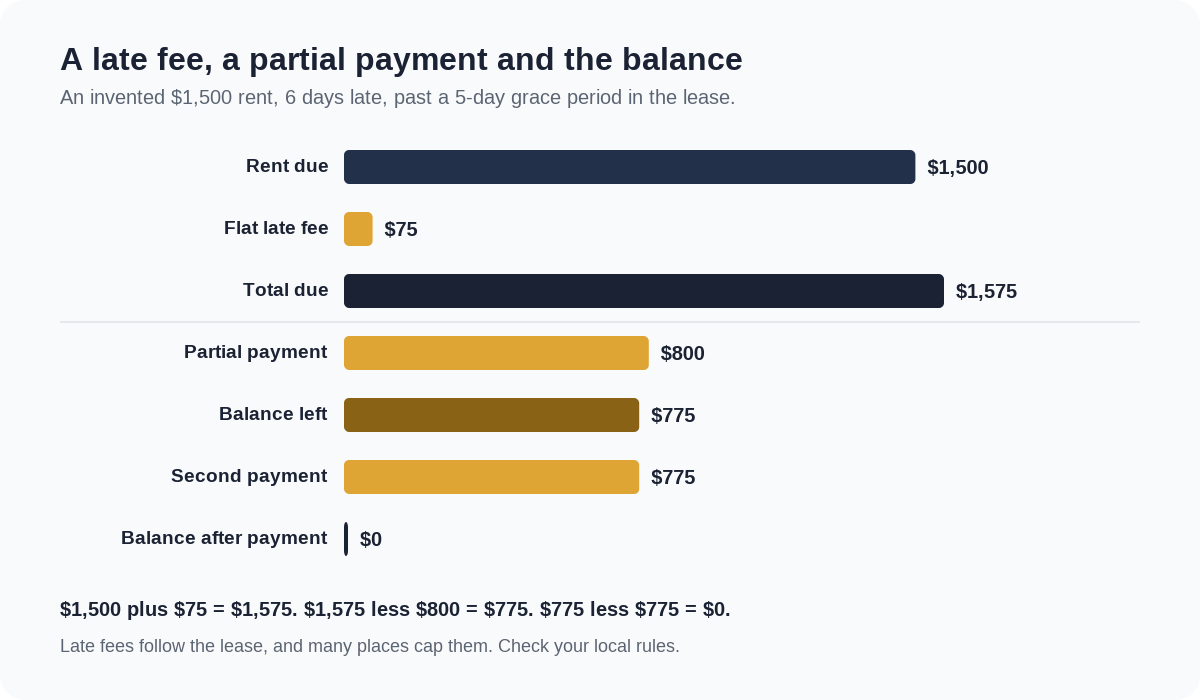
All the figures here are made up. A tenant rents a home for $1,500 a month, due on the 1st. The lease has a 5-day grace period and a flat late fee of $75, which is 5 percent of the rent. Rent has not arrived by the 7th, so it is 6 days late, and the owner sends a late rent notice.
Using the site's late fee calculator with those lease terms:
- Days late: 6, which is past the 5-day grace period, so the fee applies
- Late fee: $75.00, the flat fee in the lease, equal to 5 percent of the rent
- Total due: $1,500 + $75 = $1,575
On the 10th the tenant pays $800. The owner records it and gives a receipt, and the balance falls to $1,575 - $800 = $775. On the 20th the tenant pays the remaining $775 and the balance returns to $0. Had the tenant paid on the 4th, inside the grace period, the late fee would have been $0.
Frequently asked questions
What is a late rent notice?
It is a written reminder from the property owner that rent is past due. It usually states the rent owed, any late fee the lease allows, the total due and a date to pay.
Is a late rent notice the same as a notice to quit?
No. A late rent notice is an informal reminder. A notice to quit is a formal notice that the tenancy may end, and it has to follow local rules on form, timing and delivery.
When should a late rent notice be sent?
Many owners send one soon after the grace period ends. The lease sets the due date and any grace period, and some places require a minimum grace period before a late fee applies.
How much can a late fee be?
It depends on the lease and local law. Many places cap late fees or require them to be reasonable. In the example, a flat $75 fee on $1,500 of rent, applied after a 5-day grace period, brings the total due to $1,575.
Should an owner accept a partial rent payment?
Many owners do, and record the payment and the remaining balance. In some places, accepting part of the rent after a formal notice can affect that notice, so check with an attorney first.
Keep each tenant's balance clear when rent is late
A reminder is easier to send when the balance behind it is clear. In KeyRing, each lease keeps its rent charges, payments and balance, you can record cash and check payments, including partial ones, and overdue invoices are flagged automatically. Each month's rent invoices are drafted for you to approve before they are sent, and each tenant gets a PDF invoice by email. See what KeyRing does or how plans are priced.
Free calculators and templates
- Late fee calculatorA rent late fee as a flat amount or a percentage, with a grace period.
- Rent receipt templateA printable rent receipt, two to a page, and a CSV log for every payment you receive.
- Rent statement templateA tenant's charges, payments and balance for a period, from the opening balance to what is due now.
Browse all rental property calculators, free templates and the glossary.
From the blog
- Lease violation notice: what to include and how to send itA lease violation notice tells a tenant which lease term was broken and how to fix it. What to include, how to deliver it, typical cure periods and a sample.
- What is an ACH payment? How ACH rent payments workAn ACH payment moves money between US bank accounts over the ACH network. How ACH rent payments work, how long they take, what they cost and when they bounce.
- What are certified funds? How they work for rent and move-in moneyCertified funds are payments backed by a bank or issuer: cashier's checks, certified checks, money orders and wires. How they work for rent, with an example.