What is a lease extension? Adding time to the current lease

A lease extension is a signed agreement between a property owner and a tenant that moves the end date of the current lease to a later date. The tenant keeps the same home under the same lease, usually for a short added period such as two, three or six months. Extensions are common when a tenant needs time before a move, when an owner wants the lease to end in a busier rental season, or when either side is not ready to commit to a full new term. In the worked example below, a tenant paying $1,500 a month extends for 3 months at a 3 percent increase, and the rent over the extension comes to $4,635.
This page covers what a lease extension is, how it differs from a lease renewal, why owners and tenants use one, what an extension usually includes, how rent can change, a worked example and the mistakes that cause problems. It is general information and is not legal or tax advice. Rules vary by state and city. Check your local law or an attorney.
What is a lease extension?
A fixed-term lease has an end date. A lease extension keeps that lease in force and pushes the end date out. Everything the lease says about rent, deposits, repairs, pets and house rules carries on into the added months unless the extension changes it. The security deposit normally stays where it is, and the tenant does not sign a fresh lease.
An extension is usually a short written document, often a page or two, signed by everyone who signed the lease. It names the original lease, states the new end date and lists any term that changes, such as the rent. The guide to a lease addendum covers how short documents attached to a lease generally work, and the entry on a lease amendment covers signed changes to other terms of a lease.
Lease extension vs lease renewal
The two words are often used loosely, and some leases use them the other way round, so read the document itself. In general use:
- An extension adds time to the current lease. The original lease stays the governing document, and the added period is often short.
- A renewal starts a new term, often another full year, usually with a new lease or a renewal addendum and a fresh signature. It is also a common point to update the lease's clauses.
The entry on a lease renewal covers renewals in detail, including the month-to-month and holdover outcomes. When neither side wants to continue, the tenancy ends instead, and a notice of non-renewal is the written notice that says so.
Why owners and tenants use an extension
A few situations come up again and again:
- The tenant needs a bridge. A new home is not ready yet, a job starts later than planned, or a school year ends a few months after the lease does.
- The owner wants a better end date. Many owners prefer leases that end in spring or summer, when more people are looking for homes. A short extension can move a winter end date into a busier season.
- The owner plans to sell or renovate. A few extra months of rent can cover the gap before a sale or a planned project.
- Neither side is ready to commit. An extension keeps fixed terms for a set period, which some owners and tenants prefer to a month-to-month lease that either side can end with notice.
Without an extension or a renewal, a tenant who stays after the end date may roll over to month to month under the lease, or may become a holdover tenant, depending on the lease and local law.
What a lease extension usually includes
Most extensions cover the same short list of points. An attorney can draft or review the wording for the place where the property is.
- The names of the owner and every tenant on the lease, and the property address.
- The date of the original lease and a statement that it stays in force.
- The current end date and the new end date.
- The rent for the added period, and the date it starts if it changes.
- Any other term that changes, such as a utility arrangement or a parking charge.
- A statement that every other term of the lease stays the same.
- Signatures and dates from everyone who signed the lease, including any co-signer or guarantor if the lease has one.
Agree the extension in writing before the original end date. A spoken agreement is hard to prove, and the tenancy may roll over or become a holdover by default while the paperwork waits.
Rent changes in an extension
An extension can keep the same rent or set a new one for the added months. Many owners treat a short extension like a renewal and price it against the market, and some add a small premium for a short term because a short lease can mean an extra turnover sooner. Others keep the rent flat to hold on to a reliable tenant for a few more months.
Some places require written notice of a rent increase a set time ahead, and some cities and states cap how much rent can rise each year. Check the rule where the property is before you put a new rent in an extension. The guide to a rent increase notice covers what such a notice usually includes, and the security deposit entry covers the general rules on deposits when the rent changes.
A worked example: a 3-month extension at a 3 percent increase
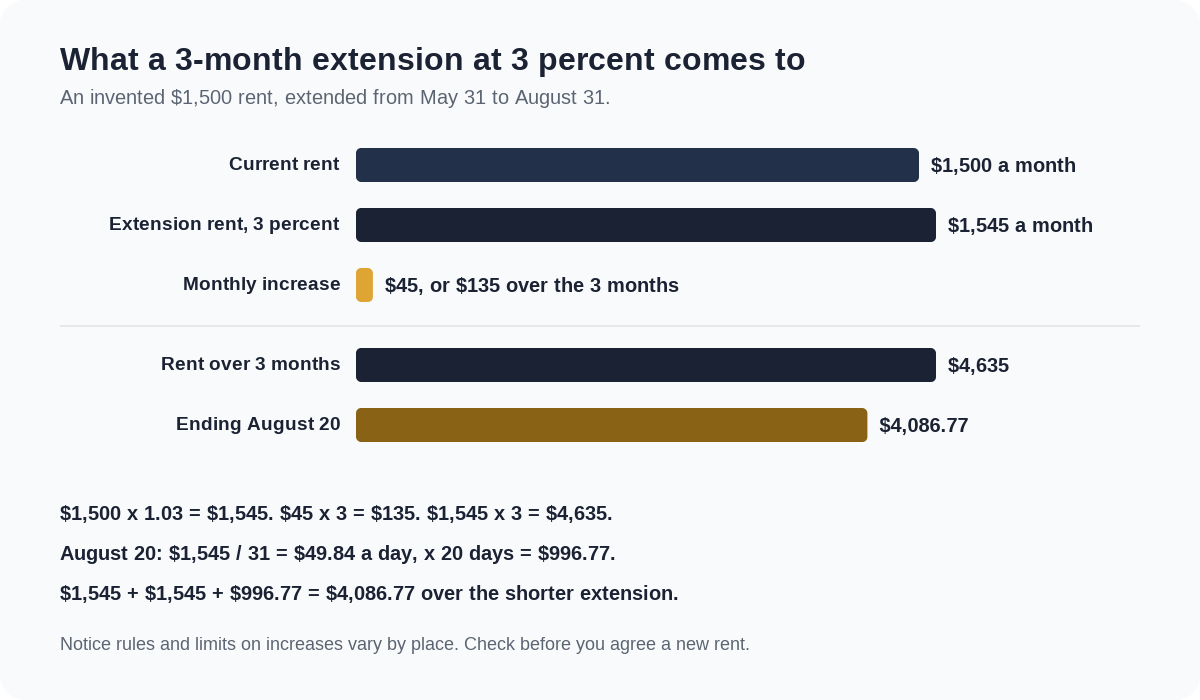
All the figures here are made up. A tenant rents a home for $1,500 a month on a one-year lease that ends on May 31. The tenant has bought a home that will be ready at the end of the summer and asks to stay through August 31. The owner agrees to a 3-month extension, June to August, at a 3 percent increase, and both sides sign before the end of April.
Using the site's rent increase calculator:
- New monthly rent: $1,500 x 1.03 = $1,545
- Monthly increase: $1,545 minus $1,500 = $45
- Increase over the 3-month extension: $45 x 3 = $135
- Rent over the extension: $1,545 x 3 = $4,635
The tenant then hears the new home will be ready earlier, and the two sides agree that the extension will end on August 20. Using the actual days in August, the prorated rent calculator gives a daily rate of $1,545 / 31 = $49.84 and August rent of 20 days x $49.84 = $996.77. The rent over the shorter extension is $1,545 + $1,545 + $996.77 = $4,086.77.
A rent roll that lists each unit's rent and end date helps you keep the new end date in view, so the next decision on that lease does not arrive as a surprise.
Mistakes that cause problems
- Waiting until the end date. An extension signed after the lease has ended can leave a gap in which the tenancy rolls over or becomes a holdover.
- Leaving out a signer. If two tenants signed the lease and only one signs the extension, it may not bind the other. Have everyone who signed the lease sign the extension.
- Vague dates. Write the exact new end date. "Through the summer" invites a dispute.
- Missing a notice rule. A rent increase in an extension may still need the written notice the local rules require.
- Forgetting the next step. Note what happens at the new end date: another extension, a renewal, a move to month to month or a move-out. The entry on a notice to vacate covers the notice that usually goes with a move-out.
Frequently asked questions
What is the difference between a lease extension and a lease renewal?
An extension adds time to the current lease, often a few months, and the original lease stays in force. A renewal usually starts a new term, often another full year, with a new lease or a renewal addendum. Some leases use the words differently, so read the document.
How long is a typical lease extension?
There is no set length. Many extensions run from one to six months, often to bridge a move or to move the end date into a busier rental season. Longer periods are usually handled as a renewal.
Can the rent go up in a lease extension?
In most places, yes, if both sides agree and any required notice is given. Some cities and states cap increases. In the example, a 3 percent increase takes the rent from $1,500 to $1,545, which adds $135 over a 3-month extension.
Does a lease extension need to be in writing?
A written extension signed by everyone on the lease is the safe course, and some leases and some places require it. Writing down the new end date and any rent change avoids disputes later.
What happens when a lease extension ends?
The same choices come up as at the original end date: another extension, a renewal, a move to month to month or a move-out. If the tenant stays with no agreement in place, the tenant may be treated as a holdover, depending on the lease and local law.
Keep each extension with the lease it changes
An extension works best when the new end date and the new rent are on the record. In KeyRing, you can attach documents to a lease, and each lease keeps its rent charges, payments and balance. KeyRing sends automatic lease-expiry reminders by email and push to you and the tenant 30 days before the end date, and each month's rent invoices are drafted for you to approve before they are sent, so you can check the amount before it goes to the tenant. See what KeyRing does or how plans are priced.
Free calculators and templates
- Rent increase calculatorA new rent from a percentage or dollar increase, with the yearly difference.
- Rent roll templateEvery unit, lease, rent and balance in a property on one page, as of one date.
Browse all rental property calculators, free templates and the glossary.
From the blog
- What is a month-to-month lease? How it works and how to end oneA month-to-month lease renews each month until either side gives written notice. How notice and rent increases work, pros and cons, and sample lease language.
- What is a holdover tenant? Your options when a lease ends and the tenant staysA holdover tenant stays in a rental after the lease ends without a new agreement. See your options, what holdover rent can look like and how to avoid one.
- How much notice for a rent increase? Rent increase notice rulesHow much notice to give before a rent increase: typical periods, month-to-month and fixed-term leases, what to put in the notice, a sample and a timeline.