What is a sublease? What property owners should put in writing
By Maya Ellison -

A sublease is an agreement in which a tenant rents their home, or part of it, to someone else for some or all of the time left on their lease. The new occupant is called the subtenant. The original tenant stays on the lease and stays responsible to the property owner for the rent and every other term.
This guide covers what a sublease is, how it differs from a lease assignment, who owes what, when a tenant can sublet, what property owners should put in writing and a worked example. It is general information and is not legal advice. Rules vary by state and city. Check your local law or an attorney.
What is a sublease?
In a sublease there are two agreements. The original lease stays between the property owner and the tenant. A second agreement, the sublease, is between the tenant and the subtenant. Toward the subtenant, the tenant plays the owner's part: they collect the subtenant's rent and pass the rent due under the lease on to the owner.
Common reasons to sublet are a job or study placement elsewhere for a few months, a move before the lease ends, and a tenant who wants to rent a spare room to help with the rent. The same word is used for all three, so ask the tenant which one they mean.
Sublease vs lease assignment
A tenant who wants to leave may ask to sublet or to assign the lease. The two often get mixed up, and they differ in who stays responsible:
| Sublease | Lease assignment | |
|---|---|---|
| What moves to the new person | Part of the lease: some of the time, some of the space or both | The rest of the lease, for all of the space |
| The original tenant | Stays on the lease and responsible for the rent | Steps out, though many leases keep them liable if the new tenant fails to pay |
| Who pays the owner | Usually the original tenant | Usually the new tenant |
| Who the new person's agreement is with | The original tenant | The owner, through the assigned lease |
| Where it is common | A summer away, a short work assignment, a spare room | A tenant who moves for good before the lease ends |
What the signed documents say is what counts. Some leases treat any new occupant as a sublet, and some assignments release the original tenant in full. Read the wording, and have an attorney review the forms you use.
Who is responsible for what
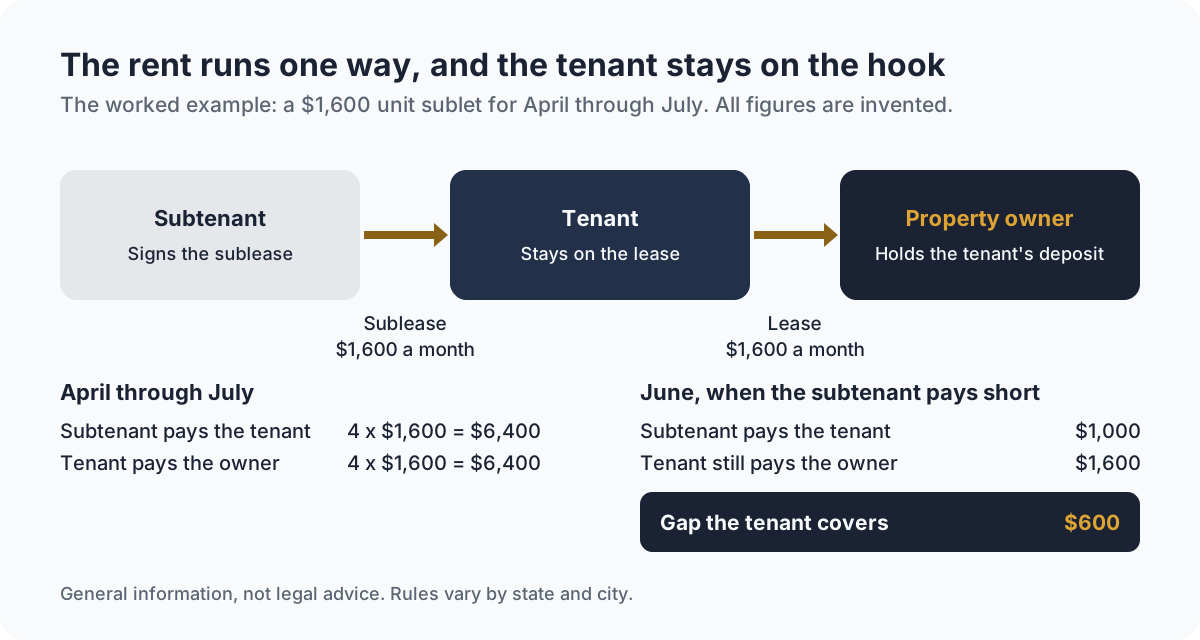
In a sublease, the chain of payment runs one way. The subtenant pays the tenant, and the tenant pays the owner. The owner usually has no lease with the subtenant, so the owner looks to the tenant for the rent, for damage beyond normal wear and tear and for any other lease term the subtenant breaks.
That makes the original tenant's position the important one. If the subtenant pays late or not at all, the tenant still owes the full rent on the due date. If the subtenant damages the unit, the cost usually comes out of the tenant's deposit or is billed to the tenant. If the lease has a guarantor, check whether the guaranty still covers the lease during a sublet; many do, and some ask for the guarantor's consent first.
The deposits follow the same chain. You keep holding the original tenant's deposit. Any deposit the subtenant pays is usually held by the tenant and settled between the two of them.
Can a tenant sublet without permission?
That depends first on the lease. Most written leases say whether the tenant may sublet, and many say a sublet needs the owner's written consent. Some leases ban subletting outright.
Local law can change the answer. Some states and cities give tenants a right to sublet in certain cases, or say an owner cannot refuse consent without a good reason. Others leave it to the lease. Short-term rentals through a booking site often fall under separate city rules, and many leases and HOA rules limit them. Rules vary by state and city. Check your local law or an attorney.
A tenant who sublets without the consent the lease requires is usually breaking the lease. The lease violation notice guide covers how to put that in writing and give the tenant a chance to fix it.
What property owners should put in writing
When a tenant asks to sublet, a few documents keep everyone clear on who answers for what:
- A subletting clause in the lease. Say whether subletting is allowed, that it needs your written consent and what you need to see before you decide.
- A written request from the tenant. Ask for the subtenant's name, the dates, the rent the subtenant will pay, the part of the home they will use and how to reach them.
- Your written consent, or a written answer. If you agree, say so in a short letter or form that names the tenant, the subtenant, the unit and the dates, and states that the original lease and the tenant's responsibility for it stay in place.
- A copy of the sublease. Ask for the signed sublease between the tenant and the subtenant, and check that it does not conflict with your lease, such as a pet or a parking space your lease does not allow.
- Contact details and a key record. Note who holds which keys and how to reach the subtenant for repairs and entry notices.
- The end date. Put in writing when the sublease ends, who moves out and when you will inspect the unit.
Apply the same standard to every request. If you review a subtenant's application, use the screening standard you use for every applicant. The rent-to-income ratio calculator works out the ratio from the subtenant's income. Costs you pay to review a request, such as an attorney's review of your consent form, are property expenses: log them in a rental property expense spreadsheet with the rest of the year's bills.
A worked example
A tenant rents an invented two-bedroom unit for $1,600 a month on a lease that ends July 31. In March they take a job in another city and ask to sublet the unit for the last four months, April 1 to July 31.
The owner's lease allows subletting with written consent. The proposed subtenant earns $5,600 a month, so the rent-to-income ratio is $1,600 / $5,600 = 28.57%, inside the owner's 30% standard. The owner signs a consent letter that names both people and the dates and keeps the original lease in place.
- Rent under the sublease: 4 x $1,600 = $6,400 for April through July, paid by the subtenant to the tenant.
- Rent under the lease: the same 4 x $1,600 = $6,400, owed by the tenant to the owner, on the usual due dates.
In June the subtenant pays the tenant only $1,000. The tenant still owes the owner the full $1,600 for June, so the tenant covers the $1,600 - $1,000 = $600 gap and collects it from the subtenant. On the owner's rent ledger, June looks like any other month: one charge and one payment from the tenant.
When the sublease ends
At the end of a sublease, the subtenant moves out and the tenant either moves back in or hands back the unit at the end of the lease. Inspect the unit against the move-in record, and settle the deposit with the original tenant, since their deposit is the one you hold.
If the subtenant stays after the lease ends, you may have a holdover on your hands, with a person you have no lease with. The holdover tenant guide covers the options, and an attorney where the property is can tell you which notice applies.
Frequently asked questions
What is a sublease in simple terms?
A sublease is a tenant renting their home, or part of it, to someone else for some or all of the time left on their lease. The tenant stays on the lease and stays responsible to the property owner.
What is the difference between a sublease and an assignment?
In a sublease the original tenant stays on the lease and the subtenant's agreement is with the tenant. In an assignment the tenant hands the rest of the lease to a new tenant, who then deals with the owner, though many leases keep the original tenant liable too.
Is the original tenant responsible for the subtenant?
Usually, yes. The tenant still owes the owner the full rent on time and answers for damage or other lease breaks by the subtenant. The tenant can then seek repayment from the subtenant under their sublease.
Can a property owner refuse a sublease?
Often, if the lease requires the owner's consent. Some states and cities limit refusals, for example by requiring a good reason. Fair housing law applies to the decision the same way it applies to screening. Rules vary by state and city. Check your local law or an attorney.
Does a subtenant need to sign the original lease?
Usually no. The subtenant signs the sublease with the tenant. Some owners also ask the subtenant to sign an acknowledgment that they have read the original lease and will follow its rules.
Keep each lease and its paperwork together
A sublet is easier to manage when the lease, the consent and the dates sit in one place. In KeyRing, you create a lease for each unit, attach documents to it, such as your signed consent letter and a copy of the sublease, and schedule a move-out or end the lease when the time comes. Rent-due, overdue and lease-expiry reminders go out by email and push automatically, and each month's rent invoices are drafted for you to approve before they are sent. See what KeyRing does or how plans are priced.