Rental property accounting terms: a plain-language guide for owners
By Claire Navarro -

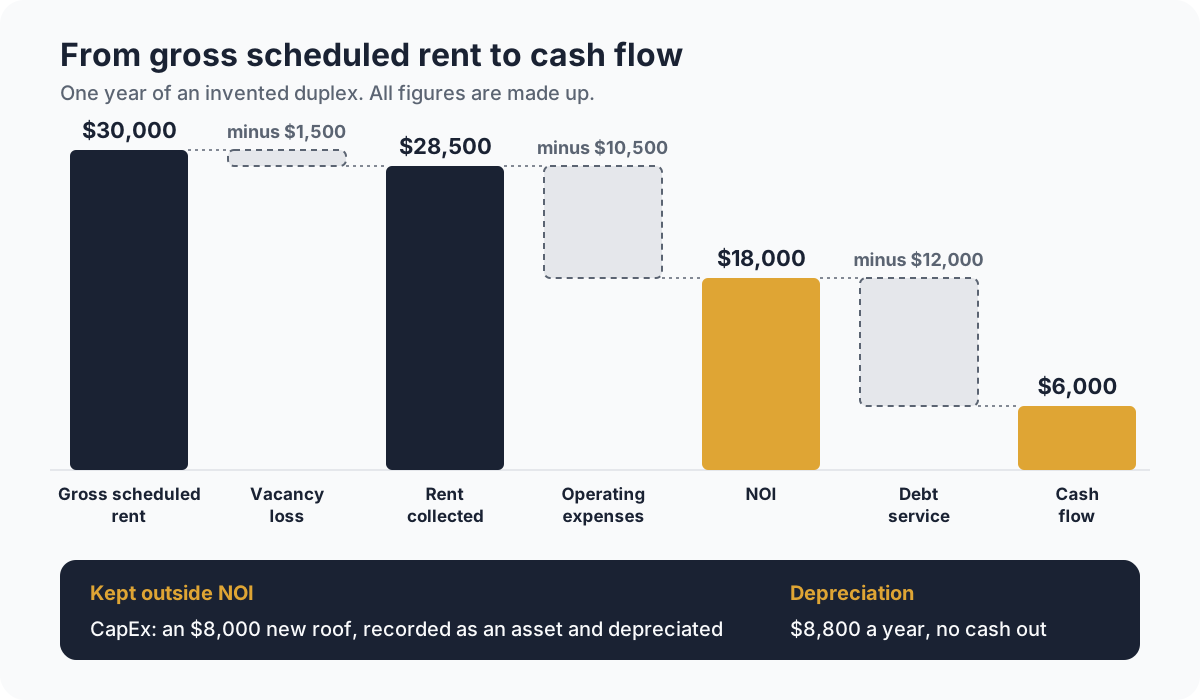
Rental property accounting terms are the words owners, bookkeepers, lenders and tax preparers use to describe the money a rental brings in, the money it costs and what is left over. Most of them describe one step on a single path, from the rent a property could earn down to the cash that reaches your bank account. In the invented duplex below, $30,000 of rent on paper becomes $6,000 of cash flow for the year once vacancy, operating expenses and the mortgage are paid.
This guide defines the terms in five groups: income, expenses, results, records and reports, and accounting methods. Each definition is short and links to a page that goes further. A worked example then follows one year of a small duplex through the same terms, and a short FAQ answers the questions owners ask most. It is general information and is not legal or tax advice. Ask a tax professional how any of these terms apply to your own return.
What are rental property accounting terms?
They are the shared vocabulary of rental bookkeeping. When a lender asks for your NOI, a buyer asks for a T12 or your tax preparer asks whether a new water heater was a repair or an improvement, each question uses a term with a fairly fixed meaning. Knowing those meanings lets you keep records that answer the question the first time.
The terms fall into a natural order. Income terms describe what comes in. Expense terms describe what goes out and how each cost is treated. Result terms are the figures you get when you subtract one from the other. Records and reports are where the figures live, and the accounting method decides when each dollar is counted.
Income terms
| Term | What it means |
|---|---|
| Gross scheduled rent | The rent every unit would bring in for the period if each one were leased all year and every tenant paid in full. It is the starting line of most rental income statements and of any pro forma. |
| Vacancy loss | The rent you did not collect because a unit sat empty or a tenant did not pay. It is often shown as a percentage of gross scheduled rent, which the vacancy rate calculator works out. |
| Rent collected | The rent that actually arrived. Gross scheduled rent minus vacancy loss gives the same figure, and a rent tracker shows it unit by unit and month by month. |
| Other income | Money the property earns besides base rent, such as late fees, pet rent, parking, storage or coin laundry. Keep it in its own account so rent figures stay clean. |
| Prepaid rent | Rent a tenant pays before the period it covers, such as January rent paid in December. How and when you count it depends on your accounting method and the tax rules, so ask your tax professional. |
| Security deposit | Money you hold for the tenant against unpaid rent or damage. While you hold it, it is a liability on your balance sheet, money you may owe back, and it stays out of rental income. |
Expense terms
| Term | What it means |
|---|---|
| Operating expenses | The everyday costs of running the property: property taxes, insurance, repairs and maintenance, utilities you pay, management, advertising and professional fees. Mortgage payments, depreciation and income tax are left out. |
| CapEx | Capital expenditures: larger spending that adds value, extends the life of the property or adapts it to a new use, such as a new roof or a full kitchen. CapEx is recorded as an asset and depreciated over time. |
| Repairs vs improvements | A repair keeps the property in its normal working order, like fixing a leak, and is usually an expense in the year you pay it. An improvement makes it better, longer lasting or different, and is usually capitalized. The line can be close, so ask a tax professional when a cost is large. |
| Depreciation | A yearly deduction for the wear on the building and on capital improvements, spread over a set recovery period. Land is never depreciated. Depreciation costs no cash in the year it is recorded. |
Result terms
| Term | What it means |
|---|---|
| Net operating income (NOI) | Rent collected plus other income, minus operating expenses. NOI leaves out the mortgage, so it describes the property itself, whoever owns it and however it is financed. |
| Debt service | The total of your mortgage payments for the period, interest and principal together. Lenders compare NOI with debt service to see how comfortably the property covers its loan. |
| Cash flow | NOI minus debt service: the cash the property leaves you before income tax. Positive cash flow means the rent covers the costs and the mortgage. |
| Cap rate | NOI divided by the property's value or price. It compares properties without regard to how each one is financed. |
| Cash on cash return | A year's cash flow divided by the cash you put in, such as your down payment and closing costs. It shows what your own money earns. |
Records and reports
| Term | What it means |
|---|---|
| Chart of accounts | The numbered list of categories your bookkeeping sorts every dollar into: assets, liabilities, equity, income and expenses. Naming expense accounts after the Schedule E lines saves work at tax time. |
| General ledger | The full record of every transaction, each posted to an account from your chart of accounts. An expense spreadsheet with an account column on each line is a simple version of the expense side. |
| Rent ledger and tenant ledger | A tenant ledger is the running record of one tenant's charges, payments and balance. A rent ledger may mean the same thing, or a record of rent charged and collected across a whole property. |
| Rent roll | A snapshot of every unit on one date: tenant, rent, lease dates, deposit and balance. It is a list of leases, so it shows no expenses. |
| Profit and loss statement (P&L) | Income minus expenses for a period, ending in net income. Also called an income statement. |
| Balance sheet | What the business owns, what it owes and the owner's equity on one date. Security deposits held and the mortgage balance appear here, as liabilities. |
| T12 statement | A trailing 12 months operating statement: income and operating expenses for the most recent 12 months, month by month, with NOI at the bottom. Lenders and buyers ask for it. |
| Schedule E | The IRS form where individual owners report rental income and expenses each year. IRS Publication 527 explains the rules for residential rental property. |
Accounting methods
| Term | What it means |
|---|---|
| Cash basis vs accrual basis | On the cash basis, you count income when you receive it and expenses when you pay them. On the accrual basis, you count income when it is earned and expenses when they are incurred, whenever the cash moves. Many small owners keep cash basis books; ask your tax professional which method fits you. |
| Reconciliation | The habit of matching your books to your bank statements, usually once a month, so every deposit and payment is recorded once and in the right account. It catches missed rent, duplicate entries and bank errors while they are still easy to fix. |
A worked example: one year of a duplex
Here is how the terms connect for an invented duplex. All the figures here are made up. Each side rents for $1,250 a month, so gross scheduled rent is 2 units x $1,250 x 12 months = $30,000. The owner bought the property for $300,000 with $77,500 down and $2,500 of closing costs, and the mortgage payment is $1,000 a month.
Income. One side sat empty for a little over a month between tenants, a vacancy loss of 5% of gross scheduled rent: $30,000 x 5% = $1,500. Rent collected was $30,000 minus $1,500 = $28,500. There was no other income this year.
Operating expenses. The year's operating costs came to $10,500:
| Operating expense | Year |
|---|---|
| Property taxes | $4,200 |
| Insurance | $1,800 |
| Repairs and maintenance | $2,400 |
| Water and trash | $1,500 |
| Accounting and advertising | $600 |
| Total operating expenses | $10,500 |
NOI. Rent collected minus operating expenses: $28,500 minus $10,500 = $18,000 a year, or $1,500 a month. The NOI calculator gives the same figure from $30,000 of rent, 5% vacancy and the five expenses.
Cash flow. Debt service was 12 x $1,000 = $12,000. Cash flow was $18,000 minus $12,000 = $6,000 for the year, or $500 a month, $250 per unit. The rental cash flow calculator shows $500 a month from $2,500 of monthly rent, 5% vacancy, $875 of monthly expenses and the $1,000 payment.
Cap rate and cash on cash. At the $300,000 price, the cap rate is $18,000 / $300,000 = 6.0%. The owner put in $77,500 plus $2,500 = $80,000, so the cash on cash return is $6,000 / $80,000 = 7.5%. The cap rate calculator and the cash on cash return calculator check both.
What stays outside NOI
Two figures from the same year never touch NOI.
- CapEx. The owner replaced the roof on one side for $8,000. It is an improvement, so it goes on the balance sheet as an asset and is depreciated over the years ahead, and it stays out of operating expenses. It still came out of the bank account, though: after the roof, the year's cash flow of $6,000 left the owner $2,000 short, which the reserve covered.
- Depreciation. Say the land is 20% of the $300,000 price plus $2,500 of purchase costs. The building's depreciable basis is then $242,000, and straight-line depreciation over 27.5 years is $242,000 / 27.5 = $8,800 a year. The rental property depreciation calculator runs the same numbers. Your tax professional sets the actual basis and schedule.
Why net income and cash flow differ
Of the $12,000 of mortgage payments, say $8,000 was interest and $4,000 was principal. Interest is an expense on the P&L. Principal lowers the loan balance on the balance sheet, so it is not an expense, though it is still cash out. The P&L for the year reads $28,500 of rent minus $10,500 of operating expenses, minus $8,000 of interest, minus $8,800 of depreciation = $1,200 of net income.
So the same duplex shows $18,000 of NOI, $6,000 of cash flow and $1,200 of net income in one year. Each figure answers a different question, and none of them is wrong. The debt service coverage ratio a lender looks at would be $18,000 / $12,000 = 1.50.
Records. The deposits are two security deposits of $1,250 each, $2,500 in all, held as a liability. If a tenant pays January rent of $1,250 in late December, ask your tax professional which year it belongs to.
Common mistakes with rental accounting terms
- Treating security deposits as income. A deposit is money you may owe back. Record it as a liability until some of it is kept.
- Putting the mortgage in NOI. NOI stops before debt service. A figure with the mortgage in it is closer to cash flow.
- Expensing an improvement. A new roof or a full renovation is usually CapEx and depreciated. Ask your tax professional when a cost is borderline.
- Mixing the principal into expenses. Only the interest part of a mortgage payment is an expense. The principal lowers the loan.
- Skipping reconciliation. Books that never get matched to the bank drift, and the errors are harder to find months later.
Frequently asked questions
What is the difference between NOI and cash flow?
NOI is rent collected and other income minus operating expenses, before any mortgage payment. Cash flow is NOI minus debt service. In the example, NOI is $18,000 and cash flow is $6,000, because $12,000 went to the mortgage.
Is depreciation an operating expense?
No. Depreciation is a deduction for wear on the building and improvements, and it costs no cash in the year it is recorded, so NOI and cash flow leave it out. It does appear on the P&L and on Schedule E, which is why net income can be far below cash flow.
Are security deposits income for a rental property?
While you hold a deposit, record it as a liability, since you may owe it back to the tenant. If you later keep part of it for unpaid rent or damage, ask your tax professional how and when to count that amount as income.
Should a small owner use cash or accrual accounting?
Many owners of a few rentals keep cash basis books, which count income when it arrives and expenses when they are paid. Accrual books match income and costs to the period they belong to, which some owners and lenders prefer. Ask your tax professional which method fits your situation.
What reports does a rental property owner need?
At a minimum, a P&L for each property and for the year, a balance sheet, a rent roll and the tenant ledgers behind it. Buyers and lenders often add a T12 statement, and at tax time your totals feed Schedule E.
Keep every transaction filed under its property
Every term in this guide starts from the same raw material: transactions recorded under the right property and the right account. In KeyRing, you connect your bank accounts securely through Plaid, and each transaction is matched to a property with suggestions you confirm. Income and expense records use categories you can edit, and you can export your transactions to Excel. See what KeyRing does or how plans are priced.
Free calculators and templates
- Rental cash flow calculatorMonthly cash flow line by line, per unit, with the break-even rent.
- NOI calculatorNet operating income and the operating expense ratio for a year.
- Rental property profit and loss statement templateIncome, expenses, NOI and net income for one property, quarter by quarter and for the year.
Browse all rental property calculators and free templates.