What is DSCR? Debt service coverage ratio for rental property

DSCR, the debt service coverage ratio, measures how many times a rental property's income covers its loan payments. It is the property's net operating income (NOI) for a year divided by its debt service, the principal and interest owed on its loans for the same year. A fourplex with $43,200 of NOI and $34,560 of yearly mortgage payments has a DSCR of 1.25: the income covers the payments one and a quarter times.
This page covers what DSCR is, how to calculate it, what the result means, a worked fourplex example, how a lender uses DSCR to size a loan, how DSCR loans for real estate investors work and the mistakes that throw the number off. It is general information and is not legal or tax advice. Each lender sets its own lending rules. Rules vary by state and city. Check your local law or an attorney.
What is DSCR?
DSCR answers one question a lender asks about every rental: if the property had to pay its own mortgage from its own income, could it? The ratio compares the money the property earns after its running costs with the money its loans take each year.
DSCR = net operating income / annual debt service
- Net operating income is the rent and other income the property collects, minus vacancy and operating expenses such as property taxes, insurance, repairs, management and utilities the owner pays. It is figured before the mortgage. The NOI guide walks through what goes in and what stays out.
- Annual debt service is the total of the loan payments for a year, principal and interest. Some lenders also count the escrow for property taxes and insurance in the payment, which is covered below.
The DSCR calculator works out the ratio from your own income, expenses and loan terms.
What the ratio means
| DSCR | What it means |
|---|---|
| Below 1.00 | The NOI does not cover the loan payments. The owner adds money each year to keep the loan current. |
| Exactly 1.00 | The NOI covers the loan payments with nothing left over. |
| Above 1.00 | The NOI covers the loan payments with room to spare. At 1.25, there is $1.25 of NOI for every $1.00 of debt service. |
A higher DSCR means more cushion if rents fall, a unit sits empty longer or a large repair comes due. Lenders set a minimum DSCR for each loan program, and it varies by lender, by property type and by the market at the time. Ask each lender for its minimum and for how it calculates the inputs.
A worked example: a fourplex
All the figures here are made up for this example. A real estate investor owns a fourplex with four units at $1,500 a month each.
- Gross potential rent: 4 x $1,500 x 12 = $72,000 a year
- Vacancy allowance of 5 percent: $72,000 x 0.05 = $3,600
- Operating expenses for the year (taxes, insurance, repairs, utilities, management): $25,200
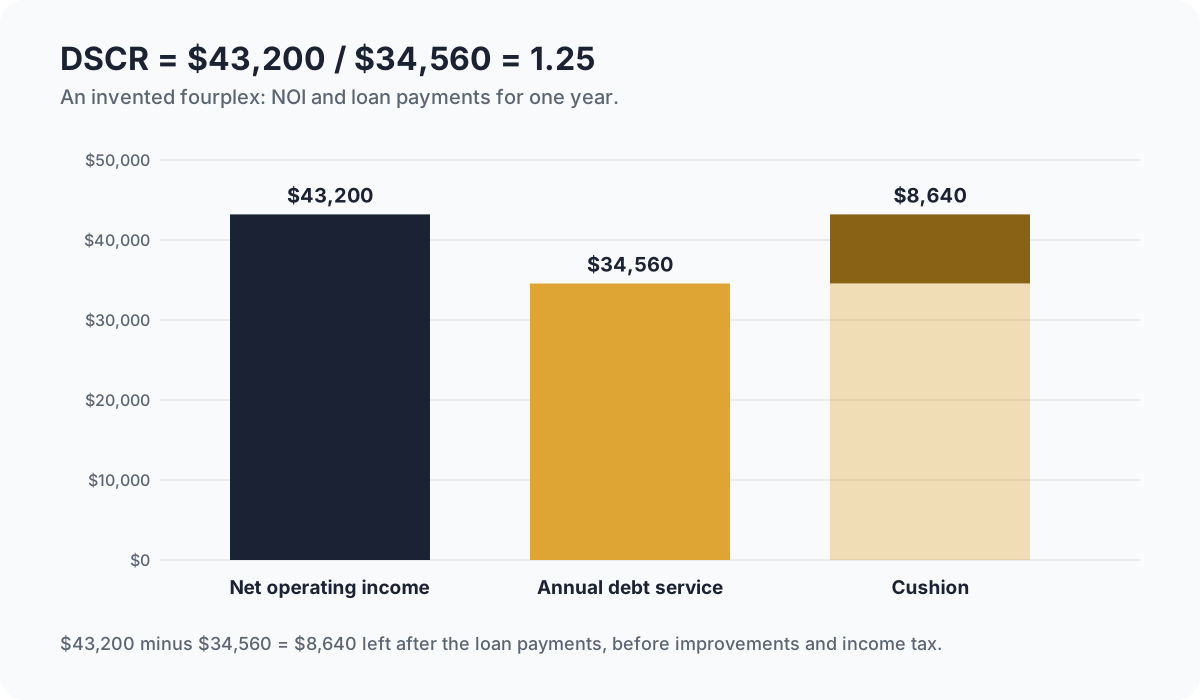
- NOI: $72,000 minus $3,600 minus $25,200 = $43,200
The fourplex has one mortgage with a payment of $2,880 a month in principal and interest:
- Annual debt service: $2,880 x 12 = $34,560
- DSCR: $43,200 / $34,560 = 1.25
The cushion is $43,200 minus $34,560 = $8,640 a year before any other costs the owner pays, such as capital improvements or income tax.
What happens when the numbers move
The ratio responds to both sides. If the property tax bill rises by $2,400, NOI falls to $43,200 minus $2,400 = $40,800, and the DSCR becomes $40,800 / $34,560 = 1.18, rounded. If one unit sits empty for three months, that is $1,500 x 3 = $4,500 of rent lost. Measured against the $3,600 vacancy allowance, NOI falls by $900 to $42,300, and the DSCR becomes $42,300 / $34,560 = 1.22, rounded.
How a lender uses DSCR to size a loan
A lender that requires a minimum DSCR can work backward from the NOI to the largest payment the property supports:
Largest annual debt service = NOI / minimum DSCR
With the fourplex's $43,200 of NOI:
| Lender's minimum DSCR | Largest annual debt service | Largest monthly payment |
|---|---|---|
| 1.20 | $43,200 / 1.20 = $36,000 | $3,000 |
| 1.25 | $43,200 / 1.25 = $34,560 | $2,880 |
| 1.35 | $43,200 / 1.35 = $32,000 | $2,666.67 |
The payment then sets the loan amount, given the lender's interest rate and term, through the loan's amortization schedule. A lender also checks loan-to-value, the loan as a share of the property's value, and lends the smaller of the two results. The loan-to-value calculator shows that side of the test.
Lenders usually want to see where the NOI comes from: a rent roll listing each unit, its tenant, its rent and its lease dates, and a trailing 12-month operating statement. The rent roll guide and the T12 guide cover both.
DSCR loans for real estate investors
A DSCR loan is an investment property mortgage that qualifies the borrower mainly on the property's rental income, with less weight on the borrower's personal income, tax returns or pay stubs. These loans are common for investors who own several properties through a company or whose tax returns show low income after depreciation.
Many DSCR lenders use a simpler version of the ratio for a one-unit rental: the monthly rent divided by the full monthly housing payment, which includes principal, interest, property taxes, insurance and any association dues (often written PITIA).
DSCR (rent-based) = monthly rent / monthly PITIA
For a single-family rental at $2,400 a month with a PITIA payment of $2,000, that is $2,400 / $2,000 = 1.20. Because PITIA already includes taxes and insurance, this version does not subtract operating expenses from the rent. The two methods can give different answers for the same property, so ask which one a lender uses before you compare quotes.
DSCR loans can carry different rates, fees, down payments and prepayment terms from a conventional mortgage. Compare the full cost, and read the loan documents with an attorney or a loan adviser you trust.
DSCR, cash flow and other ratios
- Cash flow is NOI minus debt service, in dollars. DSCR is the same comparison as a ratio. The fourplex's $8,640 cushion is its yearly cash flow before capital improvements and income tax. The rental cash flow calculator works it out month by month.
- Loan-to-value compares the loan with the property's value. DSCR compares the loan payment with the property's income. A lender usually checks both.
- Cap rate compares NOI with the property's price. It says nothing about the loan, while DSCR depends on the loan's rate and term.
Common DSCR mistakes
- Using rent before vacancy. Gross potential rent assumes every unit is full all year. Use the rent you expect to collect.
- Leaving out expenses. Insurance, property taxes, repairs and management come out of NOI even when you do the work yourself. A lender will add them back if you leave them out.
- Counting the mortgage twice. NOI is figured before the mortgage. Do not subtract the loan payment from the income and then divide by it again.
- Mixing months and years. Divide yearly NOI by yearly debt service, or monthly by monthly. Mixing them gives a ratio 12 times too large or too small.
- Comparing two methods. A rent-based DSCR and an NOI-based DSCR for the same property are not directly comparable.
Frequently asked questions
What is DSCR in simple terms?
DSCR is how many times a rental property's income covers its loan payments. It is the yearly net operating income divided by the yearly principal and interest. A DSCR of 1.25 means $1.25 of income for every $1.00 of loan payments.
How do you calculate DSCR?
Work out the property's net operating income for a year, then divide it by the total loan payments for the same year. In the fourplex example, $43,200 / $34,560 = 1.25.
What is a good DSCR for a rental property?
Above 1.00 means the property covers its loan payments from its own income, and a higher number means more cushion. Each lender sets its own minimum for each loan program, so ask the lender what it requires and how it calculates the inputs.
What is a DSCR loan?
A DSCR loan is an investment property mortgage that qualifies mainly on the property's rental income, with less weight on the borrower's personal income. Many of these lenders divide the monthly rent by the monthly principal, interest, taxes, insurance and dues.
Does DSCR include property taxes and insurance?
In the NOI-based ratio, property taxes and insurance are operating expenses, so they come out of NOI and the debt service is principal and interest only. In the rent-based ratio many DSCR lenders use, taxes and insurance are part of the monthly payment. Ask which one your lender uses.
Keep the income and expenses a lender asks for
A DSCR is only as reliable as the income and expense records behind it. In KeyRing, you connect your bank accounts securely through Plaid, and each transaction is matched to a property with suggestions you confirm. Income and expense records use categories you can edit, and you can export your transactions to Excel. See what KeyRing does or how plans are priced.
Free calculators and templates
- DSCR calculatorHow many times NOI covers the loan payments, and the loan a target ratio allows.
- Rental cash flow calculatorMonthly cash flow line by line, per unit, with the break-even rent.
- Loan to value calculatorLTV, combined LTV and equity, with the room left under your lender's limit.
- Rent roll templateEvery unit, lease, rent and balance in a property on one page, as of one date.
Browse all rental property calculators, free templates and the glossary.
From the blog
- What is NOI? Net operating income for rental propertyNOI is a rental property's income after vacancy and operating expenses, before the mortgage. What goes in, what stays out, a duplex example and its uses.
- What is a T12 statement? How to build a trailing 12-month operating statementA T12 shows a rental property's income and expenses for each of the last 12 months and the NOI they add up to. What goes on one, how to build it and an example.
- What is a rent roll (with a free template)A rent roll lists each unit, tenant, lease and rent in a property as of one date. See what it includes, a fourplex example and the numbers you can pull from it.