What is Schedule E? Rental income and expenses, line by line
By Maya Ellison -

Schedule E is the IRS form that individual owners use to report income and loss from rental real estate. If you own a rental property in your own name, or through a single-member LLC that the IRS treats as part of you, Schedule E is where a year of rent, repairs, insurance, interest and depreciation turns into one number on your tax return.
This guide explains who files Schedule E, walks through Part I line by line, works a full year for an invented single-family rental and covers the items people most often put on the wrong line. It is general information and is not tax advice. Line numbers follow recent versions of the form, so check the current year's form and instructions, or ask a tax professional, before you file.
What is Schedule E?
Schedule E (Form 1040), Supplemental Income and Loss, reports several kinds of income that do not come from a job or a business you run. Part I covers rental real estate and royalties, and it is the part most property owners fill in. The later parts cover income passed through to you from partnerships, S corporations, estates and trusts.
Each page of Part I has three columns, A, B and C, one for each property. If you own more than three rentals, you attach more pages and fill in the combined totals on just one of them.
Who files Schedule E
- Individual owners of residential or commercial rental property report it on Schedule E, Part I.
- Single-member LLCs that are disregarded for tax purposes report the same way, because the IRS looks through the LLC to the owner.
- Partners and S corporation shareholders receive a Schedule K-1 from the entity and report their share in Part II. The entity files its own return.
- Owners who provide substantial services to guests, such as regular cleaning or meals, may need to report on Schedule C instead. IRS Publication 527 explains where that line falls.
Schedule E, Part I, line by line
The top of each column describes the property:
- Line 1a: the property's address.
- Line 1b: a type code, such as 1 for a single-family residence, 2 for multi-family, 3 for a vacation or short-term rental and 4 for commercial.
- Line 2: the number of days the property was rented at a fair price and the number of days you or your family used it. Personal use changes how expenses are deducted, which Publication 527 covers in detail.
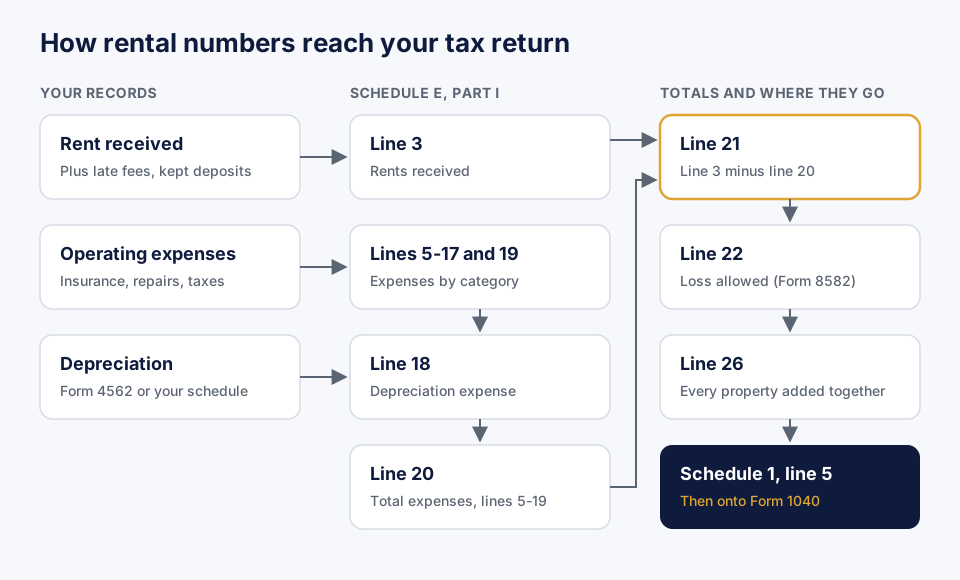
Income comes next. Line 3 is rents received: the rent itself, plus late fees, any part of a security deposit you keep, and bills a tenant pays on your behalf. Line 4 is royalties, which most rentals leave blank.
Expenses take up lines 5 through 19:
| Line | Expense | What usually goes there |
|---|---|---|
| 5 | Advertising | Listing fees, signs, online ads |
| 6 | Auto and travel | Mileage and trips to manage the property |
| 7 | Cleaning and maintenance | Routine upkeep, landscaping, pest control, turnover cleaning |
| 8 | Commissions | Leasing commissions paid to an agent |
| 9 | Insurance | Property and liability premiums |
| 10 | Legal and other professional fees | Tax preparation, attorney and bookkeeping fees for the rental |
| 11 | Management fees | Fees paid to a property manager |
| 12 | Mortgage interest paid to banks | The interest part of each loan payment, usually from Form 1098 |
| 13 | Other interest | Interest on other loans used for the rental |
| 14 | Repairs | Fixes that keep the property in working order |
| 15 | Supplies | Small items used up in running the property |
| 16 | Taxes | Property taxes and other deductible taxes on the rental |
| 17 | Utilities | Utilities you pay as the owner |
| 18 | Depreciation expense or depletion | The year's depreciation, from Form 4562 or your depreciation schedule |
| 19 | Other | Anything else, listed by name, such as HOA dues or software |
The totals follow:
- Line 20: total expenses, lines 5 through 19.
- Line 21: line 3 (plus line 4) minus line 20. A positive number is rental income and a negative number is a loss.
- Line 22: if line 21 is a loss, the part you can deduct this year. Rental losses are usually passive, so Form 8582 may limit them and carry the rest forward.
- Lines 23 to 26: totals across every property. If Part I is the only part of Schedule E you fill in, line 26 carries to Schedule 1 (Form 1040), line 5, and from there onto your Form 1040. If you also have partnership, S corporation, estate or trust income in the later parts, line 26 joins those amounts in the total on page 2 instead.
A worked example: the Cedar Court house
Here is one year on Schedule E for an invented single-family rental, the Cedar Court house, rented all of 2026 for $1,850 a month. The owner bought it some years ago, the building's depreciable basis is $220,000, and the tenant paid one $100 late fee.
| Schedule E line | Amount |
|---|---|
| 3 Rents received ($1,850 x 12 + $100 late fee) | $22,300 |
| 5 Advertising | $120 |
| 7 Cleaning and maintenance | $600 |
| 9 Insurance | $1,400 |
| 10 Legal and other professional fees | $450 |
| 12 Mortgage interest | $8,900 |
| 14 Repairs | $1,250 |
| 15 Supplies | $180 |
| 16 Taxes | $3,300 |
| 18 Depreciation ($220,000 / 27.5 years) | $8,000 |
| 20 Total expenses | $24,200 |
| 21 Income or (loss) | ($1,900) |
The arithmetic, line by line:
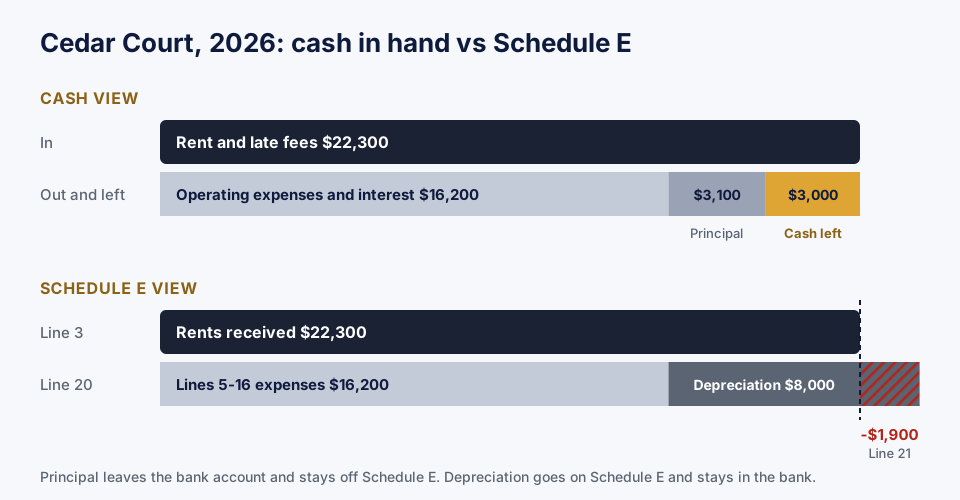
- Line 3: $1,850 x 12 = $22,200 of rent, plus the $100 late fee, is $22,300.
- Cash expenses: $120 + $600 + $1,400 + $450 + $8,900 + $1,250 + $180 + $3,300 = $16,200.
- Depreciation: residential rental buildings are generally depreciated over 27.5 years, so $220,000 / 27.5 = $8,000 for a full year. Land is never depreciated.
- Line 20: $16,200 + $8,000 = $24,200.
- Line 21: $22,300 - $24,200 = -$1,900, a loss.
The same year looks different in the bank. The mortgage payments also included $3,100 of principal, which is a payment on the loan and never an expense on Schedule E. Cash left after every bill and payment: $22,300 - $16,200 - $3,100 = $3,000. Depreciation is the reverse: a deduction on the form with no money leaving the account. That is how a rental can put $3,000 in your pocket and still show a $1,900 loss on line 21.
Whether that $1,900 loss reduces other income this year depends on the passive activity rules and your situation, which is what Form 8582 and line 22 sort out.
To see the operating side of the same numbers, the NOI calculator works out net operating income before interest and depreciation, and the rental cash flow calculator shows the money left after the mortgage. The rental yield calculator puts a year of rent against what the property cost. For line 18, the rental property depreciation calculator works out a year of depreciation, and the depreciation recapture calculator estimates the tax due on it when you sell.
Items that often land on the wrong line
- Mortgage principal. Only the interest goes on line 12. Principal pays down the loan.
- Improvements. A repair keeps the property working and goes on line 14. An improvement, such as a new roof or an added room, is depreciated over time through line 18.
- Security deposits. A deposit you expect to return stays off line 3. The part you keep for unpaid rent or damage becomes income in the year you keep it.
- Rent paid in advance. Rent you receive this year for a later period is generally income in the year you receive it.
- Tenant-paid expenses. If a tenant pays a bill that is yours, such as a repair, the amount counts as rent, and you can deduct the expense on its own line.
- Personal expenses. Costs for your own home, or for days you used the rental yourself, stay out or get split, as Publication 527 describes.
How good records make Schedule E easy
Schedule E is a summary, so it is only as good as the records behind it. Three habits make March much shorter:
- Record every transaction against one property. Three columns on the form means three sets of totals.
- Use categories that match the form's lines. When repairs, supplies and cleaning each have their own category during the year, the totals copy straight across. A chart of accounts for rental property sets those categories up once.
- Keep the paper trail. Leases, receipts, Form 1098 and last year's depreciation schedule are what your tax professional will ask for.
The rent ledger and tenant ledger guide shows how to track charges and payments for each tenant, which is where line 3 comes from, and a rent roll gives you the year's leases on one page.
Frequently asked questions
Do I need to file Schedule E if my rental lost money?
Generally, yes. You report the income and expenses each year whether the result is a profit or a loss, and a loss may be deductible now or carried forward. Your tax professional can confirm what applies to you.
Is mortgage principal deductible on Schedule E?
No. Only the interest goes on line 12. The principal part of each payment reduces the loan balance, so it is left off the form.
Where does depreciation come from?
In the year you place a property in service, you figure it on Form 4562. In later years it usually comes from your depreciation schedule, often kept by your tax professional. Either way, the year's amount goes on line 18. Residential rental buildings are generally depreciated over 27.5 years, starting when the property is placed in service. Land is left out.
Can I put more than one property on Schedule E?
Yes. Each page has columns A, B and C for three properties, and you attach more pages for more properties. The totals on lines 23 to 26 go on just one of those pages.
Where does the Schedule E total go?
When rental real estate is all you report on Schedule E, line 26 carries to Schedule 1 (Form 1040), line 5, which flows into the income on your Form 1040. With partnership, S corporation, estate or trust income too, it goes into the total on page 2 first.
Keep the categories current all year
Schedule E is easier when every transaction already sits on the right property in the right category. KeyRing pulls transactions from your bank feed and matches rent and expenses to each property, with suggestions you confirm, and shows income against expenses for every property. When tax time comes, you can download your data and hand it to your tax professional. See what KeyRing does or how plans are priced. For the form itself and its instructions, see the IRS Schedule E page and Publication 527.
Free calculators and templates
- Rental property calculatorCash flow, cap rate, cash on cash return and ROI for one property, all at once.
- Rental cash flow calculatorMonthly cash flow line by line, per unit, with the break-even rent.
- Rental yield calculatorGross and net yield: a year of rent as a share of the price.
- Rental property ROI calculatorOne year's total return from cash flow, loan paydown and appreciation.
- Cash on cash return calculatorYearly cash flow as a share of the cash you put in.
- NOI calculatorNet operating income and the operating expense ratio for a year.
- Rental property depreciation calculatorYearly and first-year depreciation over 27.5 or 39 years.
- BRRRR calculatorCash in, cash back at the refinance and cash left in a buy, rehab, rent, refinance deal.
- Depreciation recapture calculatorThe tax on the depreciation part of a rental sale, and the capital gain on the rest.