What is a pro forma? Projecting a rental property's numbers

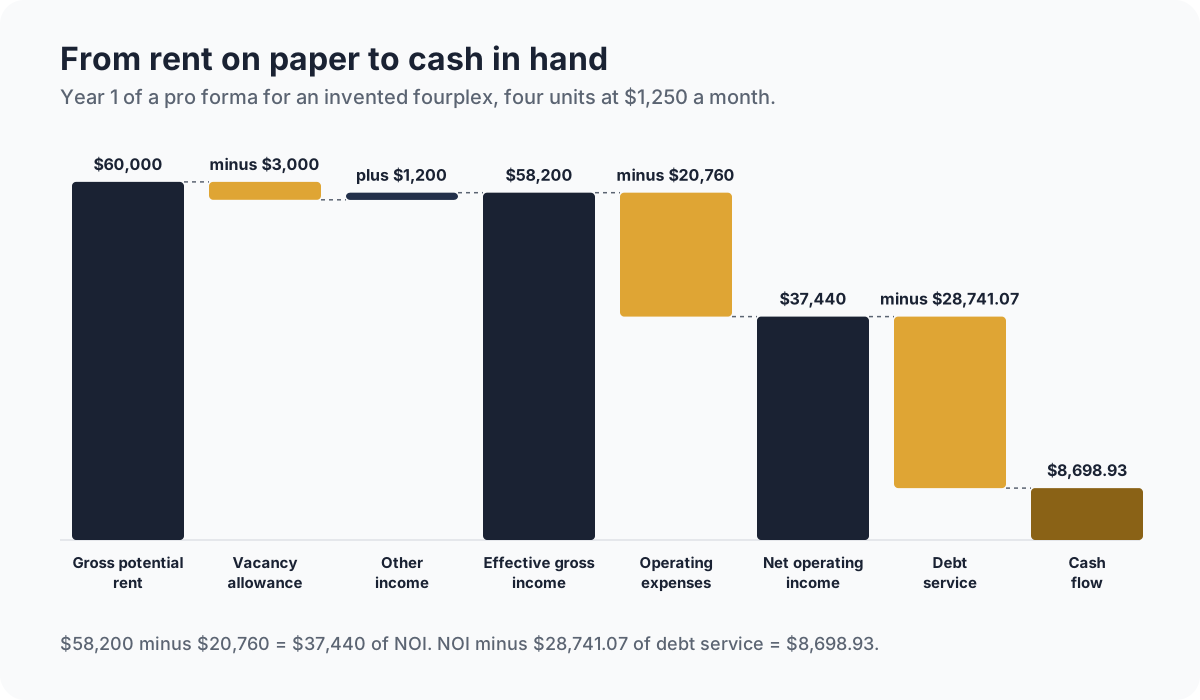
A pro forma is a projected income and expense statement for a rental property. Real estate investors build one before buying to estimate what the property will earn: gross potential rent, minus a vacancy allowance, plus other income, minus operating expenses, gives net operating income (NOI), and NOI minus the mortgage payments gives cash flow. A fourplex with four units at $1,250 a month projects $37,440 of NOI and $8,698.93 of cash flow in its first year.
This page covers what goes into a pro forma, a worked fourplex example for one year, a five-year projection with stated growth assumptions, how a pro forma differs from actual results, and how to check a seller's pro forma against the trailing 12 months. It is general information and is not legal or tax advice. Rules vary by state and city. Check your local law or an attorney.
What is a pro forma?
"Pro forma" is Latin for "as a matter of form". In real estate it means a forecast: the income statement you expect a property to produce, written down before the results exist. Brokers attach one to a listing, lenders ask for one with a loan application, and buyers build their own to decide what a property is worth to them.
A rental pro forma follows the same order as an operating statement:
Cash flow = gross potential rent minus vacancy plus other income minus operating expenses minus debt service
The difference is the source of each number. An operating statement reports what happened. A pro forma reports what you expect, so every line rests on an assumption, and the assumptions are the part worth reading closely.
What goes into a rental pro forma
- Gross potential rent. The rent every unit would bring in if all of them were leased for the full year at the rent you expect to charge. The rent roll template lists current rents unit by unit, which is where this line starts.
- Vacancy and credit loss. An allowance for empty months, turnover and rent that is billed and never collected.
- Other income. Laundry, parking, storage, pet rent and fees.
- Effective gross income. Gross potential rent minus vacancy plus other income.
- Operating expenses. Property taxes, insurance, repairs and maintenance, management, utilities the owner pays and services. The operating expenses entry explains what counts and what stays out.
- Net operating income. Effective gross income minus operating expenses. The NOI guide walks through it line by line.
- Debt service. Twelve months of principal and interest on the loan you plan to take.
- Cash flow. NOI minus debt service: what is left for the owner before income tax.
Most pro formas show year 1 in detail, then project the same lines a few years out using growth rates for rent and expenses.
A worked example: a fourplex, year 1
All the figures here are made up. A real estate investor is looking at a fourplex listed at $480,000. Each of the four units would rent for $1,250 a month, the coin laundry brings in $100 a month, and the investor plans a $360,000 loan, 75 percent of the price, at 7 percent for 30 years.
The income side:
- Gross potential rent: 4 x $1,250 x 12 = $60,000
- Vacancy allowance of 5 percent: $60,000 x 0.05 = $3,000
- Rent collected: $60,000 minus $3,000 = $57,000
- Other income: $100 x 12 = $1,200
- Effective gross income: $57,000 + $1,200 = $58,200
The operating expenses for the year:
| Expense | Amount |
|---|---|
| Property taxes | $6,000 |
| Management, 8 percent of rent collected | $4,560 |
| Repairs and maintenance | $3,600 |
| Water, sewer and trash | $3,000 |
| Insurance | $2,400 |
| Lawn care, snow removal and pest control | $1,200 |
| Total operating expenses | $20,760 |
Management is $57,000 x 0.08 = $4,560.
- NOI: $58,200 minus $20,760 = $37,440
- Debt service: the monthly payment on $360,000 at 7 percent over 30 years is $2,395.09, so a year is $28,741.07
- Cash flow: $37,440 minus $28,741.07 = $8,698.93 a year, or $724.91 a month
Two ratios come straight out of the pro forma. The cap rate at the asking price is $37,440 / $480,000 = 7.80 percent (the cap rate guide explains how buyers use it). The debt service coverage ratio is $37,440 / $28,741.07 = 1.30, the figure a lender compares with its minimum. The DSCR entry covers what lenders look for.
The rental cash flow calculator gives the same $724.91 a month from $5,000 of monthly rent, $100 of other income, 5 percent vacancy, 8 percent management, $1,350 a month of taxes, insurance, maintenance and other expenses and a $2,395.09 mortgage payment.
A five-year projection
A longer pro forma carries the year 1 figures forward with stated growth rates. For the fourplex, the investor assumes:
- Rent and other income grow 3 percent a year, with vacancy held at 5 percent.
- Operating expenses grow 4 percent a year.
- Debt service stays at $28,741.07, since the loan has a fixed rate.
| Year | Effective gross income | Operating expenses | NOI | Cash flow |
|---|---|---|---|---|
| 1 | $58,200.00 | $20,760.00 | $37,440.00 | $8,698.93 |
| 2 | $59,946.00 | $21,590.40 | $38,355.60 | $9,614.53 |
| 3 | $61,744.38 | $22,454.02 | $39,290.36 | $10,549.30 |
| 4 | $63,596.71 | $23,352.18 | $40,244.53 | $11,503.47 |
| 5 | $65,504.61 | $24,286.26 | $41,218.35 | $12,477.28 |
Each year multiplies the year before by 1.03 for income and 1.04 for expenses. Year 2 income is $58,200 x 1.03 = $59,946.00, and year 2 expenses are $20,760 x 1.04 = $21,590.40.
The table is only as good as its growth rates. Expenses growing faster than rent squeeze the margin over time. Many investors run a second version with lower rent growth and higher vacancy to see how much room the deal has.
Pro forma versus actual results
A pro forma is a projection. The actual results of the past year are reported on a trailing 12-month operating statement, often called a T12. The T12 guide shows how one is built from a year of records.
The two answer different questions. The T12 says what the property did under the current owner. The pro forma says what the property could do under you, with your rents, your management and your loan. A buyer's pro forma that differs from the T12 is normal; each difference should have a reason you can explain.
Checking a seller's pro forma against the T12
Sellers often publish a pro forma with the listing, and it tends to show the property at its best. Set it next to the T12 and your own pro forma.
| Line | Seller's pro forma | T12 | Your pro forma |
|---|---|---|---|
| Rent collected | $65,856 | $56,400 | $57,000 |
| Other income | $1,200 | $1,080 | $1,200 |
| Operating expenses | $12,800 | $21,300 | $20,760 |
| NOI | $54,256 | $36,180 | $37,440 |
The seller's figures assume rents of $1,400 a unit (4 x $1,400 x 12 = $67,200), 2 percent vacancy ($1,344), no management fee and the current property tax bill. The seller's NOI is $65,856 + $1,200 minus $12,800 = $54,256. The T12 shows $36,180, a gap of $18,076. At the $480,000 asking price, the seller's NOI implies a cap rate of 11.30 percent and the T12 implies 7.54 percent.
Questions to work through, line by line:
- Rents. Are units already leased at $1,400, or is that a hope? Compare the rent roll and the leases with the asking rents of similar units nearby.
- Vacancy. Does the T12 show months of lost rent? A projection below what the property has achieved needs a reason.
- Management. An owner who manages the property alone leaves this line empty. A buyer who hires a manager, or a lender sizing the loan, will count one.
- Property taxes. Taxes often reset after a sale. Ask the local tax office how the new bill is figured.
- Repairs. A low repair line can mean deferred maintenance. An inspection tells you what the next few years may cost.
Common mistakes
- Using the seller's numbers as your own. Start from the T12 and the rent roll, then change only the lines you can support.
- Leaving out reserves. Roofs, furnaces and water heaters wear out. Many investors set money aside each year below NOI so a large replacement does not wipe out a year of cash flow.
- One growth rate for everything. Rent, taxes and insurance rarely move together. State each assumption on its own line.
- Forgetting the loan terms. A rate one point higher changes debt service, cash flow and the coverage ratio. The rental property calculator lets you test the price, loan and rent together.
Frequently asked questions
What does pro forma mean in real estate?
It means a projected income and expense statement for a property: expected rent, vacancy, other income, operating expenses, NOI, debt service and cash flow, usually for year 1 and a few years after.
What is the difference between a pro forma and a T12?
A T12 reports the actual income and expenses of the last 12 months. A pro forma projects what the property should earn going forward under the buyer's assumptions.
How many years should a rental pro forma cover?
Year 1 in detail is the core. Many investors project five years, or as long as they plan to hold the property, using stated growth rates for income and expenses.
Should a pro forma include the mortgage?
NOI is figured before the mortgage. A full pro forma then subtracts debt service to show cash flow, which is why lenders and buyers both use it.
How do I know if a seller's pro forma is realistic?
Compare each line with the T12, the rent roll and the leases. In the fourplex example, the seller's pro forma showed $54,256 of NOI while the T12 showed $36,180.
Keep the actuals that test your projections
A pro forma is easier to check, and next year's is easier to build, when each property's income and expenses are already recorded. In KeyRing, you connect your bank accounts securely through Plaid, and each transaction is matched to a property with suggestions you confirm. Income and expense records use categories you can edit, and you can export your transactions to Excel. See what KeyRing does or how plans are priced.
Free calculators and templates
- Rental cash flow calculatorMonthly cash flow line by line, per unit, with the break-even rent.
- Rental property calculatorCash flow, cap rate, cash on cash return and ROI for one property, all at once.
- DSCR calculatorHow many times NOI covers the loan payments, and the loan a target ratio allows.
Browse all rental property calculators, free templates and the glossary.
From the blog
- What is a T12 statement? How to build a trailing 12-month operating statementA T12 shows a rental property's income and expenses for each of the last 12 months and the NOI they add up to. What goes on one, how to build it and an example.
- What is NOI? Net operating income for rental propertyNOI is a rental property's income after vacancy and operating expenses, before the mortgage. What goes in, what stays out, a duplex example and its uses.
- What is cap rate? How to calculate it for a rental propertyCap rate is net operating income divided by a property's price or value. How to calculate it, a worked fourplex example and what it leaves out.