What is a cash-on-cash return? A worked example for a small rental portfolio
By Maya Ellison -

Cash-on-cash return is a rental property's yearly pre-tax cash flow divided by the cash you put into it. If you put $60,000 into a rental and it leaves you $4,800 a year after expenses and the mortgage, your cash-on-cash return is 8%. It answers a simple question: what is my own money earning in cash each year?
This guide covers the formula, what counts as cash flow and as cash invested, a worked example for an invented portfolio of three rentals, one by one and combined, how cash-on-cash return differs from cap rate and ROI, and what moves it. It is general information and is not financial or tax advice. For decisions about a loan or your taxes, ask your lender or tax professional.
What is a cash-on-cash return?
Cash-on-cash return measures the cash a property pays you in a year as a share of the cash you paid to get it. The formula is:
Cash-on-cash return = annual pre-tax cash flow / total cash invested
- Annual pre-tax cash flow is the rent you collect in a year, less operating expenses and the mortgage payments. Put another way, it is net operating income less the year's loan payments.
- Total cash invested is the money that came out of your pocket: the down payment, closing costs and any repairs or improvements you paid for up front.
It is a pre-tax figure, so income taxes, depreciation and the loan principal you pay down stay out. The cash on cash return calculator works it out from your own figures for one property.
How to calculate it, step by step
- Add up the cash you put in. Down payment, plus closing costs, plus up-front repairs.
- Work out a month of cash flow. Rent collected, less operating expenses (taxes, insurance, repairs, management, owner-paid utilities), less the mortgage payment.
- Multiply by 12 for the year.
- Divide the year's cash flow by the cash you put in. Multiply by 100 for a percentage.
Use rent you expect to collect, after empty months and unpaid rent, so the result does not assume every unit stays full. The vacancy rate calculator works out a rate from your own vacant days.
A worked example: three rentals and the portfolio
An invented real estate investor owns three rentals. The figures are made up for this example; your own numbers will differ.
- The Maple Street house, a single-family home. $50,000 down, $5,000 of closing costs and $5,000 of repairs. Rent $2,000 a month, operating expenses $700 and a mortgage payment of $900.
- The Oak Avenue duplex, two units at $1,500 each. $80,000 down, $8,000 of closing costs and $12,000 of repairs. Operating expenses $1,100 a month and a mortgage payment of $1,400.
- The Cedar Lane cottage, bought for $140,000 in cash with $4,000 of closing costs and $6,000 of repairs. Rent $1,450 a month and operating expenses $500, with no mortgage.
Each property on its own
| Property | Cash invested | Monthly cash flow | Annual cash flow | Cash-on-cash return |
|---|---|---|---|---|
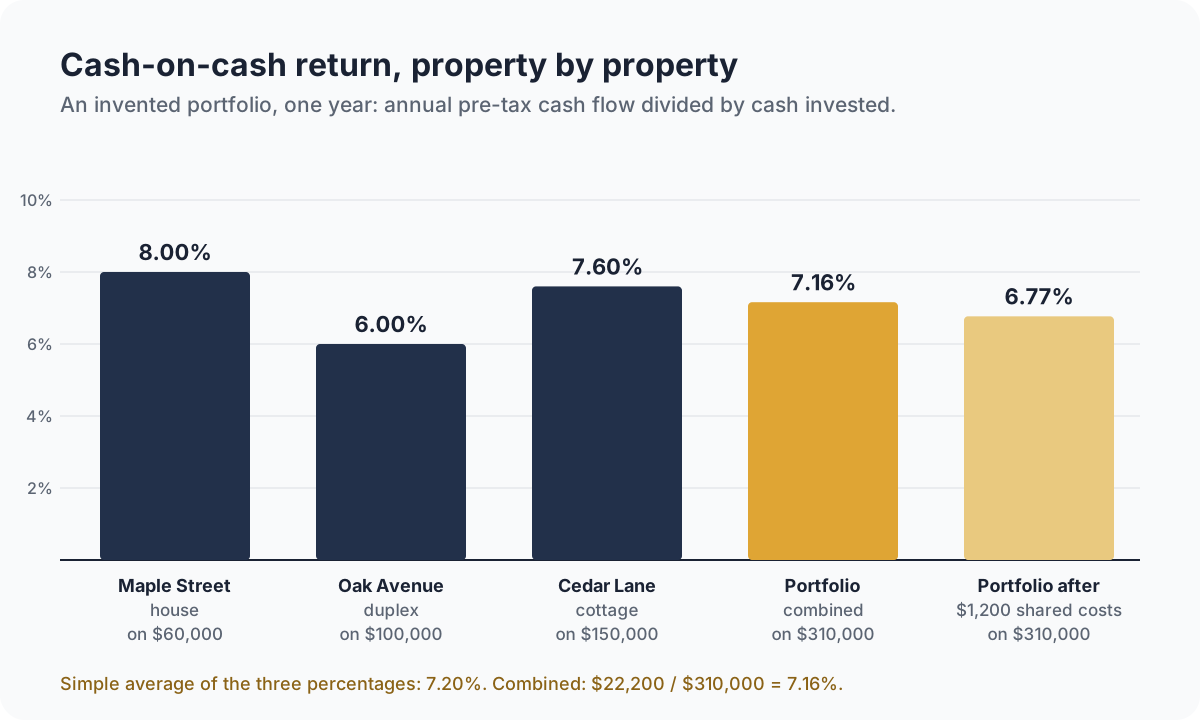
| Maple Street house | $60,000 | $400 | $4,800 | 8.00% |
| Oak Avenue duplex | $100,000 | $500 | $6,000 | 6.00% |
| Cedar Lane cottage | $150,000 | $950 | $11,400 | 7.60% |
| Portfolio | $310,000 | $1,850 | $22,200 | 7.16% |
The steps for each one:
- Maple Street: cash invested is $50,000 + $5,000 + $5,000 = $60,000. Monthly cash flow is $2,000 - $700 - $900 = $400, so $4,800 a year. $4,800 / $60,000 = 8.00%.
- Oak Avenue: cash invested is $80,000 + $8,000 + $12,000 = $100,000. Rent is 2 x $1,500 = $3,000 a month, and $3,000 - $1,100 - $1,400 = $500, so $6,000 a year. $6,000 / $100,000 = 6.00%. Its NOI is ($3,000 - $1,100) x 12 = $22,800, and twelve mortgage payments of $1,400 are $16,800, so the same $6,000 comes out either way.
- Cedar Lane: cash invested is $140,000 + $4,000 + $6,000 = $150,000. Monthly cash flow is $1,450 - $500 = $950, so $11,400 a year. $11,400 / $150,000 = 7.60%.
The portfolio combined
For the whole portfolio, add up the cash flow and the cash invested first, then divide:
- Cash invested: $60,000 + $100,000 + $150,000 = $310,000.
- Annual cash flow: $4,800 + $6,000 + $11,400 = $22,200.
- Combined cash-on-cash return: $22,200 / $310,000 = 7.16%.
Averaging the three percentages gives (8.00% + 6.00% + 7.60%) / 3 = 7.20%, which is a little high. The simple average counts each property the same, while the combined figure weighs each one by the cash in it. The duplex holds the most borrowed money and the cottage the most of the investor's own cash, so the totals give the truer picture.
Costs that belong to the portfolio as a whole count too. If the investor pays $1,200 a year for bookkeeping and tax preparation across all three, the combined cash flow is $22,200 - $1,200 = $21,000 and the return is $21,000 / $310,000 = 6.77%.
Cash-on-cash return vs cap rate vs ROI
| Measure | Formula | What it tells you |
|---|---|---|
| Cash-on-cash return | Annual pre-tax cash flow / cash invested | The yearly cash yield on your own money, after the loan |
| Cap rate | NOI / price or value | What the property earns for what it costs, with no loan |
| ROI | (Cash flow + loan paydown + appreciation) / cash invested | Your total return, including what you cannot spend yet |
Because it subtracts the mortgage, cash-on-cash return moves with your financing. A bigger loan means less of your own cash in the deal, and a bigger payment coming out of the rent, so it can push the return up or down. With no loan at all, as at Cedar Lane, there is no payment to subtract: the return is NOI over the total cash paid, which is the cap rate on the full cost. The Cedar Lane cottage's NOI is $950 x 12 = $11,400, and $11,400 / $150,000 = 7.60%, the same as its cash-on-cash return.
What moves cash-on-cash return
Anything that changes the year's cash flow or the cash you put in changes the return.
- Rent. Raising the Maple Street rent by $100 a month adds $1,200 a year: $6,000 / $60,000 = 10.00%.
- Vacancy. If one Oak Avenue unit sits empty for three months, the duplex loses 3 x $1,500 = $4,500 of rent. Its cash flow falls to $6,000 - $4,500 = $1,500, a return of $1,500 / $100,000 = 1.50%, and the portfolio's falls to ($22,200 - $4,500) / $310,000 = 5.71%.
- Expenses. A higher insurance bill or tax assessment comes straight out of cash flow.
- Financing. A refinance changes the payment and can hand cash back to you, which changes both sides of the formula. In a BRRRR deal, the refinance is set by the after repair value, and the BRRRR calculator shows the cash left in and the return on it.
- Big repairs. A new roof paid in cash is a capital expenditure. Some investors add it to their cash invested, or set aside a reserve from cash flow for it, so the return is not flattered by the years before the roof comes due.
What is a good cash-on-cash return?
There is no single good figure. A return that suits one investor may not suit another, because it depends on the property's risk, how much work it takes, what else your cash could earn and whether you are counting on cash flow now or growth later. Compare each property's return with your own goals and with what the same cash could earn elsewhere, and treat any rule of thumb you hear as a starting point to check against your own numbers.
Common mistakes
- Leaving out vacancy, management or repairs. A year with every unit full and no repairs overstates the return.
- Forgetting part of the cash invested. Closing costs and up-front repairs are cash out of your pocket, as much as the down payment.
- Averaging percentages across a portfolio. Add the cash flows and the cash invested, then divide.
- Treating it as total return. Loan paydown, appreciation and tax effects are left out on purpose. The rental property ROI calculator adds the first two.
- Comparing a year of actual figures with a forecast. Say which one you are using, and use the same kind of figures for every property you compare.
Frequently asked questions
What is cash-on-cash return in simple terms?
It is the cash a rental pays you in a year, after expenses and the mortgage, as a share of the cash you put in. $4,800 a year on $60,000 invested is 8%.
How do I work out cash-on-cash return for several properties?
Add up the year's cash flow from every property, take off any costs shared across them, and divide by the total cash invested in all of them. In the example, $22,200 / $310,000 is 7.16%.
Does cash-on-cash return include the mortgage?
Yes. The mortgage payments come out of cash flow, which is why the return changes with your loan. Cap rate leaves the loan out.
Can cash-on-cash return be negative?
Yes. If the rent does not cover operating expenses and the mortgage, the year's cash flow is negative and so is the return.
Does it include taxes or depreciation?
No. It is a pre-tax measure. How taxes and depreciation affect your return depends on your situation, so ask your tax professional.
Keep each property's cash flow current
A cash-on-cash return is only as good as the income and expense records behind it. KeyRing keeps income and expenses for each property current from your bank feed, across every company you own. You connect your bank accounts securely through Plaid, and each transaction is matched to a property with suggestions you confirm. Income and expense records use categories you can edit, and you can export your transactions to Excel. See what KeyRing does or how plans are priced.
Free calculators and templates
- Rental property ROI calculatorOne year's total return from cash flow, loan paydown and appreciation.
- Cash on cash return calculatorYearly cash flow as a share of the cash you put in.
- BRRRR calculatorCash in, cash back at the refinance and cash left in a buy, rehab, rent, refinance deal.
Browse all rental property calculators and free templates.