What are operating expenses? Running costs of a rental property

Operating expenses are the costs of running a rental property from day to day: property taxes, insurance, repairs and maintenance, utilities the owner pays, management, and services such as landscaping and trash pickup. They are paid out of the rent before any mortgage payment. Rent collected minus operating expenses is the property's net operating income (NOI). A duplex that collects $37,620 in a year and spends $14,549.60 to run has $23,070.40 of NOI.
This page covers what operating expenses are, what counts and what stays out, a worked duplex example, the operating expense ratio, how operating expenses differ from tax deductions and the mistakes that throw the numbers off. It is general information and is not legal or tax advice. Rules vary by state and city. Check your local law or an attorney.
What are operating expenses?
Operating expenses, often shortened to OpEx, are the recurring costs of keeping a rental property open, rentable and in working order. They come up every year in some form, even when the amounts move.
Net operating income = rent and other income collected minus operating expenses
Written out: start with the rent you expect to collect after vacancy, add other income such as laundry or parking, and subtract the operating expenses. The NOI guide covers the income side in detail, and the NOI calculator works it out from your own figures.
What counts as an operating expense
- Property taxes. The yearly tax bill on the property.
- Insurance. The property policy, plus liability or flood coverage if you carry it.
- Repairs and maintenance. Fixing a leak, servicing the furnace, replacing a broken window, painting between tenants.
- Utilities the owner pays. Common in multifamily buildings: water, sewer, trash, common-area electricity and sometimes heat.
- Management. A property manager's fee, often a share of the rent collected, plus leasing fees if they apply.
- Services. Landscaping, snow removal, pest control, cleaning of shared areas.
- Association dues. Condominium or homeowners association fees.
- Administration. Accounting, legal fees for routine matters, advertising for vacant units, licenses and permits, software.
What stays out of operating expenses
- The mortgage. Principal and interest are debt service. They depend on how the property is financed, so NOI leaves them out. Lenders compare NOI with debt service in the debt service coverage ratio.
- Capital expenditures. A new roof, a replacement furnace or a kitchen remodel lasts many years and is usually treated as an improvement. The CapEx guide covers how owners plan for them.
- Depreciation. A tax deduction for the wear on the building over time. It is a real deduction on a tax return with no cash leaving the account that year.
- Income tax. The owner's own tax on the profit.
- Security deposits. Money held for the tenant, and money returned to the tenant, are outside both income and expenses.
A worked example: a duplex
All the figures here are made up. A real estate investor owns a duplex with two units at $1,650 a month each.
- Gross potential rent: 2 x $1,650 x 12 = $39,600 a year
- Vacancy allowance of 5 percent: $39,600 x 0.05 = $1,980
- Rent collected: $39,600 minus $1,980 = $37,620
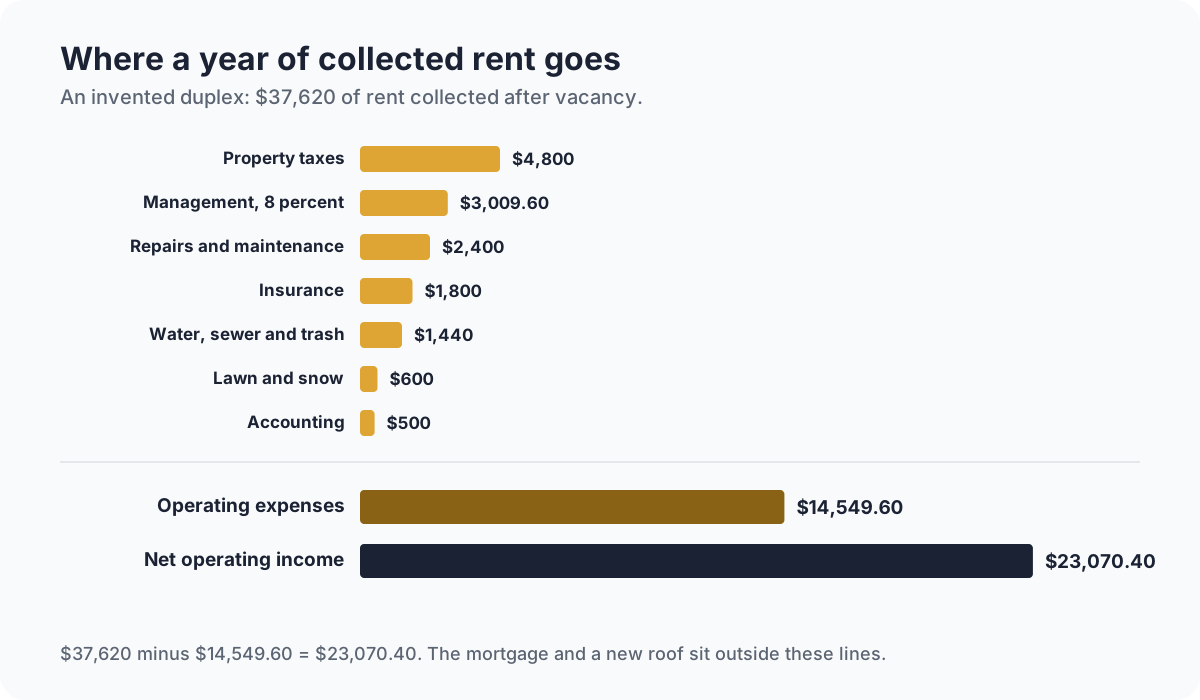
The operating expenses for the year:
| Expense | Amount |
|---|---|
| Property taxes | $4,800 |
| Management, 8 percent of rent collected | $3,009.60 |
| Repairs and maintenance | $2,400 |
| Insurance | $1,800 |
| Water, sewer and trash | $1,440 |
| Lawn care and snow removal | $600 |
| Accounting | $500 |
| Total operating expenses | $14,549.60 |
The management fee is $37,620 x 0.08 = $3,009.60. The NOI is $37,620 minus $14,549.60 = $23,070.40.
What sits below the NOI line
The duplex has a mortgage payment of $1,350 a month in principal and interest, $1,350 x 12 = $16,200 a year. Cash flow before any capital work is $23,070.40 minus $16,200 = $6,870.40. In the same year the owner replaces the roof for $9,000. The roof is a capital expenditure, so it stays out of the $14,549.60 of operating expenses, and the owner pays it from savings or reserves. The rental cash flow calculator runs the same steps month by month.
The operating expense ratio
The operating expense ratio (OER) shows how much of the rent collected goes to running the property:
Operating expense ratio = operating expenses / rent and other income collected
For the duplex, $14,549.60 / $37,620 = 38.68 percent. The rest, 61.32 percent, is NOI.
The ratio is most useful for comparing a property with itself over time, or with similar properties in the same market. Older buildings, buildings where the owner pays utilities and buildings in areas with high property taxes tend to run higher ratios. A ratio that jumps from one year to the next is a sign to look at which line moved.
Operating expenses and taxes
Most operating expenses of a rental are deductible against rental income in the year you pay them, and in the United States they are reported on Schedule E. The Schedule E guide walks through the form. The tax list and the NOI list overlap without matching:
- Mortgage interest is left out of NOI and is usually deductible on Schedule E.
- Depreciation is left out of NOI and is usually deductible on Schedule E.
- Mortgage principal is left out of both.
- Improvements are left out of operating expenses and are usually depreciated over several years.
The line between a repair and an improvement follows tax rules, and the answer can change the year you deduct a cost. Ask a tax professional where a large cost belongs.
Fixed and variable expenses
Some operating expenses change little from month to month, such as property taxes, insurance and association dues. Others move with the property's use and condition: repairs, utilities, turnover cleaning and management fees tied to rent. A forecast that sets the variable lines from a single good year usually comes in low. Use several years of records where you have them, and the vacancy rate calculator helps set the vacancy line.
Who pays each cost also depends on the lease. Under a gross lease the owner pays most operating expenses. Under a triple net lease the tenant pays a share of taxes, insurance and maintenance on top of rent.
Common mistakes
- Leaving out your own time. If you manage the property yourself, a buyer or lender will still count a management cost. Include one when you compare deals.
- Counting the mortgage. NOI is figured before debt service. Subtracting the payment from NOI and then again in a cash flow figure counts it twice.
- Calling a new roof a repair. Large replacements belong in capital expenditures. Putting them in one year's operating expenses makes that year look poor and the others look better than they are.
- Using last year's taxes on a new purchase. Property taxes often reset after a sale. Ask the local tax office how the bill is figured.
- Mixing personal and property costs. A separate account for each property, and a clear set of categories, keep the expense lines clean. The chart of accounts guide shows a simple set, and the rental property expense spreadsheet and the rental property profit and loss template lay them out by month.
Frequently asked questions
What are operating expenses in simple terms?
They are what it costs to keep a rental running each year: property taxes, insurance, repairs, utilities the owner pays, management and similar costs. They come out of the rent before the mortgage.
Is a mortgage payment an operating expense?
No. Principal and interest are debt service, which is left out of operating expenses and net operating income. Mortgage interest is usually deductible for tax purposes, which is a separate list.
Are repairs operating expenses?
Routine repairs and maintenance are operating expenses. Larger work that adds value, extends the property's life or adapts it to a new use is usually a capital expenditure. Tax rules decide the line, so ask a tax professional about large costs.
What is a good operating expense ratio for a rental?
There is no single right figure. It depends on the property's age, its size, who pays utilities and local tax rates. Compare a property's ratio with its own history and with similar properties nearby.
How do operating expenses affect NOI?
Every dollar of operating expense lowers NOI by one dollar. In the duplex example, $37,620 of rent collected minus $14,549.60 of operating expenses leaves $23,070.40 of NOI.
Keep every expense on the right property
Operating expenses are easier to total when each one is already filed under its property. In KeyRing, you connect your bank accounts securely through Plaid, and each transaction is matched to a property with suggestions you confirm. Income and expense records use categories you can edit, and you can export your transactions to Excel. See what KeyRing does or how plans are priced.
Free calculators and templates
- NOI calculatorNet operating income and the operating expense ratio for a year.
- Rental cash flow calculatorMonthly cash flow line by line, per unit, with the break-even rent.
- Vacancy rate calculatorThe share of the time units sat empty, and the rent it cost.
- Rental property expense spreadsheetEvery bill for a property, one row each, sorted into categories that match Schedule E.
- Rental property profit and loss statement templateIncome, expenses, NOI and net income for one property, quarter by quarter and for the year.
Browse all rental property calculators, free templates and the glossary.
From the blog
- What is NOI? Net operating income for rental propertyNOI is a rental property's income after vacancy and operating expenses, before the mortgage. What goes in, what stays out, a duplex example and its uses.
- What is CapEx? Capital expenditures vs repairs on a rentalCapEx is money spent on a rental that lasts for years, such as a new roof. How it differs from a repair, how it is taxed and how to budget a CapEx reserve.
- Chart of accounts for rental property (with a free template)What a chart of accounts is, how to set one up for rental property with Schedule E in mind, a worked duplex example and a free CSV template.