What is cap rate? How to calculate it for a rental property
By Jenna Whitfield -

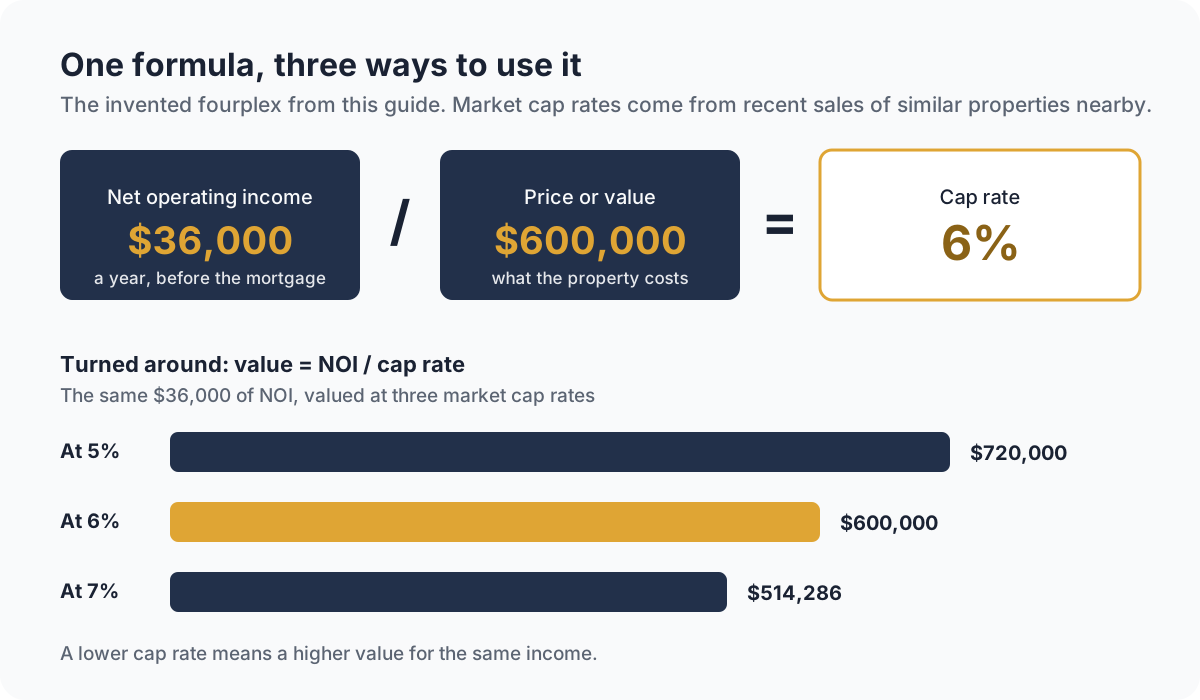
Cap rate, short for capitalization rate, is a rental property's yearly net operating income divided by its price or value. A property that earns $36,000 a year after operating expenses and sells for $600,000 has a cap rate of 6%. It is the quickest way to compare what different properties earn for what they cost, before any loan comes into it.
This guide covers what cap rate is, how to calculate it step by step, a worked example for an invented fourplex, how it compares with other rental measures and the mistakes that throw it off. It is general information and is not investment advice.
What is cap rate?
Cap rate measures a property's income as a share of its value. It answers one question: if you paid cash for this property, what share of the price would come back to you each year from operations?
The formula is:
Cap rate = net operating income (NOI) / property price or value
Net operating income is the rent you collect after vacancy, plus other income such as laundry or parking, less the costs of running the property: property taxes, insurance, repairs, management, owner-paid utilities and similar. Mortgage payments, depreciation, income taxes and big capital projects stay out of NOI. Leaving financing out is the point: two buyers with very different loans see the same cap rate on the same building.
How to calculate cap rate
- Start with the gross potential rent: every unit's rent for 12 months, as if no unit were ever empty.
- Subtract vacancy and credit loss, the rent you expect to lose to empty months and unpaid rent, and add other income. The result is effective gross income.
- Subtract operating expenses for the same 12 months. What is left is NOI. The NOI calculator works it out from your figures.
- Divide NOI by the price, or by the current market value for a property you already own. The cap rate calculator does steps 2 to 4 in one go.
Use 12 months of actual figures where you can. A seller's T12 statement gives the last 12 months of income and expenses; see what a T12 statement is for how to read one.
A worked example: an invented fourplex
A fourplex is listed at $600,000. Each of the four units rents for $1,250 a month, and you plan for 5% vacancy.
| Line | Per year |
|---|---|
| Gross potential rent (4 x $1,250 x 12) | $60,000 |
| Vacancy and credit loss (5%) | -$3,000 |
| Effective gross income | $57,000 |
| Property taxes | $6,000 |
| Insurance | $2,400 |
| Repairs and maintenance | $4,200 |
| Property management (8% of collected rent) | $4,560 |
| Owner-paid utilities | $3,000 |
| Administrative and other | $840 |
| Total operating expenses | $21,000 |
| Net operating income | $36,000 |
The cap rate is $36,000 / $600,000 = 6.0%.
Using cap rate to estimate value
Turn the formula around and it estimates a price: value = NOI / cap rate. If similar fourplexes nearby have recently sold at cap rates around 6.5%, the same $36,000 of NOI points to a value of about $36,000 / 6.5% = $553,846, which is under the $600,000 asking price.
The same arithmetic shows why NOI matters so much to value. At a 6% cap rate, every extra $1,200 a year of NOI, such as $25 a month more rent on each of the four units, adds about $1,200 / 6% = $20,000 of value. Cutting operating expenses by the same amount has the same effect.
Market cap rates come from recent sales of similar properties in the same area. An appraiser, a broker or a local sales report can give you a range for your property type.
What is a good cap rate?
There is no single good cap rate. It depends on the city and neighborhood, the property type, its age and condition, how stable the tenants are and where interest rates stand.
A higher cap rate means more income for each dollar of price. It often comes with more risk, such as an older building, a weaker local job market or more turnover. A lower cap rate usually means buyers expect steadier income or rising rents and values. The useful comparison is with recent sales of similar properties near the one you are looking at.
Cap rate vs other rental measures
| Measure | Formula | What it tells you |
|---|---|---|
| Cap rate | NOI / price | Income after operating expenses, as a share of the price, with no loan |
| Gross rent multiplier | Price / gross annual rent | How many years of gross rent the price equals, before any expenses |
| Rental yield | Annual rent / price (gross), or NOI / total cost (net) | Rent as a share of the price; the net version is close to a cap rate that includes purchase costs |
| Cash on cash return | Cash flow after the mortgage / cash invested | What your own cash earns once the loan is paid |
In the fourplex example, the gross rent multiplier is $600,000 / $60,000 = 10.0 and the gross yield is $60,000 / $600,000 = 10%. Both look better than the 6% cap rate because they ignore expenses, which is why cap rate is the more common yardstick for comparing deals.
Common cap rate mistakes
- Including the mortgage. Loan payments belong in cash flow and cash on cash return. Taking them out of NOI makes the cap rate depend on the buyer's loan.
- Using gross rent. A cap rate built on rent before expenses is really a gross yield, and it overstates what the property earns.
- Trusting pro forma numbers. A listing's projected rents and expenses are a forecast. Ask for the last 12 months of actual income and expenses and a current rent roll.
- Leaving out management or vacancy. Even if you manage the property yourself, include a management cost and a vacancy allowance so the cap rate compares fairly with other properties.
- Comparing across markets or property types. A 6% cap rate on a downtown fourplex and a 6% cap rate on a rural single-family home describe very different properties.
Frequently asked questions
What is cap rate in simple terms?
It is the yearly income a property earns after operating expenses, as a percentage of its price. A $600,000 property with $36,000 of net operating income has a 6% cap rate.
Does cap rate include the mortgage?
No. Cap rate uses net operating income, which is before loan payments. That keeps it the same whoever buys the property and however they finance it. To see the return on your own cash after the mortgage, use cash on cash return.
Is a higher cap rate better?
A higher cap rate means more income for each dollar of price, but it often comes with more risk, such as an older building or a less stable area. Compare a property's cap rate with recent sales of similar properties nearby.
How do I find the cap rate for a property I already own?
Divide the last 12 months of net operating income by what the property would sell for today. Using today's value shows how the property performs now, while the purchase price shows the return on what you paid.
What is the difference between cap rate and ROI?
Cap rate looks at one year of operating income against the price, with no loan. ROI usually measures your total return over the time you own the property, including loan paydown, appreciation and the costs of buying and selling.
Start from your real numbers
A cap rate is only as good as the income and expenses behind it. In KeyRing, you connect your bank accounts securely through Plaid, and each transaction is matched to a property with suggestions you confirm. Income and expense records use categories you can edit, and you can export your transactions to Excel. See what KeyRing does or how plans are priced.
Free calculators and templates
- Cap rate calculatorNet operating income as a share of the property's value.
- Rental yield calculatorGross and net yield: a year of rent as a share of the price.
- NOI calculatorNet operating income and the operating expense ratio for a year.
- Gross rent multiplier calculatorPrice over a year of gross rent, and the price your target GRM supports.
Browse all rental property calculators and free templates.