What is CapEx? Capital expenditures vs repairs on a rental
By Maya Ellison -

CapEx, short for capital expenditures, is money you spend on a rental property that lasts for years: a new roof, a furnace, a water heater, new flooring or an added bathroom. A repair keeps the property working as it is. A capital expenditure replaces a major part, makes the property better or adapts it to a new use.
The difference matters twice. For taxes, a repair is usually deducted in the year you pay it, while a capital expenditure is usually depreciated over several years. For planning, CapEx is the big, uneven spending that a monthly budget can miss until the roof starts leaking. This guide covers both, with a worked example for an invented duplex. It is general information and is not tax advice. Ask a tax professional how the rules apply to your own property before you file.
What is CapEx?
A capital expenditure is a cost that buys or improves something with a useful life of more than a year. On a rental, that usually means the building's major parts and systems:
- The structure and outside: the roof, siding, windows, doors, decks, fences and driveways.
- Building systems: heating and air conditioning, plumbing, the water heater and electrical wiring.
- Inside the units: flooring, wall-to-wall carpet, a kitchen remodel and appliances.
- Additions: a new bedroom, bathroom, garage or patio.
IRS Publication 527, which covers residential rental property, lists examples like these as improvements, including a new roof, central air conditioning, a water heater, wall-to-wall carpeting and kitchen modernization.
The opposite is operating spending: the repairs, cleaning, insurance, utilities and property taxes that keep the property running from month to month. Those costs go into net operating income. CapEx sits below it.
CapEx vs repairs
Publication 527 says you must capitalize an expense if it results in a betterment to your property, restores it, or adapts it to a new or different use:
- Betterment: fixing a defect that existed before you bought the property, enlarging it, or increasing its capacity, strength or quality.
- Restoration: replacing a substantial structural part, or bringing back a part that had worn out and stopped working.
- Adaptation: changing how the property is used, such as turning a garage into a rentable unit.
Anything that does none of these, and simply keeps the property in good working order, is usually a repair. Here is how common jobs tend to sort out:
| Job | Usually | Why |
|---|---|---|
| Replacing a few shingles after a storm | Repair | Fixes a small part of the roof |
| Replacing the whole roof | CapEx | Replaces a major part of the building |
| Fixing a leaking faucet | Repair | Keeps the plumbing working |
| Installing a new water heater | CapEx | A new part of the plumbing system |
| Repainting a unit between tenants | Repair | Routine upkeep |
| Replacing all the carpet in a unit | CapEx | New flooring with a useful life of years |
| Patching drywall | Repair | Fixes a small area |
| Adding a deck | CapEx | Enlarges the property |
The size of the job is what usually decides it. Swapping one broken window is a repair; replacing every window in the building is an improvement. When one project mixes the two, such as fixing a leak while re-roofing, the whole project is often treated as an improvement, so keep the invoices separate where you can. The normal wear and tear guide covers the related question of what a tenant pays for.
How CapEx is taxed
A repair is a deductible expense on Schedule E, line 14, in the year you pay it. A capital expenditure is added to the property's basis and depreciated, so you deduct a share of it each year through line 18.
Publication 527 sets how long each kind of improvement takes to depreciate under the general system:
- Improvements to the building, such as a new roof or furnace, use the same period as the building itself: 27.5 years for residential rental property.
- Appliances, carpets and furniture used in a rental are 5-year property.
- Fences and shrubbery are 15-year property.
The IRS also offers three elections that let some smaller costs be deducted at once. Its guidance on the tangible property regulations explains each one:
- De minimis safe harbor: an owner without audited financial statements can elect to deduct items costing up to $2,500 per invoice or item.
- Safe harbor for small taxpayers: for an owner with average annual gross receipts of $10 million or less and a building with an unadjusted basis of $1 million or less, the year's repairs, maintenance and improvements on that building can be deducted if they total no more than the lesser of 2% of its unadjusted basis or $10,000.
- Routine maintenance safe harbor: recurring work you expect to do more than once in the 10 years after the building is placed in service can be deducted, even when it looks like a replacement.
Each election has conditions and is made on your tax return, so check with your tax professional before you rely on one. When you sell, the depreciation you took on improvements can be taxed again as depreciation recapture, which the depreciation recapture calculator estimates.
A worked example: a new roof on the Birch Lane duplex
The Birch Lane duplex is the invented property from our chart of accounts guide. Its building cost $250,000, it brought in $41,355 of income in 2025, and it had $28,325 of net operating income and $6,825 of cash flow after the mortgage.
Say the owner replaces the whole roof for $15,000 the next year, on top of $2,860 of ordinary repairs:
- Repair or CapEx? A full roof replaces a major part of the building, so it is a capital expenditure.
- Can a safe harbor cover it? The roof is over the $2,500 de minimis limit. The small taxpayer limit is the lesser of 2% x $250,000 = $5,000 or $10,000, so $5,000, and the year's $15,000 + $2,860 = $17,860 is over it.
- How is it deducted? It is depreciated with the building over 27.5 years: $15,000 / 27.5 = $545.45 for each full year, starting when the new roof is placed in service. The first year is smaller, because depreciation starts mid-month.
- What happens to NOI and cash flow? NOI does not change, because CapEx sits below it. The year's cash flow takes the full $15,000 the month the roofer is paid.
The rental property depreciation calculator works out the schedule for the building and any improvement you add to it.
How to budget for CapEx with a reserve
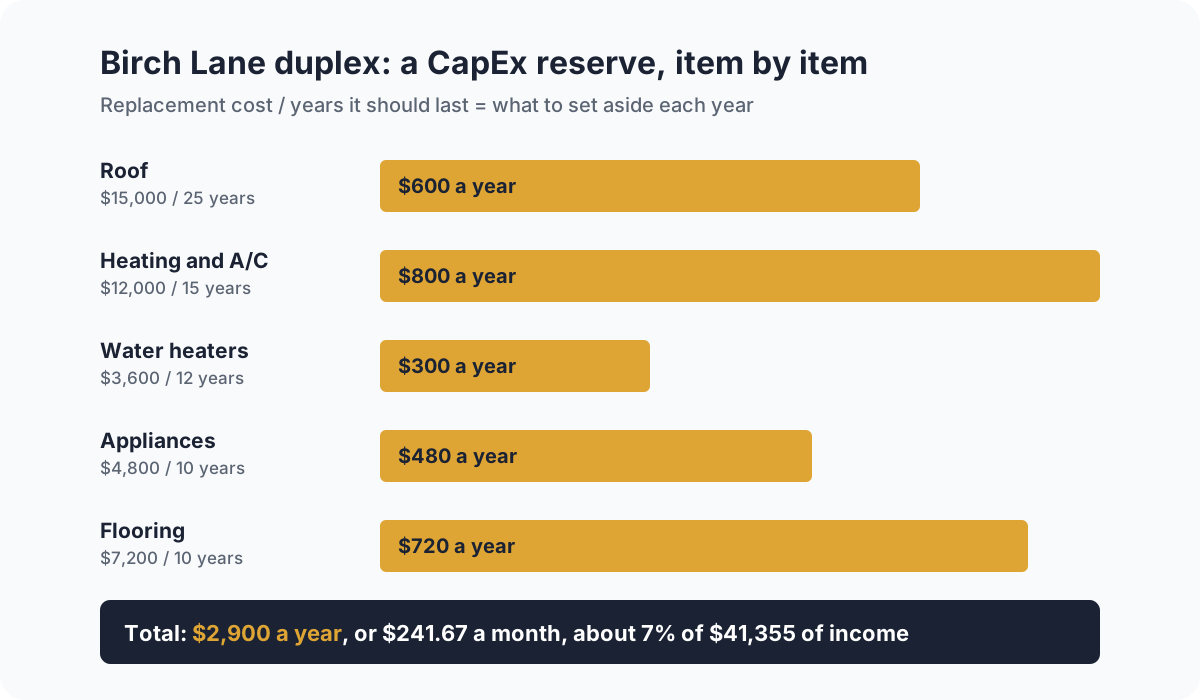
Because CapEx arrives in large, uneven amounts, many owners set money aside every month in a CapEx reserve. A simple way to size one is item by item: take each major part's replacement cost and divide it by the years you expect it to last.
For the Birch Lane duplex, with costs and lifespans assumed for this example:
| Item | Replacement cost | Expected life | Per year |
|---|---|---|---|
| Roof | $15,000 | 25 years | $600 |
| Heating and air conditioning (two units) | $12,000 | 15 years | $800 |
| Water heaters (two) | $3,600 | 12 years | $300 |
| Appliances (two kitchens) | $4,800 | 10 years | $480 |
| Flooring (two units) | $7,200 | 10 years | $720 |
| Total | $42,600 | $2,900 |
That is $2,900 / 12 = $241.67 a month, or about 7% of the duplex's $41,355 of yearly income. Set aside, it would bring the year's $6,825 of cash flow down to $6,825 - $2,900 = $3,925.
Real lifespans depend on the climate, the quality of the original work and how hard the tenants use the property, so adjust the table to what you know about your own building. An older roof or furnace near the end of its life calls for a bigger reserve now. When you analyze a purchase, subtract the reserve from cash flow in the rental cash flow calculator so the deal still works after the big items come due.
How to track CapEx through the year
- Give capital work its own category. Keep improvements apart from repairs in your books. In a chart of accounts, they belong in the buildings and improvements asset account, outside the repairs expense account.
- Log every job with its date and invoice. The rental property expense spreadsheet has a row per expense with its category and Schedule E line, and a note column for what the work was.
- Keep a record of each request. A maintenance request form gives every job a date, a description and a cost, which helps show later whether it was a repair or a replacement.
- Note when each improvement went into service. Depreciation starts from that date, and you need the cost and the date again when you sell.
- Keep a list of the major systems with their install dates, so you can see which ones are close to the end of their life.
Frequently asked questions
What does CapEx mean in real estate?
CapEx means capital expenditures: money spent on a property that lasts for more than a year, such as a new roof, a heating system or new flooring. It is separate from the repairs and running costs that keep the property working from month to month.
Is a new water heater a repair or a capital expenditure?
Usually a capital expenditure. IRS Publication 527 lists a water heater among its examples of improvements. Depending on the cost and your situation, a safe harbor election may let you deduct it in the year you buy it, so ask your tax professional.
Is CapEx included in NOI?
No. Net operating income is income minus operating expenses, and capital expenditures sit below it, along with mortgage payments. Investors often subtract a CapEx reserve after NOI to see the cash a property really produces.
How much should I set aside for CapEx?
It depends on the building's age, its systems and your local costs. A reliable way to size it is item by item: replacement cost divided by expected life for each major part, added together. In the Birch Lane example, that came to $241.67 a month, about 7% of income.
Can I deduct capital expenditures on my taxes?
Over time, through depreciation. Building improvements are usually depreciated over 27.5 years and appliances and carpets over 5 years. Some smaller costs can be deducted in the year you pay them under the IRS safe harbor elections.
Know what every system will cost you next
CapEx is easier to plan for when every job and every major system sits with its property. In KeyRing, you connect your bank through Plaid and KeyRing learns from each transaction you confirm, suggesting where the rest belong, so improvements and repairs land in their own categories. You can record each system and appliance with its install date, last service, service interval and warranty expiry, and vendors send their estimates and bills from their own login, attached to the job they belong to. When it is time to file, export your income and expenses to Excel for your tax professional. See what KeyRing does or how plans are priced. For the IRS rules themselves, see Publication 527.
Free calculators and templates
- Rental property depreciation calculatorYearly and first-year depreciation over 27.5 or 39 years.
- Rental property tax calculatorNet rental income for the year, the tax on it and what depreciation saves.
- Airbnb calculatorA short-term rental's yearly revenue, costs, cash flow and break-even occupancy.
- Cost segregation calculatorFirst-year depreciation with and without a cost segregation study, and the tax put off.
- Maintenance request formA form tenants fill in to report repairs, and a log to track each one.
- Rental property expense spreadsheetEvery bill for a property, one row each, sorted into categories that match Schedule E.
Browse all rental property calculators and free templates.