What is a T12 statement? How to build a trailing 12-month operating statement
By Maya Ellison -

A T12 statement, short for trailing 12 months, is a rental property's operating statement for the last 12 full months: income and expenses month by month, with a total for the year and the net operating income (NOI) they add up to. "Trailing" means the 12 months end with the most recent month you have closed, so a T12 run in October covers October of last year through September of this one.
Lenders ask for a T12 when you refinance or finance a purchase, buyers ask for one during due diligence, and it is the quickest way for you to see how a property actually performed over a full year. This guide covers what goes on a T12, how it differs from a rent roll, a pro forma and your tax return, how to build one step by step, a worked example for an invented fourplex and how to read the numbers.
What a T12 shows
A T12 has one column for each of the 12 months and a total column, and its rows follow the order of an operating statement:
- Gross potential rent. What every unit would bring in at its lease rent if all of them were occupied and paid the whole year.
- Vacancy, credit loss and concessions. Rent lost to empty units, to tenants who did not pay and to discounts such as a free month. The rent concession guide covers how to record those.
- Other income. Laundry, parking, pet rent, late fees and similar.
- Effective gross income. Gross potential rent, less the losses, plus other income: the money the property actually brought in.
- Operating expenses. Property taxes, insurance, repairs and maintenance, owner-paid utilities, management, landscaping and snow removal, and administrative costs.
- Net operating income. Effective gross income less operating expenses.
Mortgage payments, depreciation and capital improvements such as a new roof stay below the NOI line. Many T12s show debt service and capital spending underneath, so a reader can see cash flow too, while the NOI itself leaves them out. That keeps NOI comparable between owners who borrowed differently, and it is the figure behind a cap rate.
T12 vs rent roll, pro forma and tax return
- Rent roll. A rent roll is a snapshot of every unit, lease and balance on one date. A T12 is a year of results. Lenders and buyers usually ask for both, and check that the rent on the T12 lines up with the leases on the rent roll.
- Pro forma. A pro forma projects what the property could earn, often at market rents with full occupancy. A T12 reports what it did earn. When the two differ, the T12 is the one a lender underwrites.
- Annual profit and loss statement. A calendar-year P&L covers January to December. A T12 is the same kind of statement for the latest 12 months, whenever you run it.
- Schedule E. Your tax return reports the property's income and expenses on Schedule E, with depreciation and mortgage interest as expenses. A T12 leaves both out of NOI, so the two rarely show the same bottom line.
How to build a T12, step by step
- Pick the 12 months. End with the most recent month you have fully closed, with every deposit and bill for it recorded.
- Gather the records. Bank statements for the property's accounts, your rent ledger, bills and receipts, and the property tax and insurance statements.
- Use the same categories every month. A chart of accounts for rental property gives you a set of income and expense categories to sort every transaction into, so the rows of the T12 stay consistent.
- Fill in one column per month. Record income in the month it was earned and expenses in the month they belong to. For a bill paid once or twice a year, such as property taxes or insurance, either spread it evenly across the months it covers or show it when paid and say which you did.
- Total each row and work down to NOI. Effective gross income less operating expenses is the NOI. The NOI calculator checks the annual figure.
- Check it against the bank. Rent on the T12 should match the deposits in the bank, and the occupied units should match your rent roll for the same months.
- Note anything unusual. A vacancy, a large repair or a one-time fee is easier to explain in a note than in a conversation with a lender.
A worked T12 for an invented fourplex
An invented fourplex has four units at $1,400 a month. One unit sat empty for March between tenants, and getting it ready cost $2,050 of paint, cleaning and repairs that month. Every other month looked the same. The T12 runs from October 2025 to September 2026:
| Line | Each other month | March | T12 total |
|---|---|---|---|
| Gross potential rent (4 units x $1,400) | $5,600 | $5,600 | $67,200 |
| Vacancy | $0 | -$1,400 | -$1,400 |
| Laundry and other income | $40 | $40 | $480 |
| Effective gross income | $5,640 | $4,240 | $66,280 |
| Property taxes | $600 | $600 | $7,200 |
| Insurance | $250 | $250 | $3,000 |
| Repairs and maintenance | $250 | $2,050 | $4,800 |
| Owner-paid utilities | $300 | $300 | $3,600 |
| Landscaping and snow removal | $100 | $100 | $1,200 |
| Administrative and other | $50 | $50 | $600 |
| Total operating expenses | $1,550 | $3,350 | $20,400 |
| Net operating income | $4,090 | $890 | $45,880 |
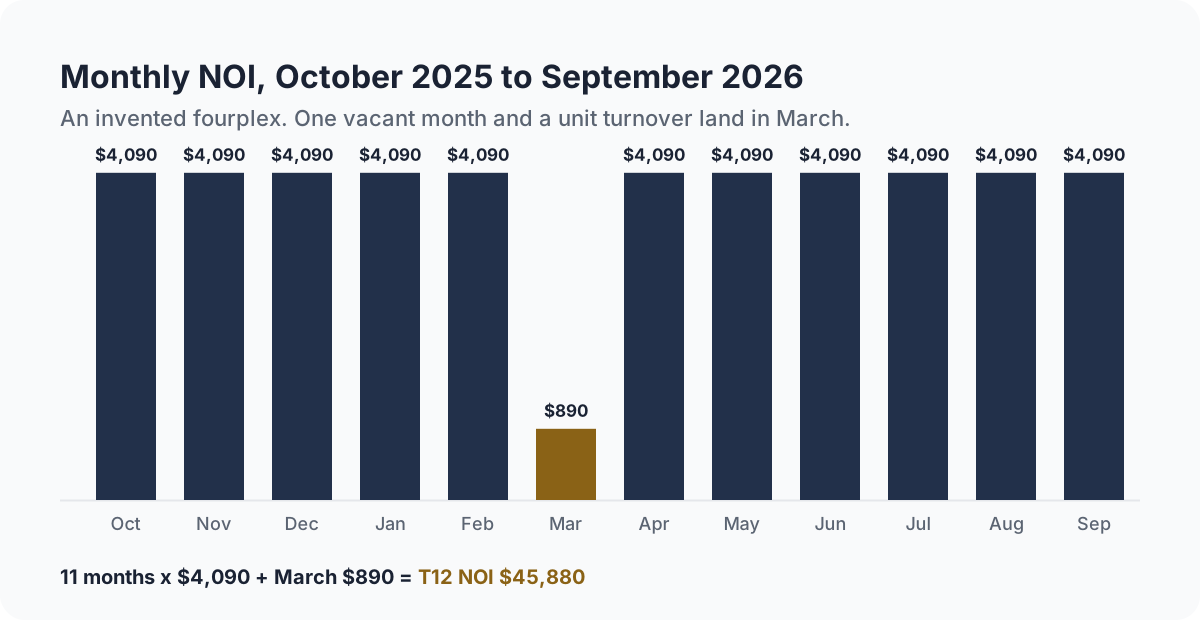
The arithmetic: gross potential rent is 4 x $1,400 x 12 = $67,200. Less $1,400 of vacancy and plus $480 of laundry income, effective gross income is $66,280. Operating expenses come to 11 x $1,550 + $3,350 = $20,400, so NOI is $66,280 - $20,400 = $45,880, the same as 11 x $4,090 + $890.
Three figures a lender or buyer works out from it:
- Expense ratio. $20,400 / $66,280 = about 31% of effective gross income goes to operating expenses.
- Cap rate. At a price of $620,000, $45,880 / $620,000 = 7.4%. The cap rate calculator runs it for any price.
- Debt service coverage. With a $2,100 monthly mortgage payment, $25,200 a year, the DSCR is $45,880 / $25,200 = 1.82. The DSCR calculator shows what a lender sees.
Below the NOI line, the $25,200 of mortgage payments leaves $45,880 - $25,200 = $20,680 of cash flow before tax.
How to read a T12
- Look for trends. Rent rising month by month, or repairs creeping up, says more than the annual total.
- Separate the one-time items. March's vacancy and turnover cost $3,200 of NOI: $4,090 - $890. A buyer will ask whether that happens every year.
- Compare it with an annualized quarter. The last three months, July to September, come to 3 x $4,090 = $12,270, which annualizes to $49,080. That is $3,200 more than the T12, because the T12 includes March. Sellers sometimes quote the annualized figure; the T12 shows the full year.
- Check what is missing. A self-managed property often shows no management fee. A buyer who plans to hire a manager will add one, which lowers the NOI they underwrite.
- Check seasonality. Heating, snow removal and summer turnovers can make some months look very different from others. Twelve months capture a full cycle.
If you are buying the replacement property in a like-kind exchange, ask the seller for a T12 early. The 1031 exchange calculator estimates the gain an exchange defers, and the T12 tells you whether the property you are buying earns what the listing says.
Frequently asked questions
What does T12 stand for?
Trailing 12 months. A T12 statement is a property's income and expenses for the 12 most recent full months, month by month, with a total and the net operating income.
What is the difference between a T12 and a rent roll?
A rent roll lists every unit, tenant, lease and balance on a single date. A T12 shows the income and expenses the property produced over the last 12 months. Lenders and buyers usually ask for both and compare them.
Does a T12 include mortgage payments?
Mortgage payments are left out of net operating income. Many T12s list debt service below the NOI line so the reader can see cash flow, while the NOI itself stays before debt.
How often should I update a T12?
Each month, once the month is closed: add the new month and drop the oldest one. Keeping it current means you can send one the same day a lender or buyer asks.
Is a T12 the same as a profit and loss statement?
It is a kind of profit and loss statement for a rental property, for the latest 12 months and usually month by month. A calendar-year P&L covers January to December, and it may include items, such as depreciation, that a T12 keeps out of NOI.
Keep a year of numbers ready
A T12 is only as good as the months behind it. KeyRing connects your bank accounts through Plaid, brings transactions in automatically and suggests matches for rent and deposits that you confirm. Income and expenses are kept by property, with categories you can edit, and the Financials page shows each property's income against its expenses. When a lender asks for a T12, export your transactions to Excel and total them by month. See what KeyRing does or how plans are priced.
Free calculators and templates
- Cap rate calculatorNet operating income as a share of the property's value.
- DSCR calculatorHow many times NOI covers the loan payments, and the loan a target ratio allows.
- NOI calculatorNet operating income and the operating expense ratio for a year.
- 1031 exchange calculatorThe gain a 1031 exchange defers, the boot taxed now and the new property's basis.
- Rent roll templateEvery unit, lease, rent and balance in a property on one page, as of one date.