Pet rent vs pet deposit vs pet fee: what each one covers and how to charge it
By Jenna Whitfield -

Pet rent, a pet deposit and a pet fee are three ways a property owner can charge for a tenant's pet. Pet rent is a monthly charge added to the rent. A pet deposit is money you hold against pet damage and return at move-out, less any lawful deductions. A pet fee is a one-time charge, often paid at move-in, that the tenant does not get back.
Many owners use one of the three, and some combine them. This guide explains how each one works, how they compare, what local rules often limit, how each is usually treated for taxes and a worked example for one dog in an invented duplex. It is general information and is not legal or tax advice. Rules vary by state and city. Check your local law or an attorney.
Pet rent vs pet deposit vs pet fee at a glance
| Pet rent | Pet deposit | Pet fee | |
|---|---|---|---|
| When it is paid | Every month, with the rent | Once, usually at move-in | Once, usually at move-in |
| Returned to the tenant | No | Yes, less lawful deductions | No, where local law allows a nonrefundable fee |
| What it pays for | Extra wear from the pet over the lease | Damage the pet causes beyond normal wear | Costs such as cleaning or preparing the unit for the next tenant |
| Usual tax treatment | Rental income when received | Not income while you hold it | Rental income when received |
What is pet rent?
Pet rent is a set monthly amount for each pet, billed on the same schedule as the rent. It spreads the cost of extra wear, such as scratched floors and worn yards, across the months the pet lives in the unit. Because the tenant pays it every month, pet rent usually brings in more over a long lease than a one-time payment does.
Write the amount, the due date and whether it is per pet into the lease or a pet addendum. Some owners also say whether a late fee applies to pet rent the same way it applies to rent. Set pet rent with the rent for the unit in mind: a high monthly charge can make a unit harder to rent to pet owners.
What is a pet deposit?
A pet deposit is a refundable amount you hold for damage the pet causes. At move-out, you compare the unit with its move-in condition, deduct what the pet damaged beyond normal wear and tear, and return the rest with an itemized list of the deductions.
A few points come up in many states:
- Many states treat a pet deposit as part of the security deposit. Where they do, a cap on the security deposit can include the pet deposit, and the same return deadline and itemized statement apply.
- Some states require deposits to be held in a separate account or to earn interest. The security deposit interest calculator works out interest at a rate you enter.
- Normal wear and tear stays your cost. A deposit covers damage. The wear and tear guide explains the difference and how to price a damaged item by the life it had left.
What is a pet fee?
A pet fee is a one-time charge the tenant pays for having a pet, usually at move-in. Owners use it for the costs a pet adds regardless of damage, such as a deeper cleaning between tenants. It is not returned at move-out.
Some states and cities limit or ban nonrefundable fees, and some treat any payment taken at move-in as part of the security deposit, which means it has to be refundable. Check before you call a fee nonrefundable in the lease.
Assistance animals and pet charges
An assistance animal, such as a service animal or a support animal a tenant needs because of a disability, is generally treated under federal fair housing rules as a reasonable accommodation for the tenant's disability. Pet rent, pet deposits and pet fees usually cannot be charged for it, and pet limits such as breed or weight rules usually do not apply. The tenant can still be held responsible for damage the animal causes, often from the regular security deposit. State and local rules can add to this, so talk with an attorney before you turn down a request or charge for an assistance animal.
What local rules often limit
Pet charges sit next to deposit and fee rules that differ from place to place. Before you add a pet charge to a lease, check:
- Deposit caps. Whether the pet deposit counts toward a limit on the total deposit.
- Nonrefundable fees. Whether a pet fee may be nonrefundable, or must be returned.
- Pet rent limits. Whether a state or city caps pet rent or requires it to be "reasonable."
- Return deadlines and statements. How long you have to return a deposit at move-out and what the itemized statement must include.
- Affordable and subsidized housing. Programs with their own rules on pet charges, if the unit is in one.
Rules vary by state and city. Check your local law or an attorney.
A worked example
A tenant in an invented duplex signs a one-year lease with a pet addendum for one dog. The addendum sets pet rent of $35 a month, a refundable pet deposit of $300 and a pet fee of $250, which local law in this example allows to be nonrefundable. At move-out a year later, the dog has scratched a door badly enough to need a refinish, which costs $120.
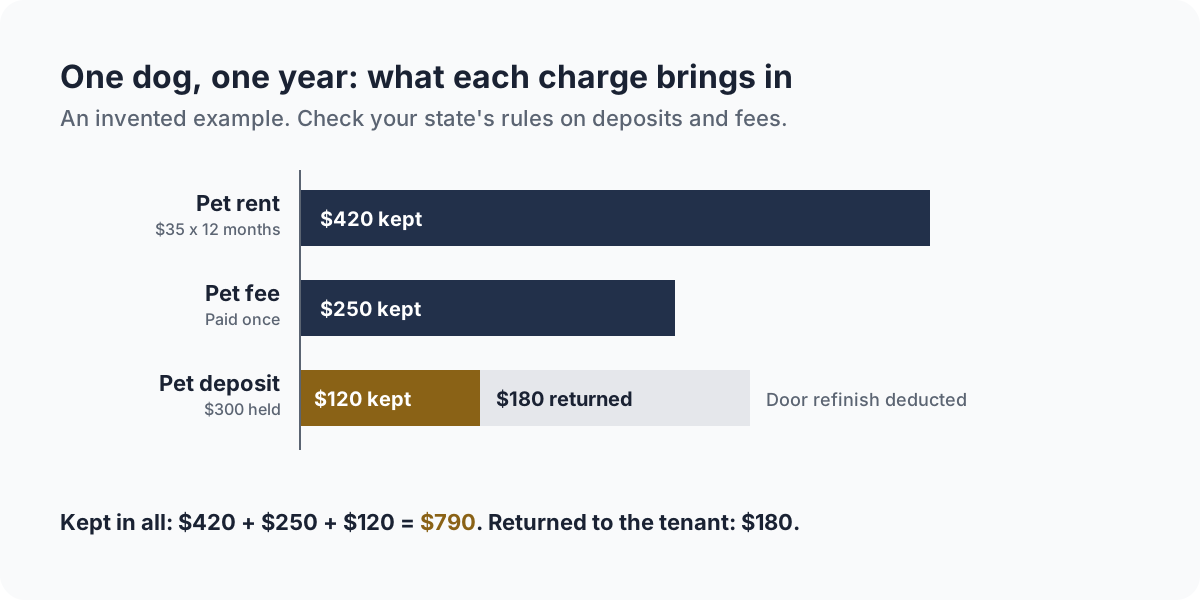
The arithmetic:
- Pet rent: $35 x 12 = $420 over the year.
- Pet fee: $250, paid once at move-in.
- Pet deposit: $300 held, less $120 for the door, so $300 - $120 = $180 goes back to the tenant with an itemized statement.
- Kept in all: $420 + $250 + $120 = $790.
For taxes, the $420 of pet rent and the $250 pet fee are generally rental income in the year you receive them. The $300 deposit is generally not income while you hold it; the $120 you keep is generally income in the year you keep it, and the $120 refinish is a repair expense. The Schedule E guide shows where rental income and repairs go on the return. A tax professional can confirm how this applies to you.
Which pet charge should you choose?
- Pet rent suits longer tenancies, because it keeps pace with the months the pet lives in the unit.
- A pet deposit gives you money set aside for damage, and the tenant gets it back for a well-kept unit.
- A pet fee covers a known cost up front, where local law allows it to be nonrefundable.
A pet deposit combined with pet rent is a common mix: the deposit covers damage, and the monthly charge covers the extra wear over time.
Good practice for pet charges
- Use a pet addendum. List each pet, the amounts, the rules for the pet and who pays for damage.
- Record the unit's condition at move-in. A dated room-by-room record, such as the move-in checklist, with photos, is what a move-out deduction is measured against.
- Bill pet rent as its own line. Showing it separately on each invoice and in the tenant ledger makes the balance easy to follow.
- Keep the pet deposit with the security deposit records. Note what was collected, any interest and every deduction, so the move-out statement is quick to write.
- Apply the same pet terms to every tenant. Consistent terms are easier to explain and to defend.
Frequently asked questions
What is the difference between pet rent and a pet deposit?
Pet rent is a monthly charge added to the rent, and the tenant does not get it back. A pet deposit is paid once, usually at move-in, and is returned at move-out less any lawful deductions for damage the pet caused.
Can I charge both pet rent and a pet deposit?
In many places, yes: owners often combine a monthly pet rent with a refundable pet deposit. Some states count the pet deposit toward a cap on the total security deposit, and some cities limit pet charges. Rules vary by state and city. Check your local law or an attorney.
Is a pet fee refundable?
A pet fee is usually meant to be nonrefundable, but some states and cities limit or ban nonrefundable fees or treat a payment taken at move-in as part of the security deposit. Where they do, the fee has to be handled like a deposit and returned less lawful deductions.
Can I charge pet rent for a service animal or support animal?
Generally, no. Under federal fair housing rules, an assistance animal a tenant needs because of a disability is usually treated as a reasonable accommodation, so pet rent, pet deposits and pet fees usually do not apply. The tenant can still be responsible for damage the animal causes.
Is pet rent taxable income?
Generally, yes. Pet rent and nonrefundable pet fees are usually rental income in the year you receive them. A refundable pet deposit is usually not income while you hold it, and any part you keep is usually income in the year you keep it. A tax professional can confirm how this applies to you.
Keep pet charges on the lease
In KeyRing, you add one-off and recurring charges to a lease, such as pet rent, parking or a repair, and credits when you need them. Each lease keeps a security deposit ledger with what was collected, deductions, interest and refunds, and KeyRing drafts each month's rent invoices for you to approve before they go out. See what KeyRing does or how plans are priced.