Is prepaid rent an asset? How owners and tenants record it
By Claire Navarro -

Prepaid rent is rent paid before the period it covers. Whether it is an asset depends on whose books you are reading. For the tenant who pays it, prepaid rent is an asset: a right to use the property for months already paid for. For the property owner who receives it, prepaid rent is a liability on accrual books, because the owner still owes the tenant those months. Each month that passes moves one month's rent out of the prepaid account, into rent expense for the tenant and into rent income for the owner.
This guide covers both sides, a worked example of six months paid up front, the journal entries, how last month's rent and security deposits fit in, and how the IRS treats rent received in advance. It is general information and is not accounting, legal or tax advice. Rules vary by state and city. Check your local law or an attorney, and ask a tax professional about your own books.
Is prepaid rent an asset?
Yes, for the party that pays it. When a tenant pays rent ahead, the tenant has traded cash for something of value it has yet to use: future months in the property. Accounting calls that a prepaid expense, and prepaid expenses are assets. The portion that covers the next 12 months is usually shown as a current asset.
For the owner, the same payment is the other way around. The owner has the cash, but has yet to provide the months it pays for. Until those months pass, the payment is unearned revenue, which is a liability. A chart of accounts for rental property usually gives it its own liability account, often called prepaid rent or unearned rent.
| Whose books | What prepaid rent is | Where it goes | What happens each month |
|---|---|---|---|
| Tenant (accrual) | An asset, a prepaid expense | Balance sheet, usually a current asset | One month moves to rent expense |
| Owner (accrual) | A liability, unearned revenue | Balance sheet, a current liability | One month moves to rent income |
| Owner (cash basis) | Income when it arrives | Income for the period it is received | Nothing to move |
Most residential tenants keep no books, so the asset side matters mainly for business tenants, such as a company renting an office or a storefront. Businesses that follow US accounting standards for leases (ASC 842) generally fold prepaid rent on a longer lease into a right-of-use asset. Their accountant decides how that is shown.
Why prepaid rent is a liability for the owner
On accrual books, income is recorded when it is earned, which for rent means when the month it covers arrives. If a tenant pays three months early and then the owner sells the property, ends the lease or the unit becomes unlivable, the owner may have to refund the months not yet provided. That obligation is what makes the balance a liability.
The liability shrinks as time passes. At the end of each month, the owner moves one month's rent from the prepaid rent account to rent income. When the last prepaid month ends, the balance is zero.
Owners who keep cash basis books, as many small rental owners do, record the payment as income on the day it arrives and skip the liability. Either way, track what each payment covers on the tenant's rent ledger, so the tenant shows a credit balance for the months paid ahead. The rent ledger vs tenant ledger guide shows how charges and payments line up month by month.
A worked example: six months paid on 1 November
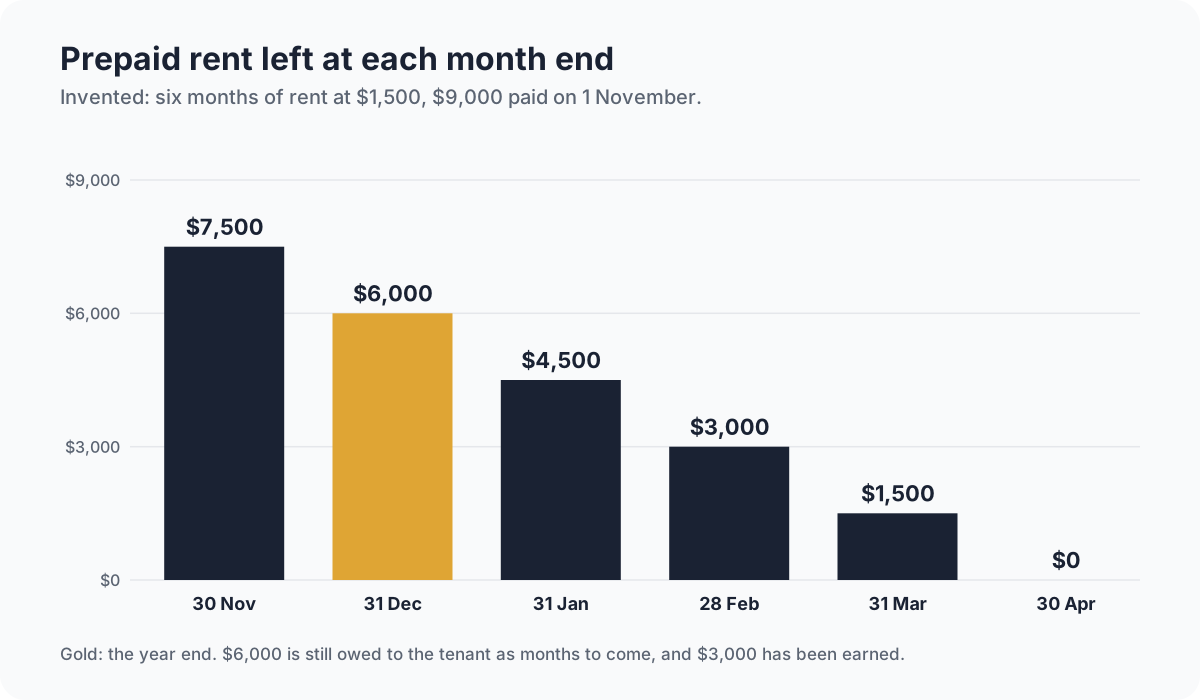
An invented tenant rents a unit for $1,500 a month. On 1 November the tenant pays six months of rent at once, for November through April: 6 x $1,500 = $9,000. The owner keeps accrual books with a year end of 31 December.
| Month end | Rent earned that month | Prepaid rent left |
|---|---|---|
| 30 November | $1,500 | $7,500 |
| 31 December | $1,500 | $6,000 |
| 31 January | $1,500 | $4,500 |
| 28 February | $1,500 | $3,000 |
| 31 March | $1,500 | $1,500 |
| 30 April | $1,500 | $0 |
At the 31 December year end, the owner's books show:
- Rent income for November and December: 2 x $1,500 = $3,000.
- A prepaid rent liability on the balance sheet for January through April: 4 x $1,500 = $6,000.
If the tenant were a business on accrual books, its balance sheet on the same date would show a prepaid rent asset of $6,000, and its income statement would show $3,000 of rent expense.
Journal entries for prepaid rent
The owner's entries on accrual books:
| Date | Debit | Credit | Amount |
|---|---|---|---|
| 1 November, payment received | Cash | Prepaid rent (liability) | $9,000 |
| Each month end, November to April | Prepaid rent (liability) | Rent income | $1,500 |
A business tenant on accrual books records the mirror image. On 1 November it debits prepaid rent (an asset) and credits cash for $9,000. At each month end it debits rent expense and credits prepaid rent for $1,500.
The year-end rental property balance sheet template has a liabilities section for rent paid in advance, next to the security deposits you hold and the mortgage balance.
How the IRS treats rent paid in advance
Tax rules can differ from the books. IRS Publication 527, Residential Rental Property, says to include advance rent in your rental income in the year you receive it, whatever period it covers and whichever accounting method you use. In the example, the owner reports all $9,000 as rent for the year it arrived, even though the books show $3,000 of rent income for that year and $6,000 of prepaid rent.
Publication 527 also covers two related payments:
- Security deposits. A deposit you plan to return at the end of the lease is not income when you receive it. If you keep part of it because the tenant did not live up to the lease, that part becomes income in the year you keep it.
- A deposit used as the last month's rent. If an amount called a security deposit is to be used as a final payment of rent, it is advance rent, and it is income when you receive it.
Rent goes on line 3 of Schedule E. The Schedule E guide walks through every line. This section is general information and is not tax advice. Ask a tax professional how these rules apply to you.
Last month's rent and other common cases
- Last month's rent collected at move-in. It is prepaid rent: a liability on accrual books until the last month of the lease, and income for tax in the year you receive it. Some states and cities limit how much an owner may collect up front, and some count last month's rent toward a security deposit limit. Rules vary by state and city. Check your local law or an attorney.
- Next month's rent paid a few days early. A payment for January that arrives on 28 December is prepaid rent on 31 December on accrual books, for $1,500 in the example.
- A tenant who overpays. An overpayment sits as a credit on the tenant's ledger until it is applied to a later month or refunded. Record which it is.
- A move-out with prepaid months left. If a lease ends early and the tenant has paid for months they will not use, the lease and local law decide whether that money is refunded. Note the answer on the ledger and in your records.
- A rent concession. A free or discounted month is the opposite case: rent forgiven. The rent concession guide shows how to record it.
Common mistakes with prepaid rent
- Counting all of it as this year's income on accrual books. Only the months that have passed are earned. The rest stays in the liability account.
- Mixing up the books and the tax return. Accrual books can show prepaid rent as a liability while the tax return counts all of it as income in the year received. Keep both views and label them.
- Calling a security deposit prepaid rent. A deposit you expect to return is held for the tenant. Last month's rent is rent paid ahead. Record them in separate accounts.
- Losing track of which months are paid. Write the months covered on each payment, so the ledger shows them at a glance.
Frequently asked questions
Is prepaid rent an asset or a liability?
Both, depending on whose books you are reading. For the tenant who pays it, prepaid rent is an asset, a prepaid expense. For the property owner who receives it, it is a liability on accrual books, unearned revenue, until the months it covers have passed.
Is prepaid rent a current asset?
For a tenant on accrual books, the part that covers the next 12 months is usually a current asset. Any part covering months beyond that is usually shown as a noncurrent asset. Ask your accountant about leases that fall under the lease accounting standard.
Is prepaid rent unearned revenue?
For the owner, yes. Prepaid rent is a form of unearned revenue: cash received for months still to come. It moves to rent income one month at a time as each month passes.
Is prepaid rent taxable in the year it is received?
IRS Publication 527 says to include advance rent in rental income in the year you receive it, whatever period it covers and whichever accounting method you use. In the example, all $9,000 counts as rent for the year it arrived. This is not tax advice.
Is last month's rent the same as a security deposit?
No. Last month's rent is rent paid ahead, and it is income for tax when you receive it. A security deposit you plan to return is held for the tenant and is not income unless you keep part of it. Some states treat the two differently for deposit limits, so check your local law.
Keep every rent payment on the record
Prepaid rent is easiest to track when each payment is recorded on the day it arrives. KeyRing connects your bank accounts through Plaid, brings transactions in automatically and suggests matches for rent and deposits that you confirm. Income and expenses are kept by property, with categories you can edit, and you can export your income and expenses as an Excel (XLSX) file for your tax professional. See what KeyRing does or how plans are priced.
Free calculators and templates
- Rent ledger templateTrack one tenant's charges, payments and running balance, in a spreadsheet or on paper.
- Rental property balance sheet templateAssets, liabilities and equity for one property at year end, next to last year's.
Browse all rental property calculators and free templates.