What is NOI? Net operating income for rental property
By Claire Navarro -

NOI, short for net operating income, is what a rental property earns in a year after vacancy and operating expenses, before the mortgage and income taxes. A duplex that collects $37,080 in a year and spends $14,880 to run has an NOI of $22,200. It measures the property itself, whoever owns it and however they paid for it, which is why buyers, lenders and appraisers start from it.
This guide covers what NOI is, what goes into it and what stays out, how to calculate it step by step, a worked example for an invented duplex, how NOI differs from cash flow and taxable income, and how it is used to value a property. It is general information and is not investment or tax advice.
What is NOI?
Net operating income is the money a property's operations produce in a year. The formula is:
NOI = effective gross income minus operating expenses
Effective gross income is the rent the property would bring in fully leased, less the rent you expect to lose to vacancy and unpaid rent, plus other income such as laundry, parking or pet rent. Operating expenses are the costs of running the property: property taxes, insurance, repairs and maintenance, management, owner-paid utilities and similar bills.
NOI is usually worked out for 12 months. It can use the last 12 months of actual figures, a calendar year, or a forecast for the year ahead, and it helps to say which one you mean.
What goes into NOI and what stays out
| In NOI | Out of NOI |
|---|---|
| Rent, less vacancy and credit loss | Mortgage principal and interest |
| Other income: laundry, parking, storage, pet rent, late fees | Depreciation |
| Property taxes and insurance | Income taxes |
| Repairs and maintenance | Capital expenditures, such as a new roof |
| Property management, even if you do it yourself | Security deposits you hold |
| Owner-paid utilities, landscaping, HOA dues | Costs of buying or selling the property |
The items on the right are left out for a reason. Loan payments depend on the owner's financing, depreciation and income taxes depend on the owner's tax position, and capital expenditures are large, uneven projects that last for years. Leaving them out keeps NOI about the property's operations alone. Many owners set aside a yearly reserve for capital projects and show it just below NOI, so it is easy to see with or without it.
How to calculate NOI
- Start with the gross potential rent: each unit's monthly rent times 12, as if every unit were leased all year. A rent roll lists the current rents.
- Subtract vacancy and credit loss. Use your own record of empty months and unpaid rent, or a planning figure for a property you are buying. The vacancy rate calculator works out the rate from your vacant days.
- Add other income. The result is effective gross income.
- Add up the year's operating expenses and subtract them. What is left is NOI.
The NOI calculator does these steps from your figures and shows the operating expense ratio too. To pull the year's numbers together, a T12 statement gives the last 12 months month by month, and the rental property profit and loss template lays out a calendar year by quarter with NOI before interest and depreciation.
A worked example: an invented duplex
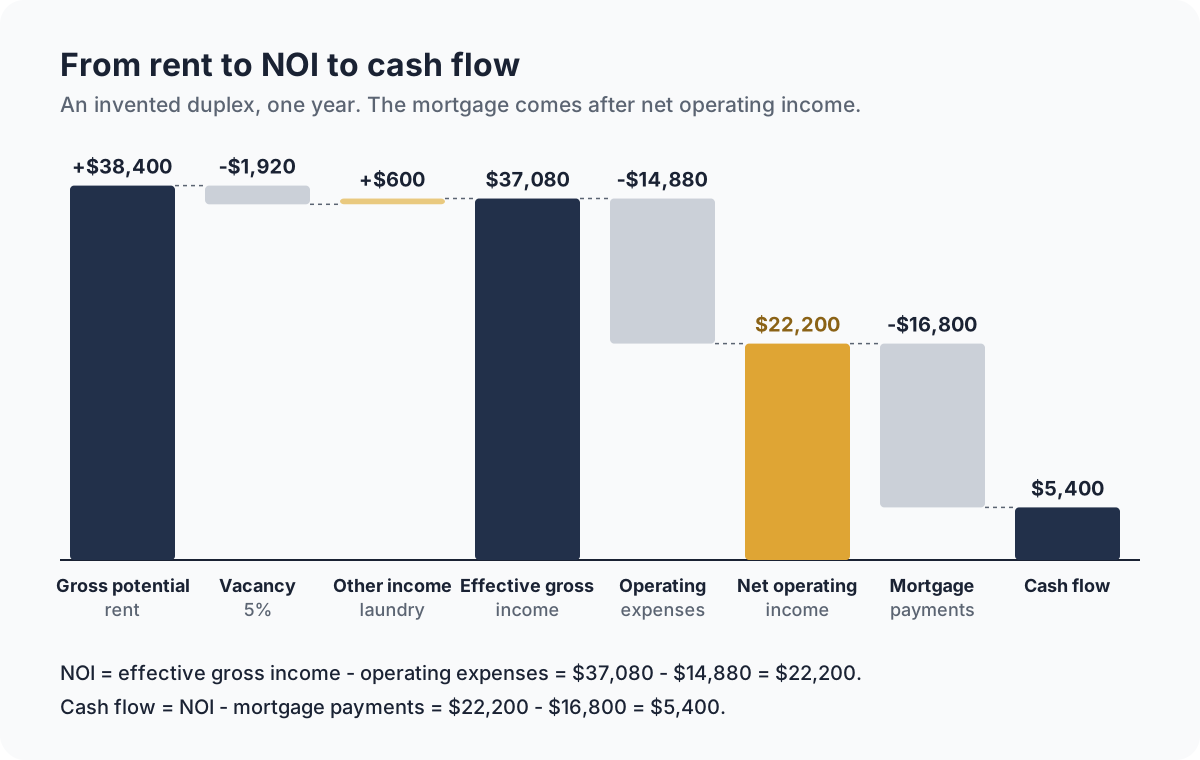
A duplex has two units that each rent for $1,600 a month. The owner plans for 5% vacancy, earns $600 a year from a shared laundry machine and pays $1,400 a month on the mortgage.
| Line | Per year |
|---|---|
| Gross potential rent (2 x $1,600 x 12) | $38,400 |
| Vacancy and credit loss (5%) | -$1,920 |
| Other income (laundry) | $600 |
| Effective gross income | $37,080 |
| Property taxes | $4,800 |
| Insurance | $1,800 |
| Repairs and maintenance | $3,000 |
| Property management ($240 a month) | $2,880 |
| Owner-paid water and trash | $1,440 |
| Landscaping and other | $960 |
| Total operating expenses | $14,880 |
| Net operating income | $22,200 |
NOI is $37,080 - $14,880 = $22,200 a year, or $1,850 a month. The operating expense ratio, expenses over effective gross income, is $14,880 / $37,080 = 40.13%.
The mortgage comes after NOI. Twelve payments of $1,400 are $16,800, so the cash flow is $22,200 - $16,800 = $5,400 a year, or $450 a month.
NOI vs cash flow vs taxable income
| Measure | What it subtracts from income | What it tells you |
|---|---|---|
| NOI | Vacancy and operating expenses | What the property earns, whatever the loan |
| Cash flow | Operating expenses and the whole mortgage payment, often a capital reserve too | What is left in your account after the bills and the loan |
| Taxable rental income | Operating expenses, mortgage interest and depreciation | What you report on Schedule E |
The same duplex shows three different numbers. NOI is $22,200 and cash flow is $5,400. Taxable income subtracts only the interest part of the mortgage, plus depreciation, which is not a cash cost at all. Depreciation changes your taxes and leaves NOI where it was, and that holds for the faster depreciation a cost segregation study can bring too; the cost segregation calculator compares a first year with and without one. The rental cash flow calculator works out the cash side.
How NOI is used
- Cap rate. NOI divided by the price or value is the cap rate. At a price of $370,000, the duplex's $22,200 of NOI is a cap rate of $22,200 / $370,000 = 6.0%. The cap rate calculator works it out from your figures.
- Value. Turned around, value = NOI / cap rate. If similar duplexes nearby have sold at cap rates around 6%, $22,200 of NOI points to a value of about $370,000. Every extra $1,200 a year of NOI, such as $50 a month more rent on each unit, adds about $1,200 / 6% = $20,000 of value at that rate.
- Loans. Lenders compare NOI with the year's loan payments. The duplex's debt service coverage ratio is $22,200 / $16,800 = 1.32. The DSCR calculator shows the ratio and the loan payment behind it.
Ways NOI goes up or down
NOI moves with three things: the rent you charge, the rent you collect and what it costs to run the property. Rent increases at renewal, fewer empty weeks between tenants, rent collected on time and new other income such as paid parking all lift it. So does a lower operating cost, for example an insurance policy rebid or a repair caught early. A tax reassessment, a rise in insurance or a long vacancy pulls it down. Because value is often NOI over a cap rate, a lasting change in NOI changes what the property is worth.
Common NOI mistakes
- Subtracting the mortgage. Loan payments belong in cash flow. Taking them out of NOI makes it depend on the owner's loan.
- Counting capital projects as operating expenses. A new roof or a full kitchen remodel lasts for years. Putting it in one year's expenses makes that year's NOI look much worse than the property's usual year.
- Leaving out vacancy or management. A year with no vacancy and no management cost overstates NOI, even if you manage the property yourself and it is full today.
- Trusting a listing's projections. A pro forma NOI is a forecast. Ask for the last 12 months of actual income and expenses and a current rent roll.
- Mixing time periods. Twelve months of rent against nine months of expenses, or this year's taxes against last year's insurance, gives an NOI no one can compare.
Frequently asked questions
What is NOI in simple terms?
It is the money a rental property makes in a year after the costs of running it, before the mortgage and income taxes. A duplex that collects $37,080 and spends $14,880 on operating expenses has an NOI of $22,200.
Does NOI include the mortgage?
No. NOI is before loan payments, so it stays the same whoever owns the property and however they financed it. Subtract the mortgage payments from NOI to get cash flow.
Is NOI the same as profit?
Not quite. NOI is operating profit before financing, depreciation and income taxes. Cash flow subtracts the mortgage, and the taxable profit on your return subtracts interest and depreciation, so each gives a different number for the same year.
Is depreciation an operating expense in NOI?
No. Depreciation is a tax deduction for the building's cost spread over its recovery period, and it involves no cash leaving your account that year. It lowers taxable income and leaves NOI unchanged.
What is a good NOI?
There is no single good figure, because NOI depends on the size and price of the property. What matters is how NOI compares with the price, which is the cap rate, and whether it covers the loan payments with room to spare.
Track the numbers behind your NOI
NOI is only as accurate as the income and expense records behind it. In KeyRing, you connect your bank accounts securely through Plaid, and each transaction is matched to a property with suggestions you confirm. Income and expense records use categories you can edit, and you can export your transactions to Excel. See what KeyRing does or how plans are priced.
Free calculators and templates
- Cap rate calculatorNet operating income as a share of the property's value.
- NOI calculatorNet operating income and the operating expense ratio for a year.
- Cost segregation calculatorFirst-year depreciation with and without a cost segregation study, and the tax put off.
- Rental property profit and loss statement templateIncome, expenses, NOI and net income for one property, quarter by quarter and for the year.
Browse all rental property calculators and free templates.