What is a notice to vacate? How a tenancy ends and what comes next

A notice to vacate is a written notice that a tenancy is ending and the unit will be empty by a stated date. Most often it comes from a tenant who is moving out. An owner can also send one to end a periodic tenancy, such as a month-to-month arrangement, when there is no lease term left to run. Either way, the notice sets the last day, and that date drives everything after it: the final rent, the move-out inspection and the return of the security deposit. In the worked example below, a month-to-month tenant moves out on June 19, pays $981.67 of prorated final rent and gets $1,605 of a $1,800 deposit back.
This page covers what a notice to vacate is, who sends one, how it compares with a notice to quit, a notice of non-renewal and an eviction notice, what it usually includes, how much notice is common, delivery and records, the move-out steps and a worked example. It is general information and is not legal or tax advice. Rules vary by state and city. Check your local law or an attorney.
What is a notice to vacate?
To "vacate" a home means to leave it and hand it back empty. A notice to vacate is the written statement that this will happen on a given date. It turns a plan to move into a fixed end date that both sides can work toward.
The notice matters most when the tenancy has no built-in end. A one-year lease ends on its last day, and many leases still ask the tenant to confirm the move-out in writing ahead of that date. A month-to-month lease or a tenancy at will renews itself every period until someone gives notice, so the notice is what ends it.
Names vary. The same document may be called a notice of intent to vacate, a move-out notice, a notice of termination of tenancy or, when an owner sends it, a notice to quit. What matters most is what it says, how it is delivered and whether it gives enough time.
Who sends a notice to vacate
There are two common senders, and the purpose is a little different for each.
- A tenant who is moving out. This is the most common use. The tenant tells the owner the date they plan to leave, so the owner can plan the inspection, the final bill and the next tenant. Many leases require this notice in writing, and some ask for it even at the end of a fixed term.
- An owner ending a periodic tenancy. When a month-to-month or other periodic tenancy should end, the owner gives written notice of the last day. In some places this is called a notice to vacate, in others a notice to quit or a notice of termination. Some places require a reason, or limit the reasons an owner may give, even for a periodic tenancy.
A notice to vacate from an owner is a request to leave by a date. It does not remove anyone on its own. If a tenant stays past the date, the owner generally has to go through a court process to recover the unit, and only a court order carried out by a public officer can remove a tenant. Owners should not change the locks, shut off utilities or remove a tenant's belongings to force a move. Those self-help steps are prohibited in most places.
Notice to vacate, notice to quit, non-renewal and eviction notice compared
These notices overlap, and local law sometimes uses the names for the same thing. As a general guide:
| Notice | Who usually sends it | When it is used | What it does |
|---|---|---|---|
| Notice to vacate | A tenant who is moving out, or an owner ending a periodic tenancy | At the end of a lease term, or to end a month-to-month or other periodic tenancy | Sets the date the tenancy ends and the unit will be empty |
| Notice to quit | The owner | When rent is unpaid, a lease rule is broken or a periodic tenancy is being ended | Tells the tenant to leave by a date, in some cases with a chance to pay or fix the problem first |
| Notice of non-renewal | Either side, most often the owner | Before a fixed-term lease ends, when it will not be renewed or extended | Confirms the lease ends on its end date with no new term |
| Eviction notice | The owner | Loosely, any notice that starts the path toward an eviction case | Usually a notice to quit by another name; on its own, it cannot remove anyone |
The key difference is cause. A tenant's notice to vacate is a choice to leave, and an owner's notice to vacate on a periodic tenancy usually ends the arrangement on schedule. A notice to quit is often about a problem, such as unpaid rent or a broken lease rule, and it can be the first step toward an eviction case if the problem is not resolved. A notice of non-renewal works at the end of a fixed term. The lease termination entry covers all the ways a lease can end, and the lease renewal entry covers the other path, where the tenancy continues.
What a notice to vacate usually includes
Exact requirements depend on the lease and local rules. Some places publish required wording for an owner's notice. In general, a notice to vacate includes:
- The names of the tenant or tenants and the owner or property manager.
- The property address, including the unit number.
- The date the notice is given.
- The move-out date, the last day the tenant will have the unit.
- A forwarding address for the deposit and any final statement, when the tenant is the one moving out.
- The reason, if the lease or local rules call for one. Many tenant notices give none, and an owner's notice in some places has to state one.
- A signature from the person giving notice. Where there are several tenants on one lease, check whether the lease expects all of them to sign.
How much notice is usually needed
There is no single answer, and the lease and local law both play a part. Some general patterns:
- Month-to-month tenancies. Many places ask for about a month's notice to end a month-to-month tenancy, and some ask for more, especially when it is the owner giving notice or when the tenant has lived there a long time.
- Fixed-term leases. Many leases ask the tenant to give written notice before the end date even though the term ends on its own, so the owner can plan for the next tenant. Without that notice, some leases roll into a month-to-month arrangement.
- The rental period. In some places notice has to line up with the rental period, so a notice given partway through a month runs to the end of the next full period. Others allow a move-out date in the middle of a month.
- Special situations. Some places have separate rules for tenants in military service, tenants facing domestic violence and certain other cases.
Read the lease first, then check local rules. Where the two differ, an attorney or a local housing office can confirm which period applies.
Delivering the notice and keeping records
How the notice is delivered can matter as much as what it says. Many leases name the methods they accept, such as hand delivery or mail, and some places limit the methods an owner can use and set when a mailed notice counts as given.
Good records make a move-out simpler for both sides:
- Keep a copy of the signed notice.
- Record the date and method of delivery. A mailing receipt, a signed acknowledgment or a dated note of hand delivery all help.
- Confirm in writing. An owner who receives a tenant's notice can reply to confirm the move-out date and the next steps.
A tenant who wants to change the date after giving notice usually needs the owner's agreement, ideally in writing. A tenant who stays past the date without an agreement may become a holdover tenant, which raises its own questions about rent and possession.
After the notice: the move-out steps
Once the date is set, a move-out usually runs through the same few steps.
- Final rent. Work out what rent is owed through the last day. If the lease and local rules allow a mid-month move-out, the last month may be prorated, and the prorated rent calculator does that math. The prorated rent entry explains the methods.
- Move-out inspection. Walk the unit, ideally with the tenant, and compare its condition with the move-in report. A move-out checklist or a rental inspection checklist keeps the notes in order. Dated photos help.
- Keys and utilities. Collect every key and access device, and note the meter readings for utilities that move back to the owner.
- Security deposit. Deduct only what the lease and local law allow, usually unpaid rent and damage beyond normal wear and tear, and return the rest with an itemized list by the local deadline. The security deposit entry covers the general rules, and the guide to normal wear and tear vs damage helps with the hard calls.
- Forwarding address and mail. Note where the deposit and any final statement should go. The guide to mail for a previous tenant covers what to do with letters that keep arriving.
A worked example: a mid-month move-out
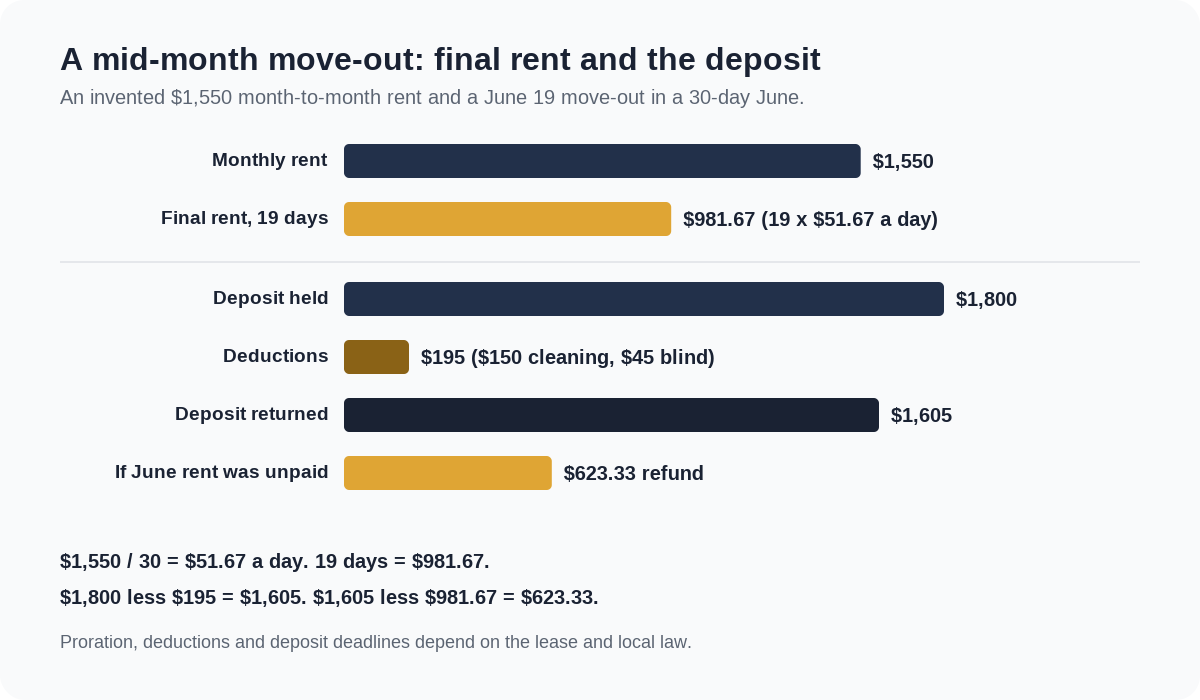
All the figures here are made up. A tenant rents an apartment month to month for $1,550, due on the 1st, and paid a security deposit of $1,800 at move-in. In mid-May the tenant gives the owner a written notice to vacate with a move-out date of June 19, 2027, and a forwarding address. This invented lease allows the final month's rent to be prorated to the move-out date. Some leases charge rent through the end of the rental period that the notice covers, so check yours.
Final rent. June has 30 days, and the tenant has the unit for 19 of them. Using the site's prorated rent calculator with the actual days in June:
- Daily rate: $1,550 / 30 days = $51.67
- Final rent: 19 days x $1,550 / 30 = $981.67
Because June has exactly 30 days, the 30-day month method gives the same answer here. The tenant pays $981.67 on June 1, so no rent is owed at move-out.
Deposit settlement. At the move-out inspection, the owner and tenant compare the unit with the move-in report. Ordinary scuffs and faded paint are normal wear and tear, so nothing is deducted for them. Two items go beyond that:
- Cleaning of a heavily soiled oven and refrigerator: $150
- A broken window blind: $45
- Total deductions: $150 + $45 = $195
- Deposit returned: $1,800 - $195 = $1,605
The owner sends $1,605 to the forwarding address with an itemized list of the two deductions and copies of the receipts.
If the final rent had gone unpaid. Suppose the tenant had not paid the June rent. Where the lease and local rules allow unpaid rent to come out of the deposit, the refund would be $1,605 - $981.67 = $623.33, with the unpaid rent shown as a third line on the itemized list.
A ledger that shows the final rent charge, the payment and each deposit deduction makes the settlement easy to explain if the tenant has questions. A rent statement can summarize the tenancy's charges and payments for the tenant.
Mistakes that cause problems
- Not putting it in writing. A spoken "we're moving at the end of next month" is easy to misremember on both sides. Ask for, and give, written notice.
- Too little notice. Check the lease and local rules before picking a date. A notice that is too short may not take effect on the date it names.
- Deducting normal wear and tear. Deposit deductions are generally limited to unpaid rent and damage beyond normal use. Itemize each one.
- Missing the deposit deadline. Many places set a deadline for returning the deposit or sending the itemized list, and missing it can carry penalties.
- Self-help when a tenant stays. If a tenant does not leave by the date, talk to an attorney about the court process. Owners should not change locks, shut off utilities or remove belongings. A writ of possession is the court order that comes at the end of that process, and some owners and tenants settle earlier through an agreement such as cash for keys.
Frequently asked questions
What is a notice to vacate?
It is a written notice that a tenancy is ending and the unit will be empty by a stated date. Tenants send one when they plan to move out, and owners can send one to end a periodic tenancy such as a month-to-month lease.
Is a notice to vacate the same as an eviction notice?
No. A tenant's notice to vacate is a choice to leave, and an owner's notice usually ends a periodic tenancy on schedule. An eviction notice usually means a notice to quit tied to a problem, such as unpaid rent. If a tenant stays past the date in any notice, a court process is required to remove them.
How much notice does a tenant need to give?
It depends on the lease and local law. Many places ask for about a month's notice to end a month-to-month tenancy, and many fixed-term leases ask for written notice before the end date too. Check the lease and local rules, or ask an attorney.
Can a tenant take back a notice to vacate?
Usually only if the owner agrees. Once the owner has relied on the date, for example by signing a lease with a new tenant, the owner may not be able to agree. Put any change to the move-out date in writing.
Does a tenant have to pay rent for the whole last month?
It depends on the lease and local rules. Some allow the last month to be prorated, and others charge rent through the end of the rental period the notice covers. In the example, 19 days of a $1,550 month in June comes to $981.67.
Keep the move-out dates and the deposit in one place
A notice to vacate starts a short run of dates and money: the last day, the final rent and the deposit. In KeyRing, you can create a lease for each unit, attach documents such as a signed agreement or a notice to the lease, and rent-due and lease-expiry reminders go out by email and push automatically. When a tenancy ends, you can end the lease and schedule the move-out. Each lease keeps a deposit ledger: what was received, deductions, interest credited to the tenant, refunds, the balance held and the date it is due back. See what KeyRing does or how plans are priced.
Free calculators and templates
- Security deposit interest calculatorSimple interest on a deposit between two dates at your rate.
- Rental inspection checklistA room by room check of an occupied rental, with the repairs it turns up.
- Rent statement templateA tenant's charges, payments and balance for a period, from the opening balance to what is due now.
Browse all rental property calculators, free templates and the glossary.
From the blog
- What is a month-to-month lease? How it works and how to end oneA month-to-month lease renews each month until either side gives written notice. How notice and rent increases work, pros and cons, and sample lease language.
- What is a holdover tenant? Your options when a lease ends and the tenant staysA holdover tenant stays in a rental after the lease ends without a new agreement. See your options, what holdover rent can look like and how to avoid one.
- What is normal wear and tear? How it differs from damageNormal wear and tear is the decline that comes from ordinary use. See how it differs from damage, common examples and how to work out a fair deposit deduction.