What is a month-to-month lease? How it works and how to end one
By Maya Ellison -

A month-to-month lease is a rental agreement that runs one month at a time. It renews on its own at the start of each rental period and keeps going until the tenant or the property owner gives written notice to end it. It gives both sides flexibility: the tenant can move with a short notice, and the property owner can change the rent or the terms, or end the tenancy, with the notice the law requires.
This guide covers how a month-to-month tenancy starts, how it compares with a fixed-term lease, how the rent can change, how to end one, a worked example and what to put in the agreement. It is general information and is not legal advice. Rules vary by state and city. Check your local law or an attorney.
What is a month-to-month lease?
A month-to-month lease, also called a month-to-month rental agreement or a periodic tenancy, has no fixed end date. Each rental period, usually a calendar month with rent due on the 1st, renews the agreement for another month. The rest of the terms work like any lease: the rent, the due date, the security deposit, who pays which utilities, the rules on pets and guests, and how repairs are requested.
Because the tenancy has no end date, it ends only when one side gives proper written notice, when both sides agree on an end date, or when a court orders it.
How a month-to-month tenancy starts
There are three common ways:
- A written month-to-month agreement. You and the tenant sign an agreement that says the tenancy runs from month to month.
- A lease that converts. Many fixed-term leases say that the tenancy continues month to month after the term ends unless either side gives notice. Read the lease's renewal clause before the end date.
- A tenant who stays on. When a tenant stays after the lease ends and the property owner accepts rent, many states treat the tenancy as month-to-month on the old lease's terms. The holdover tenant guide covers how that happens and the options before you accept a payment.
Month-to-month vs fixed-term lease
| Month-to-month lease | Fixed-term lease | |
|---|---|---|
| Length | Renews each month with no end date | A set term, often 6 or 12 months |
| Ending it | Written notice from either side, often 30 days or more | Usually at the end of the term, or early only as the lease or the law allows |
| Rent changes | Usually allowed with written notice | Usually fixed until the term ends, unless the lease says otherwise |
| Rent | Some property owners charge more for the flexibility | Often lower for a longer commitment |
| Turnover | A tenant can leave on short notice | A tenant is committed for the term |
Changing the rent or the terms
On a month-to-month tenancy, the rent and most terms can usually change with proper written notice. Many states require at least 30 days of written notice before a rent increase, and some require 60 or 90 days, often for larger increases or for tenants who have stayed longer. The new rent usually starts at the beginning of a rental period. Some cities limit how much or how often the rent can go up.
The rent increase notice guide covers typical notice periods and what a notice should say, and the rent increase calculator works out the new rent and the difference over a year.
How to end a month-to-month lease
Ending a month-to-month tenancy takes written notice. The details that matter:
- The notice period. Many states require at least 30 days of written notice from either side, and some require 60 days or more from the property owner, especially once a tenant has lived there for a year or longer. Some states set a shorter period for tenants.
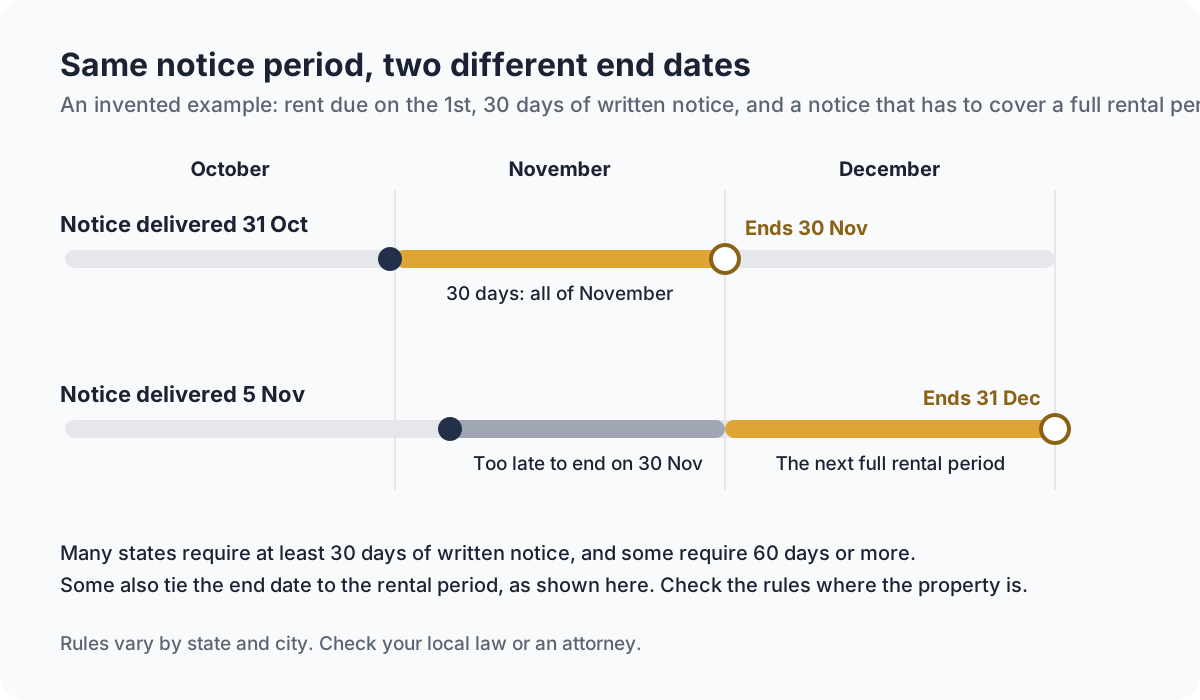
- The end date. In some states the notice has to cover a full rental period, so the tenancy ends on the last day of a period. A notice delivered a few days late can push the end date out by a whole month.
- How the notice is delivered. The law or the agreement may say how: in person, by mail or another method. Keep a copy and a record of the date and how you delivered it.
- A reason. In most places, either side can end a month-to-month tenancy without giving a reason. Some states and cities require a property owner to have a reason the law accepts, often called just cause, and some require relocation help.
- What follows. After the end date, the deposit return, the move-out inspection and any final charges follow the same rules as any other lease.
A worked example: an invented single-family rental
A tenant rents a house for $1,800 a month on a month-to-month tenancy, with rent due on the 1st. The property owner plans to sell and wants the house empty. The state in this example requires 30 days of written notice that covers a full rental period.
- Notice delivered on 31 Oct. The 30 days cover all of November, so the tenancy ends on 30 Nov.
- Notice delivered on 5 Nov. It is too late for 30 Nov, so the tenancy ends on 31 Dec, the end of the next full rental period.
- An agreed earlier date. If the tenant finds a new place and both sides agree in writing that the tenancy ends on 15 Dec, December's rent can be prorated: $1,800 / 31 days = $58.06 a day, and 15 days come to $1,800 x 15 / 31 = $870.97. The prorated rent calculator works out the partial month for any rent and date.
Pros and cons for a property owner
- Flexibility. You can change the rent or the terms with notice, sell or move into the property, or end a tenancy that is not working, within the notice rules.
- A short commitment for a new tenant. It can suit a tenant between homes, or a period while you decide what to do with the property.
- More turnover risk. A tenant can also leave on short notice, which can mean more empty months and more move-out costs. The vacancy rate calculator shows what empty days cost a property.
- Other ways to rent. Some owners of a furnished home weigh a month-to-month lease against short stays. The Airbnb calculator estimates what nightly bookings could earn after booking fees, cleaning and running costs, and many cities limit short-term rentals or need a permit.
What to put in a month-to-month agreement
- The names of every adult tenant and the property address.
- That the tenancy runs from month to month, with the start date and the day rent is due.
- The rent, how it is paid and any late fee the law allows.
- The notice either side gives to end the tenancy, at least what the law requires, and how notice is delivered.
- The security deposit, utilities, pets, guests, maintenance requests and entry rules, the same as in a fixed-term lease.
Frequently asked questions
What is a month-to-month lease in simple terms?
It is a rental agreement with no end date. It renews each month and continues until the tenant or the property owner gives written notice, or both agree on an end date.
How much notice do you need to end a month-to-month lease?
It depends on the state and city. Many states require at least 30 days of written notice, and some require 60 days or more from the property owner, especially for longer tenancies. Some also require the notice to cover a full rental period. Rules vary by state and city. Check your local law or an attorney.
Can the rent go up on a month-to-month lease?
Usually, yes, with proper written notice. Many states require at least 30 days, and some require 60 or 90 days for larger increases or longer tenancies. Some cities limit increases.
Does a lease become month-to-month when it ends?
Often. Many leases say they continue month to month after the term, and in many states accepting rent from a tenant who stays on creates a month-to-month tenancy. Read the lease's renewal clause and check your state's rules before the end date.
Is a month-to-month lease good for a property owner?
It suits some situations. It gives you flexibility to change the rent or end the tenancy with notice, and it also lets the tenant leave on short notice. Weigh the flexibility against the cost of more turnover for your property.
Keep every lease and notice in one place
A month-to-month tenancy runs on dates: when rent is due, when notice went out and when the tenancy ends. In KeyRing, you can create a lease for each unit, attach documents such as a signed agreement or a notice to the lease, and rent-due and lease-expiry reminders go out by email and push automatically. When a tenancy ends, you can end the lease and schedule the move-out. See what KeyRing does or how plans are priced.
Free calculators and templates
- Prorated rent calculatorRent for a partial first or last month, by actual days or a 30-day month.
- Rent increase calculatorA new rent from a percentage or dollar increase, with the yearly difference.
- Airbnb calculatorA short-term rental's yearly revenue, costs, cash flow and break-even occupancy.
Browse all rental property calculators and free templates.