What is a notice to quit? The written notice to end a tenancy

A notice to quit is a written notice from a property owner telling a tenant that the tenancy is ending and the tenant must leave the home by a stated date. Some versions give the tenant a chance to fix the problem first, for example by paying overdue rent. In most places a proper notice is the first formal step before an owner can ask a court to end a tenancy, and a notice that is wrong in form or timing can delay everything after it. In the worked example below, a tenant who owes $1,400 in rent and a $70 late fee pays in full after receiving notice, and the tenancy continues.
This page covers what a notice to quit is, the common types, what one usually contains, what happens after it is delivered, a worked example and the mistakes that cause problems. It is general information and is not legal or tax advice. Rules vary by state and city. Check your local law or an attorney.
What is a notice to quit?
To "quit" a home here means to leave it. A notice to quit is the owner's written statement that the tenant's right to stay is ending, with a date to leave and, where it applies, what the tenant can do to keep the tenancy.
A notice to quit comes before any court case, and on its own it cannot remove anyone. If the tenant stays after the date in the notice, the owner generally has to file a case in the local court, and only a court order carried out by a public officer can remove a tenant. The entry on a writ of possession explains that later stage.
Names vary from place to place. The same kind of document may be called a notice to vacate, a notice of termination, a pay or quit notice or a cure or quit notice.
Common types of notice to quit
Most notices fall into a few general groups. Which ones exist, and what each requires, depends on local law.
- Pay rent or quit. The tenant has fallen behind on rent and can either pay the amount stated or leave by the date given.
- Cure or quit. The tenant has broken a lease rule, such as an unauthorized pet or occupant, and can either fix it or leave. A lease violation notice is often the informal step before this one.
- Unconditional quit. For serious problems, some places allow a notice that gives no chance to fix the issue. Many places limit when this kind can be used.
- End of a periodic or at-will tenancy. To end a month-to-month lease or a tenancy at will, the owner gives notice that the arrangement is ending. Some places require a reason even then.
What a notice to quit usually includes
Exact requirements are set locally, and some places publish required wording. In general, a notice to quit includes:
- The tenant's name and the property address.
- The reason, such as unpaid rent or a specific lease violation.
- What the tenant can do, if anything, to keep the tenancy, such as pay a stated amount or fix a stated problem.
- The date by which the tenant must act or leave.
- The owner's name, signature and the date the notice was given.
How the notice is delivered matters too. Many places allow only certain methods, such as hand delivery or mail, and the method can affect when the notice period starts. Keep a record of when and how it was delivered.
What happens after a notice to quit
There are a few common outcomes.
- The tenant fixes the problem. The rent is paid or the violation is cured, and the tenancy continues.
- The tenant leaves. The owner inspects the unit, settles the final balance and handles the security deposit under local rules.
- The owner and tenant agree on a move-out. Some owners offer help with moving costs in exchange for a set move-out date. The guide to cash for keys covers how that works.
- The tenant stays. The owner may then file an eviction case in the local court. A judge decides whether the tenancy ends.
Throughout, owners should not change locks, remove belongings or shut off utilities to force a tenant out. Those self-help steps are prohibited in most places. A tenant who is pushed out that way may also have a claim along the lines described in the constructive eviction entry.
A worked example: a pay rent or quit notice
All the figures here are made up. A tenant rents an apartment for $1,400 a month, due on the 1st. The lease charges a late fee of 5 percent of the rent once a 5-day grace period has passed. March rent has not arrived by March 12, so it is 11 days late.
Using the site's late fee calculator with those lease terms:
- Days late: 11, which is past the 5-day grace period, so the fee applies
- Late fee: $1,400 x 5 percent = $70.00
- Total on the tenant's ledger: $1,400 + $70 = $1,470
Some places allow only the rent itself in a pay or quit notice, so this owner lists $1,400 in the notice and keeps the $70 late fee as a separate charge on the ledger. The tenant pays $1,470 before the date in the notice, the balance returns to zero and the tenancy continues.
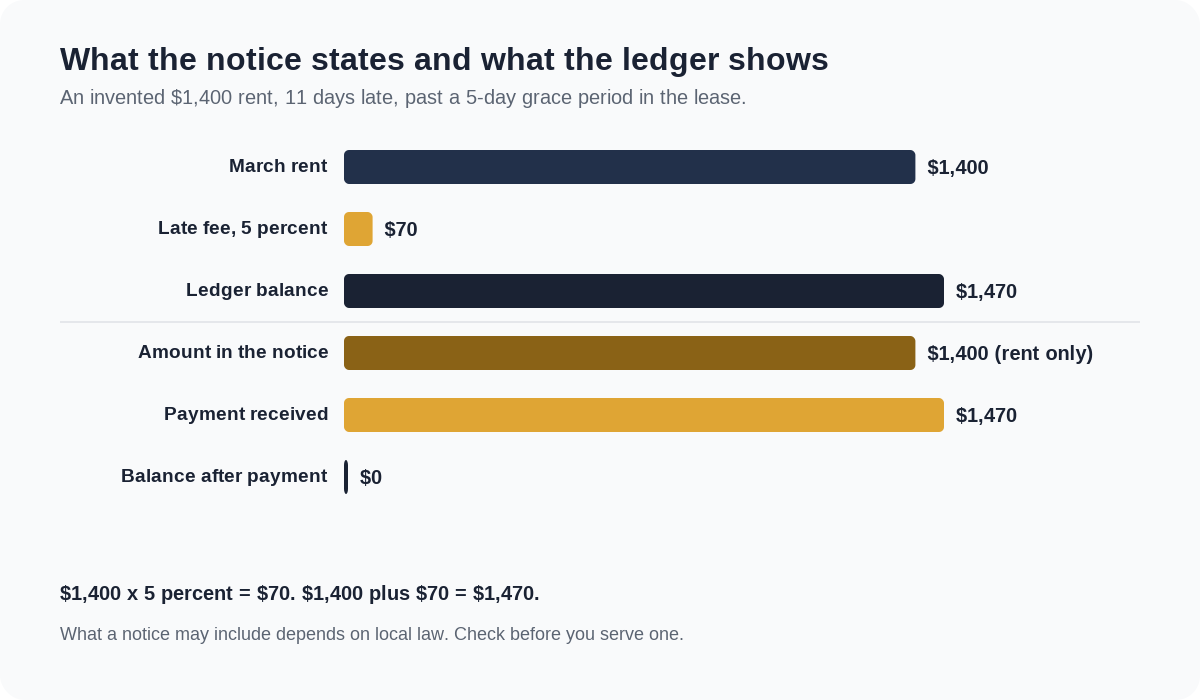
A rent ledger that shows the charge, the fee, the notice date and the payment makes it simple to show what was owed at each step. In some places, accepting part of the amount after a notice can affect whether the notice still stands, so check with an attorney before taking a partial payment.
Mistakes that cause problems
- Wrong form or wording. Some places require specific language or a specific form. A notice missing a required part may have to be served again.
- Wrong amount. Listing charges the local rules do not allow in the notice can make it invalid.
- Wrong notice period or delivery. Counting days the wrong way, or delivering by a method that is not allowed, is a common reason for delay.
- No records. Keep a copy of the notice, proof of delivery and the ledger.
- Acting on your own. Self-help removal is prohibited in most places. Talk to an attorney before you serve a notice and before any next step.
Frequently asked questions
What does a notice to quit mean?
It is a written notice from the owner telling the tenant that the tenancy is ending and giving a date to leave. Some notices give the tenant a chance to fix the problem first, such as paying overdue rent.
Is a notice to quit the same as an eviction?
No. A notice to quit is usually the first step. If the tenant stays after the date in the notice, the owner generally has to file a case in court, and only a court order can lead to removal.
What should a notice to quit include?
In general: the tenant's name and address, the reason, what the tenant can do to keep the tenancy if anything, the deadline and the owner's signature and date. Some places require specific wording, so check local rules.
Can an owner change the locks after a notice to quit expires?
In most places, no. Changing locks, removing belongings or shutting off utilities to force a tenant out is prohibited self-help. A court process is the lawful path.
Can late fees go in a pay rent or quit notice?
It depends on local law. Some places allow only rent itself in the notice. In the example, the notice lists $1,400 of rent and the $70 late fee stays as a separate ledger charge, for a total of $1,470.
Keep each tenant's balance clear before a notice
A notice is only as good as the balance behind it. In KeyRing, each lease keeps its rent charges, payments and balance, you can record cash and check payments, including partial ones, and overdue invoices are flagged automatically. Each month's rent invoices are drafted for you to approve before they are sent, and each tenant gets a PDF invoice by email. See what KeyRing does or how plans are priced.
Free calculators and templates
- Late fee calculatorA rent late fee as a flat amount or a percentage, with a grace period.
- Rent statement templateA tenant's charges, payments and balance for a period, from the opening balance to what is due now.
Browse all rental property calculators, free templates and the glossary.
From the blog
- Lease violation notice: what to include and how to send itA lease violation notice tells a tenant which lease term was broken and how to fix it. What to include, how to deliver it, typical cure periods and a sample.
- Cash for keys: how it works and what to put in the agreementCash for keys is a deal where a property owner pays a tenant to move out by a set date. See how it works, how to weigh the cost and what the agreement covers.
- What is a holdover tenant? Your options when a lease ends and the tenant staysA holdover tenant stays in a rental after the lease ends without a new agreement. See your options, what holdover rent can look like and how to avoid one.