What is a tenancy at will? An open-ended rental explained

A tenancy at will is a rental arrangement with no fixed end date, where the tenant lives in the home with the owner's permission and either side can end the arrangement by giving notice. It often starts informally: a handshake deal, a friend or relative moving in, or a tenant who stays on with permission after a sale or a lease talk falls through. Rent may be paid monthly, weekly or not at all. In the worked example below, an owner and tenant end a $1,350 a month arrangement partway through May, and the final partial month comes to $783.87 on the actual days method.
This page covers what a tenancy at will is, how it differs from a month-to-month lease and from a holdover, how one usually begins and ends, a worked example of the final rent, the records that help and common mistakes. It is general information and is not legal or tax advice. Rules vary by state and city. Check your local law or an attorney.
What is a tenancy at will?
A tenancy at will is an open-ended right to occupy a home that lasts as long as both the owner and the tenant want it to. The phrase "at will" means at the will of either party: there is no term to run out, so the arrangement continues until one side ends it.
A few features show up in most descriptions of it:
- Permission is the starting point. The tenant is in the home because the owner agreed. That is what separates a tenant at will from a squatter, who never had permission.
- There is no set end date. A one-year lease ends on its last day. A tenancy at will has no last day until someone gives notice.
- The paperwork is often thin. Many arrangements have no written lease at all, or only a short note about rent.
- It is usually personal. In many places the tenancy belongs to the people who made it, so a sale of the property, the death of a party or an attempt to pass it to someone else can affect it. The entry on lease assignment explains how a transfer works under a written lease.
Ending a tenancy at will still takes proper notice in most places, and the notice rules depend on where the property sits.
Tenancy at will, month-to-month and holdover compared
These three arrangements overlap, and local law sometimes treats them alike.
Month-to-month lease. A month-to-month lease is a periodic tenancy: it renews each month until someone gives notice. Many tenancies at will turn into month-to-month tenancies once the owner accepts regular monthly rent, and some places use the two terms almost interchangeably.
Holdover tenant. A holdover tenant stays after a fixed lease ends. If the owner consents and keeps accepting rent, the holdover can become a tenancy at will or a periodic tenancy, depending on local law and what the two sides do.
Tenancy at sufferance. A tenant who stays after the right to be there has ended, without the owner's consent, is often called a tenant at sufferance. The owner has not agreed to the stay, which is the key difference from a tenancy at will.
How a tenancy at will usually begins
There is often no single moment when one starts. Common patterns include:
- An informal deal. The owner lets someone move in and pay rent without signing a lease.
- A lease that never got signed. The tenant moves in while a lease is being negotiated, and the paperwork never gets finished.
- Staying on after a sale or term ends. A buyer lets the seller's tenant stay for a while, or an owner lets a tenant stay past the end of a lease while both sides decide what comes next.
Whatever the start, writing down the basics protects both sides: who lives there, the rent, when it is due, who pays which utilities and how either side can end the arrangement.
How a tenancy at will usually ends
Either side can end it, but the steps matter.
- Written notice. Most places require written notice to end a tenancy at will, and many set a minimum notice period. The period, the delivery method and the content all depend on local law.
- A clean move-out. If the tenant leaves by the end date, the owner walks the unit, settles the final rent and handles the security deposit under local rules. A move-out checklist keeps the inspection consistent.
- A court process if the tenant stays. If the tenant does not leave after proper notice, the owner generally has to go through the local court process to regain possession. Owners should not change locks, remove belongings or shut off utilities to force a tenant out. Those self-help steps are prohibited in most places and can create liability of their own.
Some owners and tenants settle the end date by agreement, sometimes with a payment to help with moving costs. The guide to cash for keys explains how that kind of agreement works.
A worked example: rent for the final partial month
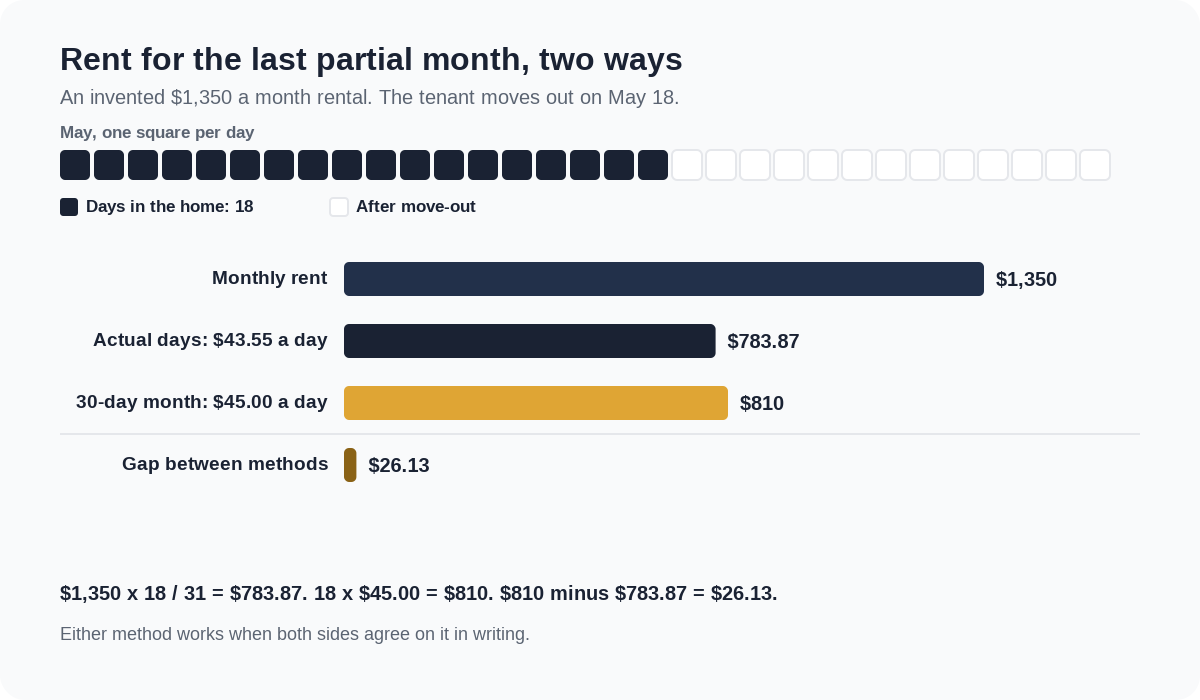
All the figures here are made up. A tenant has rented a garden apartment for $1,350 a month with no written lease. The owner decides to sell, gives written notice in the form local law calls for, and both sides record May 18 as the move-out date. Rent for May is due on May 1, and the question is how much of it covers the days the tenant actually stays.
The owner uses the actual days method, the same one used by the site's prorated rent calculator:
- May has 31 days, so the daily rate is $1,350 / 31 = $43.55
- The tenant is in the home for 18 days: $1,350 x 18 / 31 = $783.87
Some arrangements use a 30-day month for every month:
- Daily rate: $1,350 / 30 = $45.00
- Final rent: 18 x $45.00 = $810
The gap between the two methods is $26.13. Neither one is required by any rule here; what matters is that both sides agree on the method in writing and use it consistently. The prorated rent entry explains both methods in more detail.
If the tenant had already paid the full $1,350 for May, the owner would refund the unused part or apply it against anything else owed, and show that on the final statement along with the deposit.
Records that help
Because a tenancy at will is often informal, records do most of the work if questions come up later. Owners generally keep:
- A short written agreement with the rent, due date, utilities and how notice works.
- Every rent payment and the date it arrived.
- Any notice either side gave, with the date and how it was delivered.
- Move-in and move-out photos and an inspection checklist.
- The final rent and deposit statement with the method used.
Common mistakes with tenancies at will
- Leaving everything verbal. Memories differ about rent, utilities and notice. A one-page summary avoids most disputes.
- Assuming no lease means no rules. Tenant protections, deposit rules and notice periods often apply anyway.
- Mixing up the terms. Whether the arrangement counts as a tenancy at will, a periodic tenancy or a holdover can change the notice needed, so check how local law treats it.
- Using self-help. Changing locks or cutting off services to end an arrangement is prohibited in most places. A court process is the lawful path when a tenant will not leave. Respecting the tenant's right to quiet enjoyment applies here too.
- Skipping legal advice. An attorney can confirm the notice and steps that apply before you act.
Frequently asked questions
What is a tenancy at will in simple terms?
It is a rental with no fixed end date. The tenant lives in the home with the owner's permission, and either side can end the arrangement by giving the notice that local law requires.
Is a tenancy at will the same as a month-to-month lease?
They are close, and some places treat them alike. A month-to-month lease renews each month on a set rent cycle, while a tenancy at will may have no set cycle at all. Many tenancies at will become month-to-month once regular monthly rent is accepted.
Does a tenancy at will need a written lease?
Often there is none, which is part of what makes it a tenancy at will. Writing down the rent, due date, utilities and notice terms still helps both sides.
How do you end a tenancy at will?
Usually with written notice that meets local rules on timing, delivery and content. If the tenant stays after proper notice, the owner generally has to use the local court process. Self-help steps such as changing locks are prohibited in most places.
How is rent worked out for the last partial month?
Divide the monthly rent by the days in the month and multiply by the days the tenant stays. In the example, $1,350 / 31 x 18 = $783.87. A 30-day month gives $810, a gap of $26.13.
Keep informal rentals on the record
An arrangement without a lease is easier to settle when every payment is already recorded against its property. In KeyRing, you connect your bank accounts securely through Plaid, and each transaction is matched to a property with suggestions you confirm. Income and expense records use categories you can edit, and you can export your transactions to Excel. See what KeyRing does or how plans are priced.
Free calculators and templates
- Rental inspection checklistA room by room check of an occupied rental, with the repairs it turns up.
Browse all rental property calculators, free templates and the glossary.
From the blog
- What is a month-to-month lease? How it works and how to end oneA month-to-month lease renews each month until either side gives written notice. How notice and rent increases work, pros and cons, and sample lease language.
- What is a holdover tenant? Your options when a lease ends and the tenant staysA holdover tenant stays in a rental after the lease ends without a new agreement. See your options, what holdover rent can look like and how to avoid one.
- What is a squatter? Squatters' rights and what property owners can doA squatter occupies a property without the owner's permission. What squatters' rights really mean, how adverse possession works and how owners respond lawfully.