What is a writ of possession? The court order that returns a rental

A writ of possession is a court order that directs a public officer, such as a sheriff, marshal or constable, to return a property to its owner. It usually comes near the end of an eviction case: after a court has ruled that the owner is entitled to possession and the tenant has not left. The officer carries it out, and the owner does not remove anyone personally. In the worked example below, the writ is carried out on May 12, and the tenant's ledger shows $3,819.35 owed before the security deposit is applied.
This page covers what a writ of possession is, where it fits in the general eviction process, who carries it out, what tenants and owners can generally expect, a worked example of the final ledger and good practice around it. It is general information and is not legal or tax advice. Rules vary by state and city. Check your local law or an attorney.
What is a writ of possession?
A writ is a written order from a court. A writ of possession orders the officer responsible for enforcing court judgments to put the owner back in possession of a property, by removing the occupants if they have not left on their own.
Some places use other names, such as a writ of restitution, a warrant of eviction or a writ of execution for possession. The idea is the same: a judge has already decided who is entitled to the property, and the writ is the tool that makes that decision happen.
A writ of possession is generally separate from any money judgment. A court may also award unpaid rent or costs, but collecting that money is its own process. The writ deals only with who has the right to be in the home.
Where it fits in the eviction process
The steps and their names vary by state and city, but the general order looks like this:
- Notice. The owner gives the tenant written notice, such as a notice to quit, in the form local law requires.
- Court filing. If the tenant stays after the notice period, the owner files an eviction case in the local court.
- Hearing and judgment. Both sides can be heard. If the court rules for the owner, it enters a judgment for possession.
- The writ. If the tenant still has not left, the owner asks the court to issue a writ of possession.
- Notice from the officer. In many places the officer posts or delivers a notice telling the occupants when the writ will be carried out.
- Return of possession. The officer oversees the return of the property to the owner, and the owner can then change the locks.
At several points the tenant may have options, such as paying what is owed where local law allows it, asking for more time or appealing. Those options and their timing depend on local law.
Who carries out a writ of possession
The officer named in the writ does. That is usually a sheriff, marshal or constable, depending on the place. The owner's role is generally to request the writ, pay any required costs, arrange access and sometimes have a locksmith or movers on hand as the officer directs.
Owners should not remove a tenant, change the locks, take belongings or shut off utilities on their own, at any stage. Those self-help steps are prohibited in most places, even after a judgment, and can lead to claims against the owner. Pressure tactics of that kind can also raise the issues described in the constructive eviction entry.
What owners and tenants can generally expect
- Belongings left behind. Many places have specific rules about how long items must be stored, how the tenant is told and what happens to them afterward. Check those rules before touching anything left in the unit.
- Occupants who were not part of the case. A person living in the home who was never named in the case may have rights of their own in some places. Squatters are treated differently from tenants in many places too; the guide to what a squatter is explains the difference.
- A settlement along the way. Many cases end before a writ is needed. An agreed move-out date, sometimes with a payment toward moving costs, can save both sides time. The guide to cash for keys covers how those agreements usually work.
- Holdovers after a lease ends. A holdover tenant who refuses to leave usually goes through the same court process.
A worked example: the ledger when possession returns
All the figures here are made up. A tenant rents a house for $1,600 a month. Rent for March and April goes unpaid, the owner gives notice and files a case, the court enters a judgment for possession and the officer carries out the writ on May 12. The owner's job now is to bring the tenant's ledger up to date.
- Unpaid rent for March and April: 2 x $1,600 = $3,200
- May has 31 days, so the daily rate is $1,600 / 31 = $51.61
- Rent for the 12 days of May the tenant stayed: $1,600 x 12 / 31 = $619.35, the same result as the site's prorated rent calculator on the actual days method
- Ledger balance: $3,200 + $619.35 = $3,819.35
The tenant paid a $1,600 security deposit at move-in. After the owner walks the unit with a move-out checklist and finds no damage beyond normal wear, the owner applies the deposit as the local deposit rules allow and sends an itemized statement:
- Balance after the deposit: $3,819.35 minus $1,600 = $2,219.35
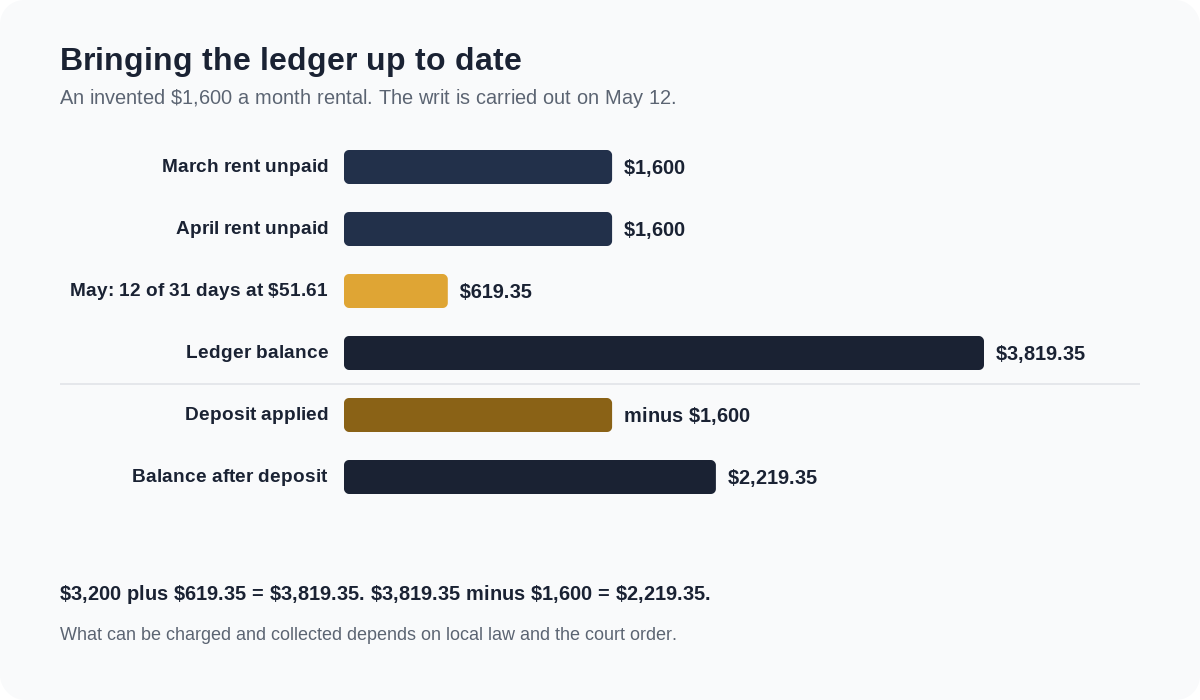
Whether the May days can be charged as rent, and whether any remaining balance is part of a judgment, depends on local law and the court's order. An attorney can tell you how it works where the property sits.
Good practice around a writ of possession
- Get legal advice early. Eviction procedure is strict and varies a great deal by place. An attorney can keep the case from restarting over a missing step.
- Keep the ledger current. Record every charge, payment and credit with its date, so the amounts in the case match your records.
- Keep copies of everything. Notices, proof of delivery, court papers and the writ itself.
- Plan the day with the officer. Follow the officer's instructions about timing, locksmiths and who may enter.
- Document the unit. Photos and a checklist at the return of possession help with the deposit statement and any later dispute.
- Respect the tenant's rights until the end. The right to quiet enjoyment and the rules on notice of entry still apply while the tenant lives in the home.
Frequently asked questions
What does a writ of possession do?
It orders a public officer, such as a sheriff or marshal, to return a property to its owner. It usually follows a court judgment for possession in an eviction case when the tenant has not left.
Who carries out a writ of possession?
The officer named in it, usually a sheriff, marshal or constable. The owner does not remove anyone personally, and self-help steps such as changing locks before the officer acts are prohibited in most places.
Is a writ of possession the same as a judgment?
No. The judgment is the court's decision that the owner is entitled to possession. The writ is the order that puts that decision into effect. Unpaid rent is usually handled separately.
Can a tenant stop a writ of possession?
In some places and situations, yes, for example by paying what is owed where local law allows it, by agreement with the owner or through an appeal. Those options and their timing depend on local law.
How do you work out rent for part of the final month?
Divide the monthly rent by the days in the month and multiply by the days the tenant stayed. In the example, $1,600 x 12 / 31 = $619.35, for a ledger balance of $3,819.35 before the deposit.
Keep every charge and payment on the right property
A ledger is easier to bring up to date when every payment is already recorded against its property. In KeyRing, you connect your bank accounts securely through Plaid, and each transaction is matched to a property with suggestions you confirm. Income and expense records use categories you can edit, and you can export your transactions to Excel. See what KeyRing does or how plans are priced.
Free calculators and templates
- Rental inspection checklistA room by room check of an occupied rental, with the repairs it turns up.
Browse all rental property calculators, free templates and the glossary.
From the blog
- Cash for keys: how it works and what to put in the agreementCash for keys is a deal where a property owner pays a tenant to move out by a set date. See how it works, how to weigh the cost and what the agreement covers.
- What is a squatter? Squatters' rights and what property owners can doA squatter occupies a property without the owner's permission. What squatters' rights really mean, how adverse possession works and how owners respond lawfully.
- What is a holdover tenant? Your options when a lease ends and the tenant staysA holdover tenant stays in a rental after the lease ends without a new agreement. See your options, what holdover rent can look like and how to avoid one.