What is a lease termination? The ways a lease can end

A lease termination is the end of a lease and of the tenancy it created. Most leases end quietly when the term runs out, and many others end because one side gives proper notice. A lease can also end early: by a written agreement between owner and tenant, under an early termination clause, through a lease assignment or sublease arrangement, or by a court order. How it ends decides what each side still owes. In the worked example below, an invented early termination clause lets a tenant leave on August 20 for a $3,200 fee plus $1,032.26 of final rent, compared with $6,400 of rent left on the term.
This page covers what a lease termination is, the common ways a lease ends, how early termination clauses and fees usually work, what happens at move-out, a worked example and the records worth keeping. It is general information and is not legal or tax advice. Rules vary by state and city. Check your local law or an attorney.
What is a lease termination?
A lease is a contract that gives a tenant the right to live in a home for a period of time in exchange for rent. A lease termination ends that right. After the termination date, the tenant is expected to move out, the owner settles the final balance and the security deposit, and the obligations under the lease stop, apart from anything still owed.
People also use the phrase for the document that ends a lease, such as a termination agreement signed by both sides or a written notice from one of them. The word covers both the event and the paperwork.
A termination is different from a renewal. A lease renewal continues the tenancy on new or the same terms, while a termination closes it.
The common ways a lease ends
How a lease ends depends on the type of lease, what it says and local law. The common paths are:
- The term runs out. A fixed-term lease, such as a 12-month lease, ends on its end date. Some leases end on that date automatically, and others roll into a month-to-month tenancy unless someone gives notice. If the tenant stays past the end date without a new agreement, the guide to holdover tenants explains what usually follows.
- Notice on a periodic tenancy. A month-to-month lease or a tenancy at will continues until one side gives written notice. A tenant usually gives a notice to vacate. The required notice period and reasons, if any, are set locally.
- Mutual agreement. The owner and tenant can agree in writing to end the lease on a chosen date, often with terms about final rent and the deposit. This is sometimes called a lease surrender or a mutual termination.
- An early termination clause. Some leases let the tenant end early by giving notice and paying a set fee. The next section covers how these usually work.
- A legal right to end early. In many places, tenants can end a lease early in specific situations set by law, for example certain military orders, some safety situations or a home that is no longer fit to live in. The entries on constructive eviction and the warranty of habitability cover that last one.
- Someone else takes over. A tenant may hand the lease to a new tenant through a lease assignment, or rent the home to a subtenant through a sublease. An assignment can end the original tenant's role in the home, though often without ending their liability. A sublease keeps the original lease running.
- A court order. If a tenant breaks the lease and does not fix the problem after a notice to quit, the owner may ask a court to end the tenancy through an eviction case. Only a court process can remove a tenant, and owners should not use self-help such as changing locks, shutting off utilities or removing belongings.
Early termination clauses and fees
An early termination clause sets out how a tenant can leave before the term ends. Common features include:
- A notice requirement. The tenant tells the owner in writing by a stated point, such as one or two months before the new end date.
- A fee. Often a flat amount or a number of months of rent. The fee replaces some or all of the rent the tenant would otherwise owe for the rest of the term.
- Rent through the termination date. The tenant pays rent up to the day the lease ends, which may mean a prorated final month.
- Move-out terms. The usual move-out inspection, keys returned and deposit handled under local rules.
Some places limit what an early termination fee can be, or require the owner to try to re-rent the home and count that rent against what the tenant owes. Without any clause, a tenant who leaves early may be liable for the rent left on the lease, though many places expect the owner to make a fair effort to find a new tenant first. Check local rules before setting or charging a fee.
What happens at move-out
Whatever the path, the end of a lease usually follows the same steps:
- Confirm the date in writing, along with how keys will be returned.
- Charge final rent through the termination date. A partial month can be worked out with the prorated rent calculator.
- Inspect the home against the move-in condition. A move-out checklist helps keep this consistent.
- Settle the deposit under local rules, with an itemized list of any deductions and the time limit for returning it.
- Close the ledger so the final charges, payments and deposit settlement all show up in one place.
A worked example: an early termination fee
All the figures here are made up. A tenant has a 12-month lease at $1,600 a month that runs to December 31. The lease has an early termination clause: the tenant may end the lease early with written notice by the 1st of the month before, by paying a fee equal to two months of rent and paying rent through the move-out date.
The tenant accepts a job in another city, gives notice on July 1 and sets the move-out date as August 20. August has 31 days, and the lease prorates by the actual days in the month. Using the prorated rent calculator:
- Daily rate: $1,600 / 31 = $51.61
- August rent through the 20th: $1,600 x 20 / 31 = $1,032.26
- Early termination fee: 2 x $1,600 = $3,200
- Due at move-out: $1,032.26 + $3,200 = $4,232.26
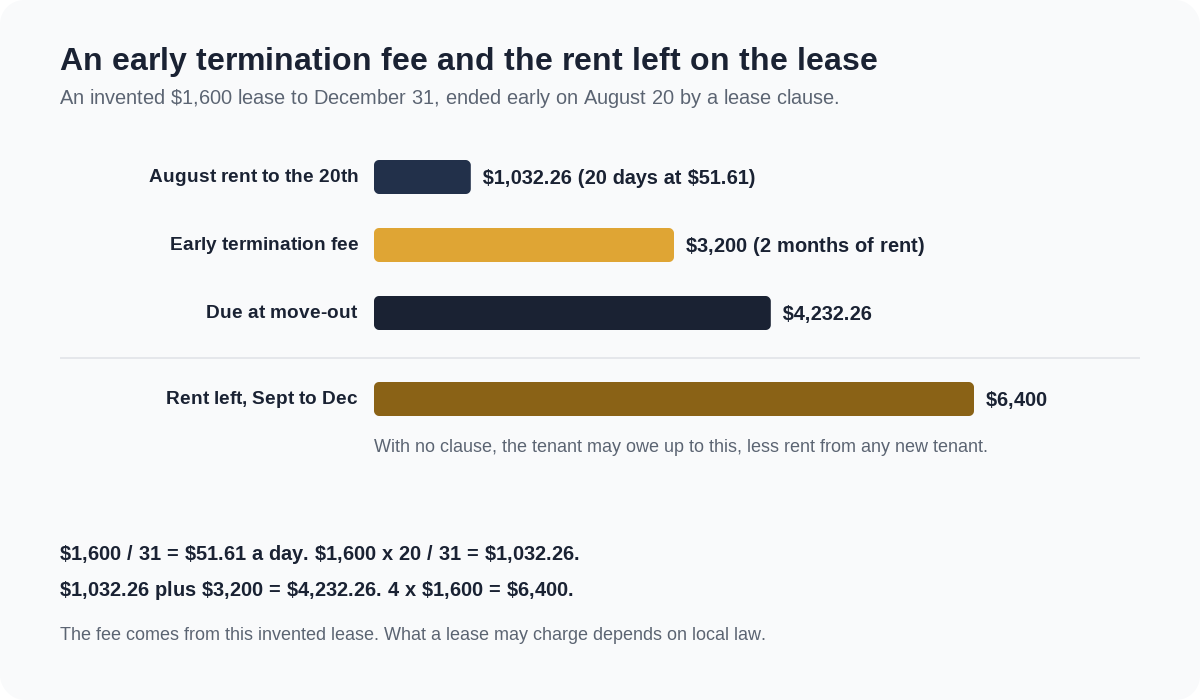
From September through December there are 4 months left: 4 x $1,600 = $6,400. With the clause, the tenant pays $3,200 for that period and the lease is over. Without a clause, the tenant may have owed up to $6,400, less any rent the owner collected from a new tenant in that time. For the owner, the fee gives a known amount up front while the home is re-rented.
The owner records the August charge, the fee and the payment on the rent ledger, then settles the security deposit separately after the move-out inspection.
Records worth keeping
When a lease ends, a clear file helps if a question comes up later.
- The signed lease and any clause the termination relied on.
- The written notice or termination agreement, with the date it was given or signed.
- The final rent calculation and any fee charged.
- The move-out inspection, with photos, compared with the move-in record.
- The deposit settlement, with the itemized list and proof of when it was sent.
Frequently asked questions
What does lease termination mean?
It means the lease and the tenancy it created have ended. That can happen at the end of the term, after proper notice on a periodic tenancy, by written agreement, under an early termination clause or by a court order.
Can a tenant end a lease early?
Often, yes, though it may cost something. The lease may have an early termination clause with a fee, the owner may agree to a mutual termination, or local law may allow early termination in specific situations. Without any of these, the tenant may still owe rent for the rest of the term.
How much is a typical early termination fee?
It is set by the lease, and some places limit it. Many leases use one or two months of rent. In the example on this page, a two-month fee on a $1,600 lease is $3,200, compared with $6,400 of rent left on the term.
Is a lease termination the same as an eviction?
No. Most terminations happen without a court: the term ends, someone gives notice or both sides agree. An eviction is the court process an owner uses to recover the home when a tenant does not leave, and only a court order can lead to removal.
What should a lease termination agreement include?
In general: the names of the owner and tenant, the property address, the termination date, any fee, how final rent is calculated, how keys are returned and how the security deposit will be handled. Both sides sign and date it, and each keeps a copy.
Keep the end of every lease on the record
The end of a lease goes more smoothly when the dates, documents and balance are all in one place. In KeyRing, you create a lease for each unit, attach documents to it, and schedule a move-out or end the lease when the time comes. KeyRing sends automatic lease-expiry reminders by email and push to you and the tenant 30 days before the end date, and each lease keeps its rent charges, payments and balance, so you can record cash and check payments, including partial ones. See what KeyRing does or how plans are priced.
Free calculators and templates
Browse all rental property calculators, free templates and the glossary.
From the blog
- What is a sublease? What property owners should put in writingA sublease is a tenant renting their home to someone else for part of the lease. How it differs from an assignment, who owes the rent and what goes in writing.
- What is a month-to-month lease? How it works and how to end oneA month-to-month lease renews each month until either side gives written notice. How notice and rent increases work, pros and cons, and sample lease language.
- What is a holdover tenant? Your options when a lease ends and the tenant staysA holdover tenant stays in a rental after the lease ends without a new agreement. See your options, what holdover rent can look like and how to avoid one.