What is an eviction? The court process to recover a rental

An eviction is the legal process a property owner uses to recover possession of a rental from a tenant. It usually starts with a written notice, moves to a case in the local court if the problem is not resolved, and ends with a judge's decision. Only a court order carried out by a public officer can remove a tenant who stays. Most evictions start with unpaid rent, and many end before a judge ever hears them, through a payment plan or an agreed move-out. In the worked example below, an agreed move-out costs an owner $4,075 on paper, while a case that runs three more months without rent costs $6,075 before any legal costs.
This page covers what an eviction is, the general stages of the process, why owners should not act on their own, common alternatives, what drives the cost, a worked example and good record keeping. It is general information and is not legal or tax advice. Rules vary by state and city. Check your local law or an attorney.
What is an eviction?
People use "eviction" loosely for any time a tenant has to leave. In law, an eviction is the court process that ends a tenant's right to stay and returns possession of the home to the owner. The owner asks a court to decide, the tenant has a chance to respond, and a judge rules.
The process exists to protect both sides. The owner gets a lawful way to recover the property, and the tenant gets notice and a hearing before losing their home. Because of that, an owner who wants a tenant out generally has to go through the court, even when the lease has clearly been broken.
Eviction is different from a few related ideas:
- A notice to quit is the written notice that usually comes first. On its own it cannot remove anyone.
- A late rent notice is an informal reminder about overdue rent, sent before any formal notice.
- Constructive eviction describes a tenant who moves out because the owner left the home unusable. No court case is involved.
- A lease termination can happen in many ways, and most of them need no court at all.
Common reasons for an eviction
The grounds an owner can use are set by local law, and some places limit them further. In general, cases fall into a few groups:
- Unpaid rent. The most common reason.
- A broken lease rule. For example, an unauthorized occupant, a pet the lease does not allow or repeated noise complaints. A lease violation notice is often the first step.
- Staying after the lease ends. A tenant who stays past the end of the term without a new agreement is often called a holdover tenant.
- Serious harm or illegal activity at the property.
- Ending a periodic tenancy, such as a month-to-month lease, where local law allows it. Some places require a stated reason even then.
A person who moves in without ever having a lease is a different situation. The guide to squatters covers how that usually differs.
The general stages of an eviction
Every place sets its own steps, deadlines and forms, so treat this as a general outline only.
- Written notice. The owner gives the tenant notice of the problem and a date to fix it or leave. The form, the notice period and how it must be delivered all depend on local law.
- Filing a case. If the tenant does not fix the problem or leave, the owner files a case in the local court and the tenant is formally served with the papers.
- The tenant's response and a hearing. The tenant can respond and raise defenses, such as a repair problem or a mistake in the notice. Both sides can bring records to the hearing. Some courts offer mediation first.
- Judgment. The judge decides whether the tenancy ends and may decide what money is owed. If the owner wins, the tenant may be given a short time to move out.
- Writ and removal. If the tenant still stays, the owner asks the court for an order that lets a public officer, such as a sheriff or marshal, return possession. The entry on a writ of possession covers this stage.
A mistake at any stage, such as a notice with the wrong amount or the wrong delivery method, can send the owner back to the start.
Self-help eviction is prohibited
A court process is required to remove a tenant. Owners should not change the locks, remove a tenant's belongings, shut off utilities or take doors and windows off to force someone out, even after a notice period ends. Those self-help steps are prohibited in most places, and an owner who uses them may owe the tenant money and still have to go to court. Only a public officer acting on a court order carries out a removal.
Alternatives to an eviction case
Many disputes end without a judgment. Common options include:
- A payment plan. When a tenant has fallen behind but can catch up, a written plan that spreads the balance over a few months can keep a good tenancy going.
- Cash for keys. The owner pays the tenant an agreed amount to move out by a set date and leave the unit in an agreed condition. The guide to cash for keys covers how these agreements usually work.
- A mutual move-out agreement. Owner and tenant agree in writing to end the lease on a set date, sometimes with part of the balance waived.
- Mediation. Some courts and local programs offer a neutral mediator who helps both sides reach terms.
Whatever the terms, put the agreement in writing and have an attorney review it, especially if a case has already been filed.
What drives the cost of an eviction
The cost of an eviction varies widely by place and by how the case goes, so this section gives no typical amounts. The main parts are:
- Rent that goes unpaid while the process runs, often the largest part.
- Court and service costs, which vary by place.
- Attorney fees, if the owner hires an attorney.
- Turnover costs after the unit is returned, such as cleaning, repairs and the time it sits empty.
Money a court awards is a separate question from money actually collected, so many owners compare the cost of a case with the cost of an agreed move-out.
A worked example: an agreed move-out compared with a court case
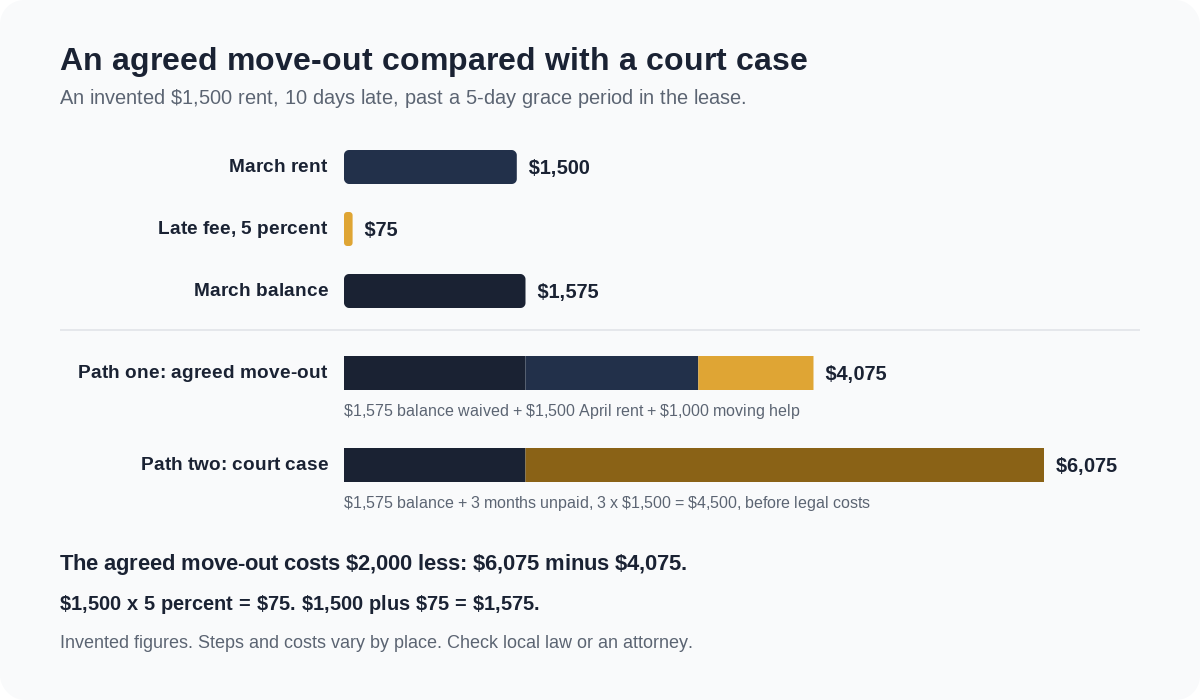
All the figures here are made up, and the timeline is invented. A tenant rents a home for $1,500 a month, due on the 1st. The lease charges a late fee of 5 percent of the rent once a 5-day grace period has passed. March rent has not arrived by March 11, so it is 10 days late.
Using the site's late fee calculator with those lease terms:
- Days late: 10, which is past the 5-day grace period, so the fee applies
- Late fee: $1,500 x 5 percent = $75.00
- Balance on the tenant's ledger: $1,500 + $75 = $1,575
The tenant tells the owner they cannot catch up. The owner compares two paths.
Path one: an agreed move-out. The tenant agrees in writing to leave by April 30. The owner pays $1,000 toward moving costs, does not collect April rent and waives the March balance.
- Waived March balance: $1,575
- April rent not collected: $1,500
- Moving help paid: $1,000
- Total: $1,575 + $1,500 + $1,000 = $4,075
Path two: a court case. In this invented timeline the case and the removal run through the end of June, and no rent is paid for April, May or June.
- March balance: $1,575
- Unpaid rent for three months: 3 x $1,500 = $4,500
- Total before any legal costs: $1,575 + $4,500 = $6,075
On these made-up numbers, the agreed move-out costs $2,000 less, before counting any court or attorney costs on the second path. The second path also carries a judgment for the unpaid amount, but a judgment does not guarantee the money is collected.
A rent ledger that shows each charge, fee, notice and payment makes either path simpler to document. The prorated rent calculator helps if a move-out date falls partway through a month.
Good record keeping before and during an eviction
- Keep the lease and every signed addendum in one place.
- Keep the ledger current. Record each charge, late fee and payment, including partial ones, on the date it happened. In some places, accepting a partial payment after a notice can affect the case, so ask an attorney first.
- Keep copies of every notice and proof of how and when it was delivered.
- Keep repair requests and responses. A tenant may raise the condition of the home as a defense, and dated records help show what was done.
- Put agreements in writing, including payment plans and move-out terms.
- Talk to an attorney before serving a notice and before each later step.
Frequently asked questions
What does eviction mean?
An eviction is the court process a property owner uses to recover possession of a rental from a tenant. It usually starts with a written notice and ends with a judge's decision. Only a court order carried out by a public officer can remove a tenant who stays.
What are the general steps of an eviction?
In general: written notice, filing a case in the local court, the tenant's response and a hearing, a judgment and, if the tenant still stays, a court order carried out by a public officer. The exact steps, forms and deadlines vary by state and city.
Can an owner change the locks to evict a tenant?
In most places, no. Changing locks, removing belongings or shutting off utilities to force a tenant out is prohibited self-help. A court process is required to remove a tenant.
What are the alternatives to an eviction?
Common options are a written payment plan, a cash for keys agreement, a mutual move-out agreement and mediation. Each should be in writing, and an attorney can review the terms.
Is cash for keys cheaper than an eviction?
It can be, depending on the facts. In the invented example, an agreed move-out costs $4,075 and a court case running through June costs $6,075 before legal costs, a difference of $2,000.
Keep each tenant's balance clear before an eviction
A clear balance makes every next step simpler. In KeyRing, each lease keeps its rent charges, payments and balance, you can record cash and check payments, including partial ones, and overdue invoices are flagged automatically. Each month's rent invoices are drafted for you to approve before they are sent, and each tenant gets a PDF invoice by email. See what KeyRing does or how plans are priced.
Free calculators and templates
- Late fee calculatorA rent late fee as a flat amount or a percentage, with a grace period.
- Rent statement templateA tenant's charges, payments and balance for a period, from the opening balance to what is due now.
Browse all rental property calculators, free templates and the glossary.
From the blog
- Cash for keys: how it works and what to put in the agreementCash for keys is a deal where a property owner pays a tenant to move out by a set date. See how it works, how to weigh the cost and what the agreement covers.
- What is a holdover tenant? Your options when a lease ends and the tenant staysA holdover tenant stays in a rental after the lease ends without a new agreement. See your options, what holdover rent can look like and how to avoid one.
- What is a squatter? Squatters' rights and what property owners can doA squatter occupies a property without the owner's permission. What squatters' rights really mean, how adverse possession works and how owners respond lawfully.