Cash for keys: how it works and what to put in the agreement
By Jenna Whitfield -

Cash for keys is an agreement in which a property owner pays a tenant to move out by an agreed date, leave the unit empty and hand back the keys. The tenant gets money toward the move and a clean exit; the owner gets the unit back on a known date, often sooner and for less than a court process would take.
It is a voluntary deal. The tenant can say no, and the owner pays only once the tenant has left as agreed. This guide covers when cash for keys makes sense, how the process usually runs, a worked cost comparison for an invented unit and the terms a written agreement should cover. It is general information and is not legal advice. The rules for ending a tenancy, eviction and tenant buyouts are set by each state, and some cities add their own, so check your state's rules and any local rules before you make an offer. A local attorney can review the agreement.
When property owners offer cash for keys
Cash for keys is most common when a tenancy needs to end and the usual paths are slow or costly:
- The tenant is behind on rent and an eviction would take weeks or months, with no rent coming in.
- The lease has ended and the tenant has not moved out.
- You are selling, renovating or moving into the property and need it empty by a certain date.
- The relationship has broken down and both sides would rather part on agreed terms.
For the tenant, the offer can help too. The payment covers moving costs, and leaving by agreement avoids an eviction case, which can follow a tenant onto future rental applications.
How cash for keys works, step by step
- Run the numbers. Estimate what the alternative would cost you: the rent you would lose while the unit stays occupied and unpaid, and the fees for filing, service and an attorney. The example below shows the comparison.
- Make the offer in writing. Keep it short and factual: the amount, the move-out date and the conditions. Present it as an offer the tenant is free to accept or decline, and make offers on consistent terms to every tenant in a similar situation.
- Agree on the terms and sign. Put everything in a written agreement signed by everyone on the lease. The section below lists what it should cover.
- Walk the unit on move-out day. Check that it is empty and in the agreed condition, take dated photos, and collect every key, remote and access card.
- Pay as agreed. Most agreements pay in full when the keys come back and the walkthrough is done. Some pay a small part earlier to help with moving costs.
- Close out the tenancy. Handle the security deposit as your state requires and keep the signed agreement, the photos and proof of payment with the lease.
Keep the whole process voluntary. Lockouts, removing doors or cutting off utilities to push a tenant out are against the law in most states, and pressure on the tenant can put the agreement itself at risk.
Is cash for keys cheaper than an eviction? A worked example
Unit 3 of an invented fourplex rents for $1,500 a month, and the tenant has stopped paying. You compare two paths from today. The amounts below are this example's assumptions; eviction timelines and fees vary a lot by state and court, so use your own estimates.
- Eviction: you expect the unit back in about 3 months, with $1,800 in filing, service and attorney fees.
- Cash for keys: you offer $2,000 for a move-out in 1 month, paid when the keys come back.
| Cost from today | Eviction | Cash for keys |
|---|---|---|
| Time to get the unit back | 3 months | 1 month |
| Rent lost while you wait ($1,500 a month) | $4,500 | $1,500 |
| Filing, service and attorney fees | $1,800 | $0 |
| Payment to the tenant | $0 | $2,000 |
| Total cost | $6,300 | $3,500 |
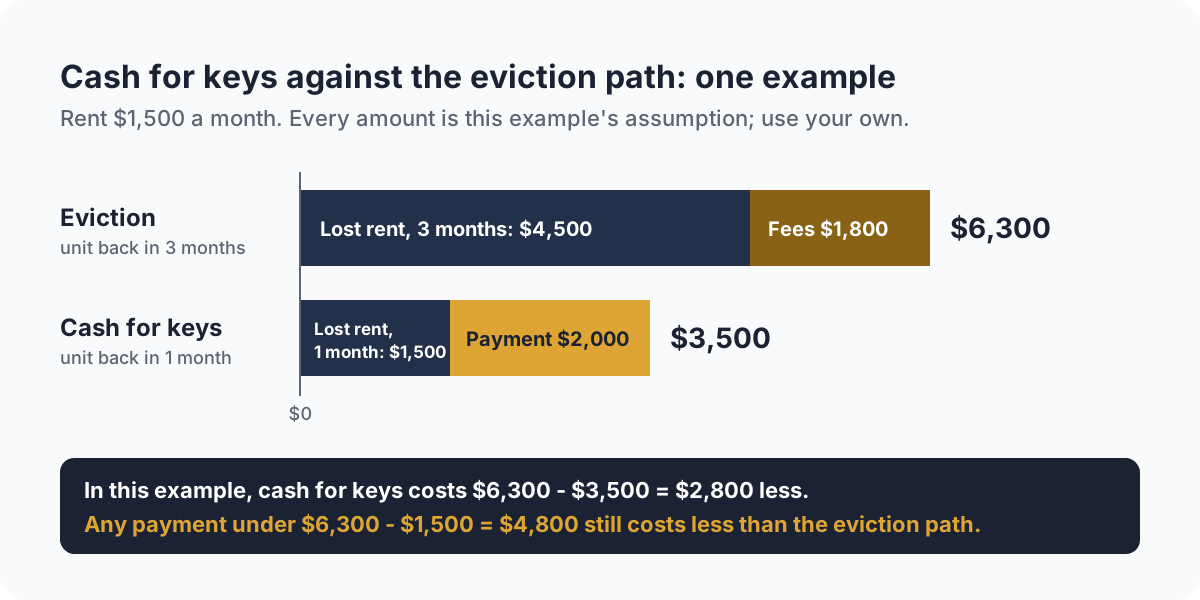
The arithmetic: $4,500 + $1,800 = $6,300 for the eviction path and $1,500 + $2,000 = $3,500 for cash for keys, a difference of $6,300 - $3,500 = $2,800. The comparison also gives you a ceiling for the offer. With $1,500 of lost rent on the cash for keys path, any payment under $6,300 - $1,500 = $4,800 still costs less than the eviction path in this example.
Both columns leave out the rent already owed, on the assumption that you would struggle to collect it either way, and the cost of getting the unit ready for the next tenant, which you pay on both paths. To estimate the rent for a partial month on either side of a move-out date, the prorated rent calculator does the daily math.
What to put in a cash for keys agreement
A clear agreement answers every question before move-out day. Most cover these terms:
- The parties and the property. Everyone on the lease and every adult living in the unit, and the property and unit.
- The move-out date and time. The date by which everyone has moved out and every belonging is gone.
- The payment. The amount, how it is paid (check or bank transfer) and when: usually on the day the keys come back, after the walkthrough.
- The condition of the unit. Usually empty and broom-clean, with no trash or belongings left. Say what happens to anything left behind, following your state's rules on abandoned property.
- Keys and access. Every key, garage remote, mailbox key and access card, returned by the move-out time.
- Rent and other balances. Whether rent is owed up to the move-out date and whether any past-due balance is waived. Put a waiver in writing so neither side has a different memory of it later.
- The security deposit. Deposit rules generally still apply, so say how the deposit will be handled and return it, or send an itemized statement, as your state requires. The wear and tear guide covers fair deductions.
- A forwarding address and utilities. Where to send the deposit and any notices, and the date utilities in the tenant's name will be closed.
- What happens if the date is missed. Usually the offer lapses and no payment is due. Spell it out.
- Signatures and dates. Every adult on the lease signs, you sign, and everyone keeps a copy.
Some agreements also include a release in which both sides give up claims against each other. That term has legal weight, so have an attorney draft it. If an eviction case has already been filed, the agreement may need to be filed with the court or tied to the case being dismissed; ask your attorney how it fits.
A few cities with rent control, San Francisco and Los Angeles among them, have their own rules for buyout agreements, such as a written disclosure before talks begin, a period in which the tenant can cancel, and filing the agreement with the city. Check your state's rules and any local rules before you start.
Records to keep
- The signed agreement, with every page and every signature.
- Dated move-out photos and video, room by room, to compare with the move-in set. The move-out checklist gives you a room-by-room list to work from.
- Proof of payment, such as a cancelled check or a transfer confirmation.
- Key return and deposit records, including the itemized statement and the date you sent it.
The payment is a cost of the rental. Ask a tax professional how to record it and whether any tax forms apply.
Frequently asked questions
What is cash for keys?
It is a voluntary agreement in which a property owner pays a tenant to move out by a set date, leave the unit empty and return the keys. The owner pays once the tenant has left as agreed.
How much should I offer for cash for keys?
There is no set amount. Many offers start from the tenant's moving costs, such as a truck and a deposit on the next place, and stay below what the alternative would cost you. In the example above, the eviction path costs $6,300, so any payment under $4,800 costs less.
Is a cash for keys agreement legally binding?
A written agreement signed by both sides is generally a contract, but whether a particular term holds up depends on state and local law. Check your state's rules, and have a local attorney review the agreement, especially any release of claims.
When do I pay the tenant?
Usually when the tenant has moved out, the walkthrough shows the unit empty and in the agreed condition, and every key is back. Some owners pay a small part earlier to help with moving costs and the rest at move-out.
Can I offer cash for keys during an eviction?
Often, yes. Many cases end with an agreement to move out by a date. If a case is already filed, the agreement may need to be filed with the court, so ask your attorney how to handle it.
Keep the move-out and its paperwork together
A cash for keys deal ends a tenancy, and KeyRing keeps the steps in one place. You can end the lease or schedule the move-out, file the signed agreement and other move-out documents to the lease or tenant they belong to, record the payment as an expense, and follow the deposit in the lease's security deposit ledger, from deductions to the refund. See what KeyRing does or how plans are priced.