What is a notice of non-renewal? Ending a lease on its end date

A notice of non-renewal is written notice that a fixed-term lease will end on its end date and will not be renewed or extended. Either the property owner or the tenant can send one. It gives the other side time to plan: the tenant to find a new home, the owner to prepare the unit and find the next tenant. In the worked example below, a lease that ends on June 30 asks for 60 days of notice, so the notice has to arrive by May 1.
This page covers what a notice of non-renewal is, who sends it, how much notice is usually needed, where the rules limit non-renewal, what the notice usually includes, what happens if the tenant stays, a worked example and the mistakes that cause problems. It is general information and is not legal or tax advice. Rules vary by state and city. Check your local law or an attorney.
What is a notice of non-renewal?
A fixed-term lease, such as a one-year lease, has an end date. As that date gets close, the tenancy can go one of a few ways: a lease renewal for a new term, a shorter lease extension, a rollover to month to month, or an ending. A notice of non-renewal is how one side tells the other, in writing, that it wants the ending. The lease runs to its last day on its current terms, and then the tenancy is over.
The notice does not end the lease early. Rent stays due through the end date, and both sides keep their duties under the lease until then. Ending a lease before its end date is a different step, covered in the entry on lease termination.
Who sends a notice of non-renewal
- The owner. An owner may plan to sell, move in, renovate or rent to someone else, or may not want to continue with a tenant. The owner's notice tells the tenant the lease will not be offered again.
- The tenant. A tenant who is buying a home, moving for work or simply moving on can send the notice to confirm the move-out date. Many leases ask the tenant for written notice even when the lease has a fixed end date.
When the tenant is the one leaving, the written notice usually doubles as a notice to vacate, the notice that gives the date the unit will be empty.
How much notice is usually needed
Start with the lease. Many leases say how much written notice either side must give before the end date, and some say the lease rolls over to month to month, or renews, if nobody gives notice in time. Many leases and many places ask for notice a month or more before the end date. Some places set a minimum for owners, and the minimum can be longer for a tenant who has lived in the home for years. Check both the lease and the local rule, and use whichever asks for more time.
If the notice arrives late, the lease may roll over to month to month under its own terms. The guide to a month-to-month lease explains how that arrangement works and how it can later end.
Where the rules limit non-renewal
In many places, an owner can choose not to renew a lease at its end without giving a reason. Some places are different:
- Some cities have just-cause rules that let an owner decline to renew only for reasons the rules list, such as nonpayment or the owner moving in, and some of those rules require relocation payments.
- Some places limit non-renewal for certain types of housing, such as rent-stabilized or subsidized units. The entry on rent stabilization explains how those programs generally work.
- A non-renewal should never be used to retaliate against a tenant who asked for repairs or reported a problem, or to discriminate. Both are prohibited in most places.
Because these rules vary so much, an owner who is unsure should check with an attorney before sending the notice.
What a notice of non-renewal usually includes
- The names of the tenant and the owner, and the property address.
- The lease's start date and end date.
- A clear statement that the lease will not be renewed or extended and will end on the end date.
- The date the tenant is expected to return the keys and leave the unit.
- Any reason, where the lease or local rules require one.
- Move-out details, such as how to arrange the final walk-through and where to send the forwarding address for the security deposit.
- The date the notice was delivered and how it was delivered.
Deliver the notice the way the lease and local rules allow, such as by hand or by mail, and keep a copy with proof of the delivery date. This page does not provide sample letter wording, so have an attorney review any notice you plan to rely on.
If the tenant stays after the end date
A tenant who stays after the lease ends without an agreement is often called a holdover tenant. What happens next depends on the lease and local law: some leases set a holdover rent, and in some places accepting rent after the end date can create a new month-to-month tenancy or a tenancy at will. The guide to a holdover tenant covers the common outcomes.
If the tenant still does not leave, the owner may need to give a further notice, such as a notice to quit, and only a court can order the tenant out through an eviction. An owner should never change the locks or remove belongings to force a move-out.
A worked example: counting back from the end date
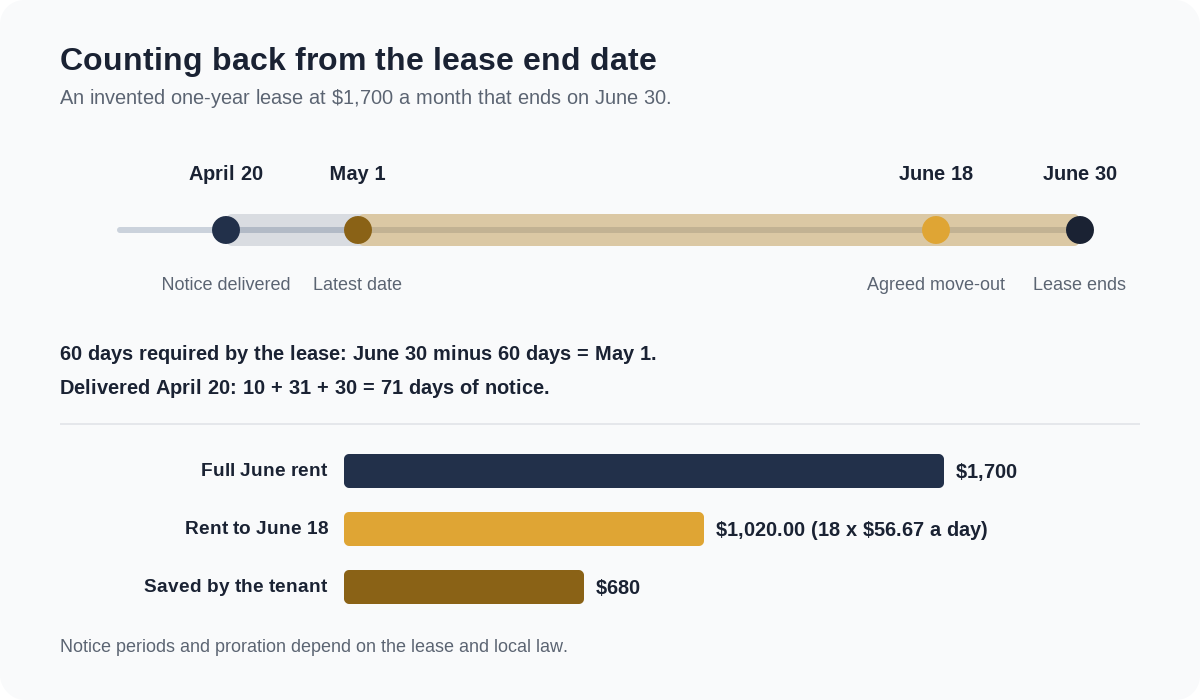
All the figures here are made up. A tenant pays $1,700 a month on a one-year lease that ends on June 30, 2027. The lease's own terms say either side must give at least 60 days of written notice if it does not want to renew. The owner plans to sell the home and decides not to renew.
- Latest date for the notice: June 30 minus 60 days = May 1
- The owner delivers the notice on April 20, which gives 71 days of notice: 10 days left in April, 31 in May and 30 in June.
In May, the tenant finds a new home and asks to leave on June 18. The lease does not require it, but the owner agrees in writing to end the tenancy on June 18 and charge June rent through that day only. Using the site's prorated rent calculator with the actual days in June:
- Daily rate: $1,700 / 30 = $56.67 a day
- June rent through June 18: 18 x $56.67 = $1,020.00
- What the early move-out saves the tenant: $1,700 minus $1,020 = $680
A rent statement for the final month shows the tenant the prorated charge and any payments, and the rental inspection checklist helps both sides record the unit's condition at the walk-through.
Mistakes that cause problems
- Counting from the wrong date. Count the notice period back from the lease's end date, and leave extra days for mail.
- Missing the lease's own notice term. A notice that arrives late can let the lease roll over or renew under its own terms.
- Skipping the local rule. A city's just-cause or notice rule can override what the lease says.
- Leaving it verbal. A spoken notice is hard to prove. Put it in writing and keep proof of delivery.
- Forgetting the deposit. Plan the walk-through and the deposit return before the end date arrives.
Frequently asked questions
What does a notice of non-renewal mean?
It means one side, the owner or the tenant, is telling the other in writing that the fixed-term lease will end on its end date and will not be renewed or extended.
Does an owner need a reason not to renew a lease?
In many places, no, but some cities have just-cause rules that list the reasons an owner can use, and some types of housing have their own limits. A non-renewal should never be retaliation or discrimination. Rules vary by state and city, so check the local rule or an attorney.
How much notice does a notice of non-renewal need?
It depends on the lease and local law. Many leases and many places ask for notice a month or more before the end date. In the example, the lease asks for 60 days before a June 30 end date, so the notice is due by May 1.
What happens if a tenant stays after a notice of non-renewal?
The tenant may be treated as a holdover. Depending on the lease and local law, the owner may need to give a further notice, and only a court can order the tenant out.
Can a tenant send a notice of non-renewal?
Yes. A tenant who plans to leave at the end of the lease can send one, and many leases ask for written notice from the tenant before the end date. It usually also serves as the tenant's notice to vacate.
Keep each lease end date and move-out on the record
A notice of non-renewal works best when you see the end date coming. KeyRing sends automatic lease-expiry reminders by email and push to you and the tenant 30 days before the end date, and each lease keeps its rent charges, payments and balance. In KeyRing, you create a lease for each unit, attach documents to it, and schedule a move-out or end the lease when the time comes. See what KeyRing does or how plans are priced.
Free calculators and templates
- Rent increase calculatorA new rent from a percentage or dollar increase, with the yearly difference.
- Rental inspection checklistA room by room check of an occupied rental, with the repairs it turns up.
- Rent statement templateA tenant's charges, payments and balance for a period, from the opening balance to what is due now.
Browse all rental property calculators, free templates and the glossary.
From the blog
- What is a holdover tenant? Your options when a lease ends and the tenant staysA holdover tenant stays in a rental after the lease ends without a new agreement. See your options, what holdover rent can look like and how to avoid one.
- What is a month-to-month lease? How it works and how to end oneA month-to-month lease renews each month until either side gives written notice. How notice and rent increases work, pros and cons, and sample lease language.
- What is normal wear and tear? How it differs from damageNormal wear and tear is the decline that comes from ordinary use. See how it differs from damage, common examples and how to work out a fair deposit deduction.