What is rent stabilization? How local rent limits work

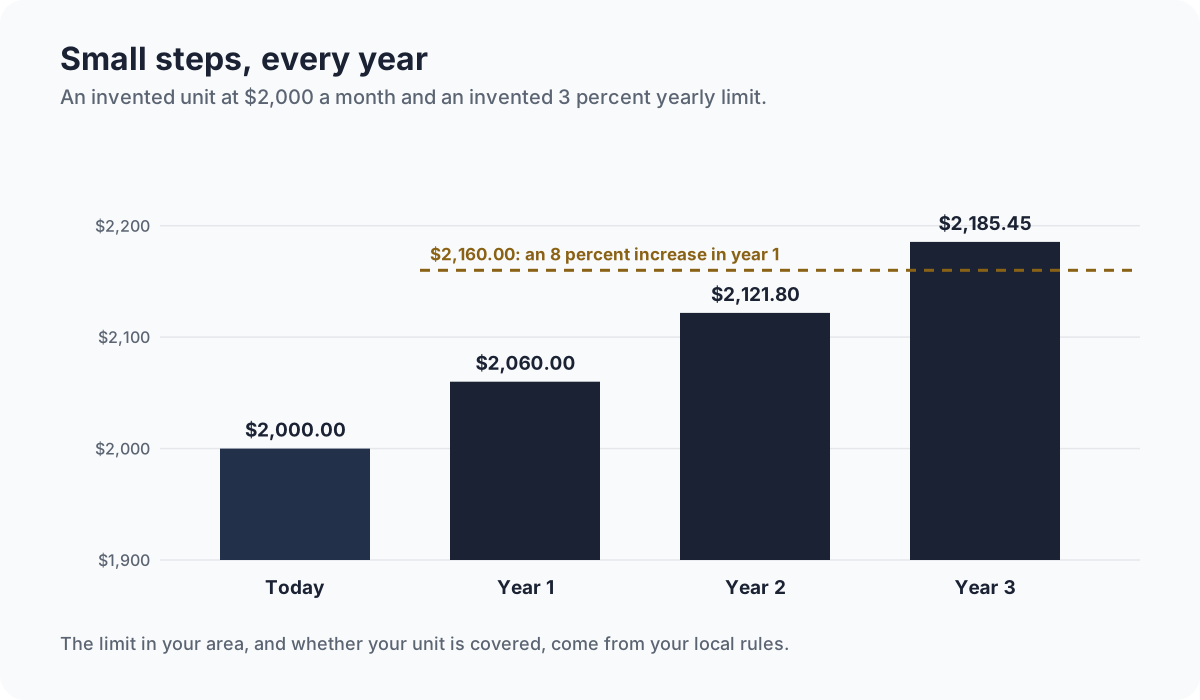
Rent stabilization is a set of local or state rules that limit how much the rent on a covered unit can go up, usually once a year, by a percentage set by a board or a formula. Most programs also give tenants added protections, such as a right to renew the lease, and give owners duties, such as registering the unit and its rent. Under an invented 3 percent yearly limit, a $2,000 stabilized unit can go to $2,060.00 in the next year, where an uncapped 8 percent increase would have made it $2,160.00.
This page covers what rent stabilization is, how it differs from rent control, which units are often covered, a worked example, what owners usually have to track and the mistakes that cost owners money. Rent stabilization is local by nature, and the details on this page are general patterns. It is general information and is not legal or tax advice. Rules vary by state and city. Check your local law or an attorney.
What is rent stabilization?
A rent stabilization program sets a legal rent for each covered unit and limits how fast that rent can rise. The limit is usually one of these:
- A percentage set each year by a local rent board after public hearings.
- A formula tied to inflation, such as a share of the change in a consumer price index, sometimes with a ceiling.
- A fixed percentage written into the law.
Many programs go further. Common features include a right for the tenant to renew the lease on similar terms, limits on ending a tenancy to reasons the law lists, a duty to register the unit and its rent with a local agency, and a process for the owner to apply for a larger increase after major building improvements or in cases of financial hardship. Which of these apply, and how, depends entirely on the program.
Rent stabilization vs rent control
People often use the two terms for the same thing. Where both exist as separate programs, "rent control" usually means an older, stricter system that covers fewer units and allows smaller increases, and "rent stabilization" means a newer system that allows regular, modest increases. New York City is a well-known example of a city with both.
| Rent stabilization | Rent control (where separate) | |
|---|---|---|
| Increases | Regular, set by a board or a formula | Smaller or more restricted |
| Units covered | Often a larger group defined by building age and size | Often a smaller, older group |
| Tenant protections | Commonly renewal rights and registration | Commonly stronger limits on increases and eviction |
Some states bar their cities from passing rent control or rent stabilization at all. Others set a statewide cap on yearly increases for many rental units, and some cities run their own programs on top of state law. Check both your state's rules and your city's or county's.
Which units are often covered
Coverage rules differ widely. Programs commonly look at:
- When the building was built. Many programs cover buildings built before a set date and leave newer construction out.
- How many units the building has. Small buildings, or owner-occupied buildings with few units, are often exempt.
- The type of housing. Single-family homes and condominiums are exempt under some programs and covered under others.
- How the unit is financed. Some buildings are covered because they received a tax benefit or public financing.
The only reliable way to know whether a unit is covered is to check with the local agency that runs the program, or an attorney who practices there. When you buy a building, ask the seller for registration records and check them with the agency.
A worked example: a stabilized unit
All the figures here are made up, including the 3 percent limit. A tenant rents a covered unit at $2,000 a month. The local board sets the allowed yearly increase at 3 percent for the next three years.
- Year 1: $2,000 x 1.03 = $2,060.00, an increase of $60 a month, or $60 x 12 = $720 over the year
- Year 2: $2,060.00 x 1.03 = $2,121.80
- Year 3: $2,121.80 x 1.03 = $2,185.45, rounded to the cent
If the unit were not covered and the owner raised the rent 8 percent in year 1, it would be $2,000 x 1.08 = $2,160.00, which is $2,160.00 minus $2,060.00 = $100 a month above the stabilized rent.
Some programs set different limits for one-year and two-year renewals, round the result in a set way or apply the increase only on the lease renewal date. Use the figure and the method your program publishes. The rent increase calculator works out a new rent from any percentage.
What owners usually have to track
- The legal rent for each unit. The highest rent the program allows, which may differ from the rent the tenant actually pays if the owner charged less.
- Lease renewals and notices. Many programs set when and how a renewal offer or a rent increase must be given. The rent increase notice guide covers notice in general.
- Registration. Some programs require yearly registration of each unit and its rent, sometimes with a fee.
- Records of improvements. Programs that allow added increases for major work usually require proof of the cost and an application.
- Rent paid by each tenant. A clear statement of charges and payments for each lease helps answer questions about the rent history. A rent roll lists every unit's rent in one place.
Charging more than the legal rent can lead to refunds of the overcharge and, in some programs, penalties on top. Rules on how far back a tenant can claim differ by program.
How rent stabilization affects a tenancy
Stabilized tenancies often continue for years, because tenants have renewal rights and a below-market rent. Ending a tenancy usually requires a reason the law allows, and notice rules can be strict. A tenant who stays after a lease ends may have rights under the program that differ from a holdover tenant in an uncovered unit, and a month-to-month lease may be treated differently under a program. Some programs also set rules for buyouts, where an owner pays a tenant to move out voluntarily. Speak with an attorney who practices locally before ending a stabilized tenancy.
Common mistakes
- Assuming a unit is exempt. Coverage can turn on details such as the building's age or a past tax benefit. Check with the agency.
- Applying the increase on the wrong date. Many programs tie increases to the renewal date.
- Losing the rent history. A gap in records makes it harder to show the legal rent.
- Giving a concession without paperwork. A temporary discount can be read as a permanent rent change in some programs. The rent concession guide covers concessions in general.
- Following another city's rules. Two programs a few miles apart can work very differently.
Frequently asked questions
What is rent stabilization in simple terms?
It is a set of local or state rules that limit how much the rent on a covered unit can rise, usually once a year. Many programs also give tenants a right to renew and require owners to register units.
What is the difference between rent control and rent stabilization?
The terms are often used for the same thing. Where both exist as separate programs, rent control usually means an older, stricter system for fewer units, and rent stabilization means a system that allows regular, modest increases.
How much can rent go up under rent stabilization?
It depends on the program. Some set a percentage each year through a rent board, some use a formula tied to inflation and some set a fixed limit. In the invented example, a 3 percent limit takes a $2,000 rent to $2,060.00.
How do I know if my unit is rent stabilized?
Check with the local agency that runs the program, or an attorney who practices there. Coverage often depends on when the building was built, how many units it has, the type of housing and how it was financed.
Can an owner end a rent-stabilized lease?
Usually only for reasons the program allows, and with the notice it requires. Many programs give tenants a right to renew. Ask a local attorney before you act.
Keep each lease's charges, payments and documents together
A stabilized unit's rent history is easier to show when every charge and payment is on record. In KeyRing, each lease keeps its rent charges, payments and balance, you can record cash and check payments, including partial ones, and overdue invoices are flagged automatically. Each month's rent invoices are drafted for you to approve before they are sent, and each tenant gets a PDF invoice by email. See what KeyRing does or how plans are priced.
Free calculators and templates
- Rent increase calculatorA new rent from a percentage or dollar increase, with the yearly difference.
- Rent roll templateEvery unit, lease, rent and balance in a property on one page, as of one date.
- Rent statement templateA tenant's charges, payments and balance for a period, from the opening balance to what is due now.
Browse all rental property calculators, free templates and the glossary.
From the blog
- How much notice for a rent increase? Rent increase notice rulesHow much notice to give before a rent increase: typical periods, month-to-month and fixed-term leases, what to put in the notice, a sample and a timeline.
- What is a month-to-month lease? How it works and how to end oneA month-to-month lease renews each month until either side gives written notice. How notice and rent increases work, pros and cons, and sample lease language.
- What is a holdover tenant? Your options when a lease ends and the tenant staysA holdover tenant stays in a rental after the lease ends without a new agreement. See your options, what holdover rent can look like and how to avoid one.