What is constructive eviction? When repairs push a tenant out

Constructive eviction is what happens when an owner's act, or failure to act, makes a rental so hard to live in that the tenant moves out. No one changes the locks or files a case, yet the result looks like an eviction: the tenant has lost the use of the home. In many places a tenant who leaves for this reason can stop paying rent for the rest of the lease. Most claims start with a repair that waited too long. In the worked example below, a heater fixed within two days costs the owner $553.23, while the same failure left to drag on until the tenant leaves costs $4,250.
This page covers what constructive eviction means, what tends to lead to a claim, the general steps courts look at, how it differs from a court-ordered eviction, a worked repair cost example and the habits that keep a rental livable. It is general information and is not legal or tax advice. Rules vary by state and city. Check your local law or an attorney.
What is constructive eviction?
A tenant who signs a lease gets the right to possess and use the home for the term. Two promises usually come with it: the covenant of quiet enjoyment, which protects the tenant's use of the home from interference by the owner, and, in most places, a duty on the owner to keep the rental fit to live in, often called habitability.
Constructive eviction describes a serious break of those promises. "Constructive" means the law treats something as true because of its effect. The tenant leaves on their own, pushed out by conditions the owner caused or allowed. When a claim succeeds, the usual result is that the tenant's duty to pay rent ends from the time they moved out.
A few points shape how it works in general:
- It is about serious problems. A dripping tap or a scuffed wall rarely qualifies. The question is whether the home, or a main part of it, became unusable.
- It runs against the owner. It covers what the owner does, fails to do, or allows people under the owner's control to do.
- The tenant usually has to leave. In most places the claim depends on the tenant moving out within a reasonable time. Some places have a related idea, partial constructive eviction, for losing one part of the home.
- It is decided on the facts. Whether a given problem was serious enough, and whether the owner had a fair chance to fix it, depends on local law and the circumstances.
What tends to lead to a claim
Most claims trace back to one of a few patterns.
Repairs left undone. No heat in winter, no running water, a sewage backup, a roof leak that soaks a bedroom, or mold that spreads after a leak are common examples. A slow response after the tenant reports the problem is often the center of the claim.
Services cut off. Shutting off utilities the owner is meant to provide, such as heat, water or electricity, can make a home unusable within hours.
Access blocked. Removing doors, blocking a parking space or entrance the lease includes, or leaving a building's only elevator out for long periods can all raise the issue.
Repeated interference. Entering again and again without proper notice, or running renovation work that makes the home unlivable, can add up. The guide to notice of entry covers how owners usually give notice before they come in.
Disturbance the owner controls. Constant noise or threats from another tenant, when the owner knows and does nothing, can count in some places.
The general steps courts look at
Rules vary by state, but many places look for some version of the same pattern:
- A serious problem. The condition substantially interfered with the tenant's use of the home.
- The owner knew. The tenant told the owner, ideally in writing, or the owner caused the problem directly.
- A fair chance to fix it. The owner had a reasonable time to make the repair and did not.
- The tenant left. The tenant moved out within a reasonable time after the problem began, because of it.
What counts as serious, how notice must be given and how long is reasonable all differ by place, and this page does not set out any local rule. A tenant who leaves too soon, or an owner who assumes a claim cannot succeed, can both end up worse off, so each side usually gets local legal advice before acting.
How it differs from a court-ordered eviction
A formal eviction is a court process the owner starts to remove a tenant. It often begins with a written notice such as a notice to quit, and if the court rules for the owner, a writ of possession lets a sheriff or marshal return the home to the owner. Only that process can lawfully remove a tenant who will not leave.
Constructive eviction runs the other way: the tenant leaves and the owner's conduct is the reason. It is closely related to so-called self-help eviction. Changing the locks, removing a tenant's belongings, or cutting off utilities to push a tenant out are unlawful in most places and can bring penalties of their own. Owners who want a tenant to leave use the court process and speak with an attorney first.
A worked example: what a slow repair can cost
All the figures here are made up. A tenant rents a two-bedroom apartment for $1,600 a month. On January 4 the building's heater fails during a cold week, and the tenant reports it the same morning on a written maintenance request form.
Path A: the repair happens fast. The owner books a technician that day. A new valve and labor cost $450, and the heat is back within 2 days. The owner offers a voluntary rent credit for the 2 days, using the actual days in January. The lease does not call for one; it is the owner's choice. The prorated rent calculator gives the same daily figure.
- Daily rate: $1,600 / 31 = $51.61
- 2-day credit: 2 x $1,600 / 31 = $103.23
- Total cost: $450 + $103.23 = $553.23
Path B: the repair drags on. The same failure sits for weeks while quotes go back and forth. The tenant moves out and says the home was unlivable. Whatever a court might later decide, the owner still pays for the repair, the unit sits empty while it is fixed and re-let, and turnover costs come on top.
- Repair: $450
- 2 empty months: 2 x $1,600 = $3,200
- Turnover cleaning and listing: $600
- Total cost: $450 + $3,200 + $600 = $4,250
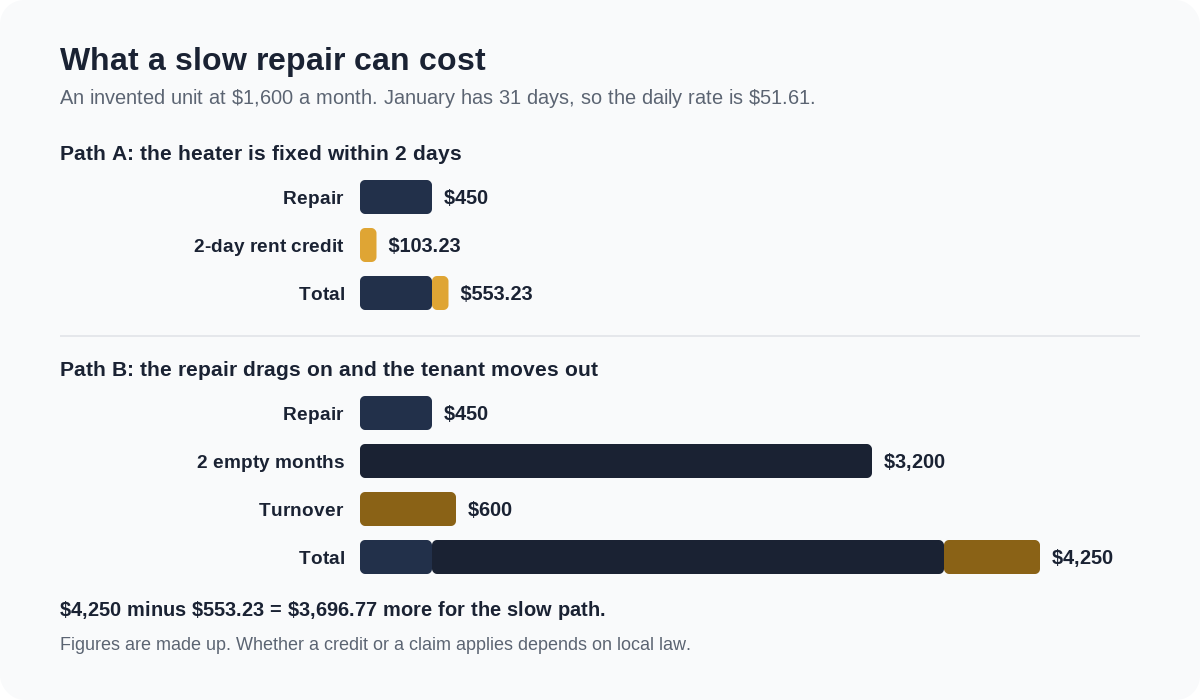
The slow path costs $4,250 minus $553.23 = $3,696.77 more, before any claim for rent the tenant says they no longer owe and before legal costs. The numbers are invented, but the shape is common: a quick repair is almost always the cheaper path. The prorated rent entry explains the daily rate methods if you prefer a 30-day or yearly basis.
Keeping a record of repairs
If a tenant later says a home became unlivable, records are what show what happened and when. Owners generally keep:
- Every repair request with the date and time it arrived.
- Each response: when you replied, who you sent and when the work was done.
- Quotes, invoices and contractor notes so the timeline is clear.
- Photos before and after the work, and a rental inspection checklist at move-in, move-out and after big repairs.
- Any rent credit and the letter explaining it.
These records also help tell normal living from damage when the tenancy ends. The guide to normal wear and tear versus damage explains the difference.
Good practice for keeping a rental livable
Most constructive eviction claims are avoidable with steady habits.
- Treat heat, water, power and leaks as urgent. Respond the same day and say when the work will happen.
- Give tenants an easy written way to report problems and answer every report.
- Keep a short list of trusted contractors so emergency work does not wait on quotes.
- Tell the tenant what is happening when a repair needs parts or several visits.
- Offer temporary fixes such as a space heater or a short hotel stay when a repair cannot be done at once.
- Never cut off services or change locks to pressure a tenant, and get local advice before any step that limits a tenant's access.
Frequently asked questions
What is constructive eviction in simple terms?
It is when an owner's conduct, often a serious repair left undone, makes a home so hard to live in that the tenant moves out. In many places that tenant can then stop paying rent for the rest of the lease, as if the owner had evicted them.
What are common examples of constructive eviction?
No heat in winter, no running water, a sewage backup, a major leak or mold left unrepaired, utilities the owner provides being shut off, and access to the home being blocked. Whether any one problem is serious enough depends on local law and the facts.
Does a tenant have to move out to claim constructive eviction?
In most places, yes, within a reasonable time after the problem began. Some places recognize a partial version when one part of the home becomes unusable. Rules vary by state, so tenants and owners usually get local legal advice first.
Is constructive eviction the same as an illegal lockout?
They are related. A lockout or utility shutoff by the owner is a form of self-help eviction, which is unlawful in most places. Constructive eviction is the broader idea that the owner's conduct, including neglect, forced the tenant out. Removing a tenant lawfully takes a court process.
How can owners avoid constructive eviction claims?
Fix serious problems quickly, keep written records of every request and repair, give proper notice before entering, and talk with the tenant while work is under way. In the example on this page, a fast repair cost $553.23 and a slow one $4,250.
Keep repair costs and rent credits on the right property
A repair timeline is easier to show later when every bill and rent payment is already recorded against its property. In KeyRing, you connect your bank accounts securely through Plaid, and each transaction is matched to a property with suggestions you confirm. Income and expense records use categories you can edit, and you can export your transactions to Excel. See what KeyRing does or how plans are priced.
Free calculators and templates
- Maintenance request formA form tenants fill in to report repairs, and a log to track each one.
- Rental inspection checklistA room by room check of an occupied rental, with the repairs it turns up.
Browse all rental property calculators, free templates and the glossary.
From the blog
- Notice of entry: how much notice to give before you enter a rentalA notice of entry tells a tenant when you will enter their home and why. Typical notice periods, when entry without notice may be allowed and a sample notice.
- What is normal wear and tear? How it differs from damageNormal wear and tear is the decline that comes from ordinary use. See how it differs from damage, common examples and how to work out a fair deposit deduction.
- Lease violation notice: what to include and how to send itA lease violation notice tells a tenant which lease term was broken and how to fix it. What to include, how to deliver it, typical cure periods and a sample.