What is the warranty of habitability? A livable rental home

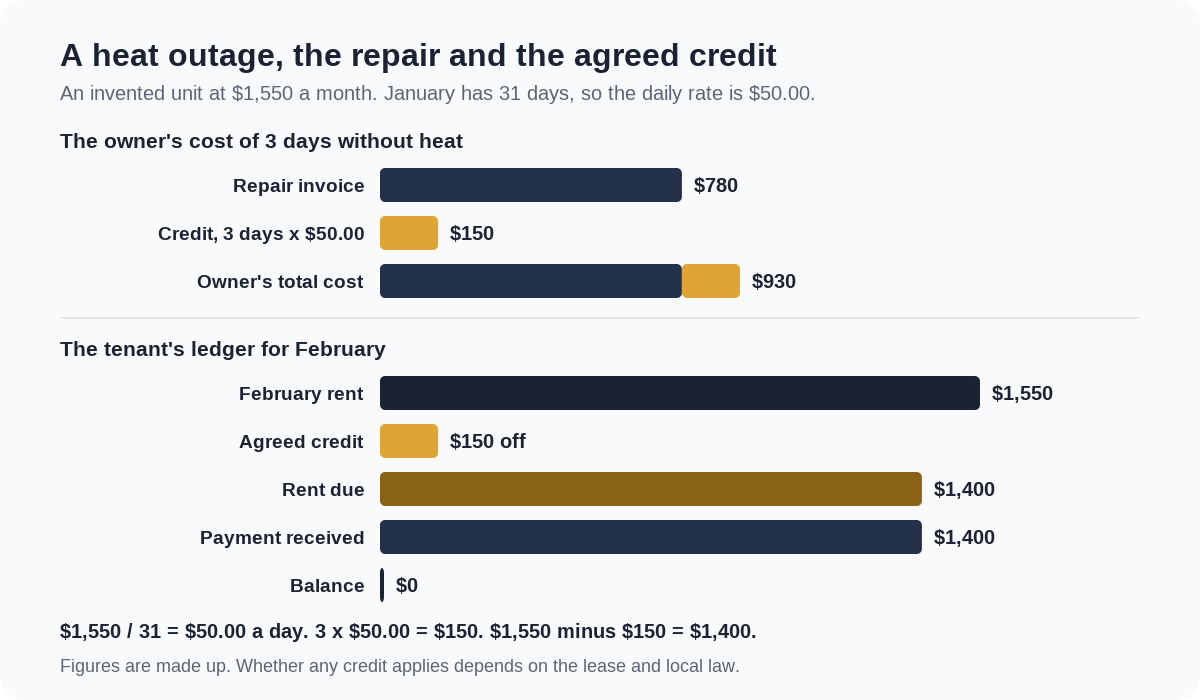
The warranty of habitability is the general rule, in most places, that a rental home must be fit to live in when the tenant moves in and stay that way for the whole tenancy. It usually means working heat, safe drinking water, hot water, plumbing and sanitation, sound structure and wiring, and a home free of serious hazards. The promise is usually implied, so it applies even when the lease says nothing about it, and in many places a lease clause cannot waive it. In the worked example below, the heat in a unit renting for $1,550 a month is out for three days in January: the repair costs the owner $780, the agreed rent credit is $150 and February's rent due drops to $1,400.
This page covers what the warranty of habitability means, what it usually covers, how repair requests generally work, what tenants may be able to do in some places when serious repairs go unmade, a worked rent credit example and the records owners keep. It is general information and is not legal or tax advice. Rules vary by state and city. Check your local law or an attorney.
What is the warranty of habitability?
When an owner rents out a home, the law in most places reads a promise into the lease: the home will be safe and fit for people to live in. That promise is the implied warranty of habitability. Local housing, building and health codes usually set the detail of what "fit to live in" means, and courts fill the gaps.
A few points shape how it works in general:
- It is usually implied. The lease does not need to mention it. In many places a clause that tries to waive it has no effect.
- It covers serious conditions. It is about health and safety: heat, water, sanitation, structure, wiring and pests. Worn carpet, an old paint color or a dated kitchen are usually outside it.
- It runs for the whole tenancy. A home that was fine on move-in day still has to be kept fit to live in as things break.
- It depends on notice. The owner generally has to know about a problem, usually from the tenant, and then has a reasonable time to fix it.
- It sits beside quiet enjoyment. The covenant of quiet enjoyment protects the tenant's use of the home. A serious repair left undone can raise both, and in the worst cases a constructive eviction claim when the tenant moves out.
What it usually covers
The exact list comes from local codes, but in many places a habitable rental usually has:
- Heat that works in cold weather, and in some places cooling in extreme heat.
- Water: safe drinking water, hot water and plumbing that drains.
- Sanitation: a working toilet, a bath or shower and a way to dispose of trash.
- Electrical and gas systems that are safe and working.
- A sound structure: roof, walls, floors and stairs without leaks or collapse risk.
- Safety devices such as smoke detectors, and in many places carbon monoxide detectors.
- Locks on doors and windows that work.
- Freedom from serious pests, mold and other conditions that put health at risk.
Damage the tenant or a guest causes is usually the tenant's to pay for, even when it affects habitability. The guide to normal wear and tear versus damage explains where that line usually falls.
How repair requests generally work
Most habitability problems are settled with a request, a visit and a repair. In general, a well run repair looks like this:
- The tenant reports the problem in writing, with the date, what is wrong and when the owner may enter. A maintenance request form makes that easy for both sides.
- The owner acknowledges it and sorts it by urgency. No heat in winter, no water, a gas smell or sewage backing up are emergencies. A dripping faucet can usually wait a few days.
- The owner gives notice before entering, unless it is an emergency. The guide to notice of entry covers the usual reasons and how much notice is common.
- The work is done within a reasonable time. What counts as reasonable depends on the problem and local law. Emergencies usually call for action within hours or a day or two.
- Both sides confirm the fix and the owner keeps the invoice, photos and notes.
What tenants may be able to do in some places
When a serious problem goes unrepaired after notice, many places give tenants some options. They vary a great deal, and each one usually comes with a set procedure. In general they can include:
- Reporting the problem to a local housing or code office, which may inspect the home.
- Asking a court for a rent reduction or an order to make the repair.
- Repair and deduct, where some places let a tenant pay for certain repairs and take the cost off rent, within limits.
- Paying rent into a court or escrow account in some places, under a procedure the local law sets.
- Ending the lease where conditions make the home unlivable.
These options are narrow and depend on the facts, and a tenant who skips a required step can end up behind on rent. Tenants and owners alike should check local law or an attorney before relying on any of them. Many places also bar an owner from retaliating against a tenant who asks for repairs or reports a code problem, for example by raising the rent, cutting services or starting a case.
Habitability can also come up in court. In many places a tenant facing an eviction for unpaid rent can raise the condition of the home as a defense. Removing a tenant always takes a court process. Owners should never use self-help such as changing locks, shutting off utilities or removing belongings.
A worked example: a heat outage and an agreed credit
All the figures here are made up. A tenant rents a two-bedroom apartment for $1,550 a month. On the morning of January 8 the furnace stops working. The tenant reports it in writing that day. The owner sends a technician, a part has to be ordered, and the heat comes back on the evening of January 10.
- The heat is out for 3 days: January 8, 9 and 10.
- The repair invoice comes to $780, the owner's cost as the furnace failed from age.
- The owner and tenant agree in writing to a rent credit for the days without heat, taken off February's rent.
Whether any credit is owed depends on local law and the facts. Here the owner offers it and both sides sign off on the amount. They use the days in the month as the basis, which matches the actual-days method in the prorated rent entry and the prorated rent calculator.
- Daily rate: $1,550 / 31 days in January = $50.00
- Credit: 3 days x $50.00 = $150
- February rent due: $1,550 minus $150 = $1,400
- The owner's total cost of the outage: $780 plus $150 = $930
On the ledger, February shows the $1,550 rent charge, the $150 credit and the tenant's $1,400 payment, for a balance of $0. The credit appears as its own line with a note on the reason, so anyone reading the ledger later can see February was paid in full.
The repair invoice is an expense of the property, recorded against it. It does not go on the tenant's ledger, since the tenant did not cause the failure. If a tenant or guest had damaged the furnace, the lease and local law would decide whether the cost could be charged back.
Keeping records of habitability and repairs
If a tenant later says the home was not fit to live in, records are what show what happened and how fast. Owners generally keep:
- Every repair request and the date it arrived.
- Notices of entry and how they were delivered.
- A rental inspection checklist at move-in, at move-out and at routine inspections, with photos.
- Invoices and contractor notes with dates, so the timeline is clear.
- Any rent credit in writing, with the dates, the reason and the amount, and the matching line on the tenant's ledger.
Good habits keep most problems small: inspect the home between tenancies, service heating and water heaters before the cold months, test smoke and carbon monoxide detectors, answer emergencies the same day and tell the tenant when work will happen.
Frequently asked questions
What does the warranty of habitability mean?
It is the general rule, in most places, that a rental home must be fit to live in for the whole tenancy. It usually covers heat, water, sanitation, safe wiring and structure, and freedom from serious hazards. The details come from local law and codes.
Does the warranty of habitability apply if the lease does not mention it?
In most places, yes. It is usually implied into residential leases, and many places do not allow a lease clause to waive it.
What is not covered by the warranty of habitability?
Cosmetic issues such as worn carpet, scuffed paint or dated fixtures are usually outside it. Damage caused by the tenant or a guest is usually the tenant's responsibility, even when it affects the home.
Can a tenant stop paying rent for a habitability problem?
Some places allow rent to be reduced, paid into an account or withheld under a set procedure. The rules differ a great deal from place to place. Skipping a required step can leave a tenant behind on rent, so both sides should check local law or an attorney first.
How do you work out a rent credit for days without heat or water?
Pick a daily rate, such as the monthly rent divided by the days in that month, then multiply by the days affected. In the example, $1,550 / 31 = $50.00 a day, and 3 days comes to a $150 credit.
Keep repair costs and rent credits on the right property
A repair timeline is easier to show later when every bill and rent payment is already recorded against its property. In KeyRing, you connect your bank accounts securely through Plaid, and each transaction is matched to a property with suggestions you confirm. Income and expense records use categories you can edit, and you can export your transactions to Excel. See what KeyRing does or how plans are priced.
Free calculators and templates
- Maintenance request formA form tenants fill in to report repairs, and a log to track each one.
- Rental inspection checklistA room by room check of an occupied rental, with the repairs it turns up.
Browse all rental property calculators, free templates and the glossary.
From the blog
- Notice of entry: how much notice to give before you enter a rentalA notice of entry tells a tenant when you will enter their home and why. Typical notice periods, when entry without notice may be allowed and a sample notice.
- What is normal wear and tear? How it differs from damageNormal wear and tear is the decline that comes from ordinary use. See how it differs from damage, common examples and how to work out a fair deposit deduction.