Rental comps: how to find comparable rentals and set your rent
By Maya Ellison -

Rental comps, short for rental comparables, are rentals near yours that match it on size, type and condition, and that are listed or leased now or were leased recently. Their rents show what tenants in your area pay for a home like yours, which is the best guide you have to the rent your own unit can charge. Five comps for a 1,400 square foot three-bedroom house that rent for a middle rate of $1.55 a square foot a month point to a rent of about $2,170 a month.
This guide covers what makes a good rental comp, where to find comps, how to run a comp analysis step by step, a worked example, how to adjust for differences between homes and how to use comps when a lease comes up for renewal. It is general information and is not legal or financial advice. Rules vary by state and city. Check your local law or an attorney.
What are rental comps?
A rental comp is a home that a tenant choosing between listings would see as a real alternative to yours. Two homes on the same street can be poor comps for each other if one has two bedrooms and the other has four, and a home a mile away can be a good comp if it matches on the points tenants care about.
Comps come in two kinds:
- Active listings. Homes for rent right now. They show the competition a tenant sees today, but an asking rent is a hope, and some listings sit empty for weeks at a price that is too high.
- Recent leases. Homes that were rented in the last few months. They show what a tenant actually agreed to pay, which makes them the stronger evidence when you can get them.
Comps for a rental work much like comps for a sale. A buyer's agent compares sold homes to price a house; you compare rented homes to price a lease. The same comps also help an investor test the rent a seller claims before buying, and they feed the rent figure in a rent roll or a pro forma.
What makes a good rental comp
The closer a comp matches your unit, the less you have to adjust its rent. Look for homes that match on these points, roughly in this order:
| What to match | Why it matters |
|---|---|
| Location | The same neighborhood or school area, ideally within a short drive; rents can change from one area to the next |
| Property type | A house, a townhouse and an apartment in a larger building rent differently, even at the same size |
| Bedrooms and bathrooms | Tenants search by bedroom count first, and a second bathroom often matters as much as extra space |
| Size | Square feet of livable space, measured the same way for every home |
| Condition | A recently renovated home commands more than one with dated finishes |
| Features | Parking, a garage, a yard, in-unit laundry, central air and outdoor space |
| Utilities and terms | Whether rent includes water or other utilities, and whether pets are allowed |
| Timing | Listings and leases from the last few months, since rents move with the season and the market |
Three to six good comps are usually enough. A long list of weak comps tells you less than a short list of close ones.
Where to find rental comps
- Listing sites. The large rental listing sites show what is for rent now, with photos, size and features. Save each listing as you find it, since it disappears once the home is rented.
- Your own records. If you own other units nearby, your own leases are comps you can trust, because you know the exact rent, terms and condition. A rent roll keeps them in one place.
- Local agents and property managers. They see recent leases that never show up online. A property manager who works the area can often tell you what similar homes rented for and how fast.
- Signs and word of mouth. Small owners often rent through yard signs and referrals, so a drive around the neighborhood can turn up comps that are not listed online.
- Rent estimate tools. Online rent estimates are a quick starting point. They are models built from listing data, so check the result against real comps before you rely on it.
Write down each comp's address, rent, size, bedrooms, bathrooms, features, whether it is a listing or a lease, and the date. That record is what lets you explain your rent to a tenant, a lender or a buyer later.
How to run a rental comp analysis, step by step
- Describe your unit. Note its address, type, bedrooms, bathrooms, square feet, condition, features and what the rent includes.
- Collect comps. Gather listings and recent leases for similar homes nearby, and set aside any that differ on several points at once.
- Put them on the same basis. Divide each comp's monthly rent by its square feet to get a rent per square foot. The rent per square foot calculator does this and shows the rent the market rate supports.
- Take the middle rate. Sort the rates and use the middle one, the median. It is less swayed by a single unusual home than the average is.
- Apply it to your unit. Multiply the middle rate by your unit's square feet.
- Adjust for differences. Add or subtract for features your unit has or lacks compared with most of the comps.
- Check the result. Compare it with the asking rents of homes on the market today, and with how quickly similar homes rented. A rent well above the comps can mean more empty weeks, which the vacancy rate calculator can put a figure on.
A worked example: pricing a three-bedroom house
An owner has a 1,400 square foot three-bedroom, two-bathroom house that rents for $2,000 a month, and the lease ends in two months. All the figures here are made up. The owner finds six homes nearby and sets one aside: a newly renovated house with a pool, 1,400 square feet at $2,800 a month, or $2.00 a square foot, which no tenant would see as an equal choice. The five comps left are:
| Comp | Bedrooms and bathrooms | Square feet | Monthly rent | Rent per square foot |
|---|---|---|---|---|
| Comp 1 (lease, 2 months ago) | 3 bed, 2 bath | 1,300 | $2,015 | $1.55 |
| Comp 2 (listing) | 3 bed, 2 bath | 1,450 | $2,175 | $1.50 |
| Comp 3 (lease, 3 months ago) | 3 bed, 2 bath | 1,500 | $2,175 | $1.45 |
| Comp 4 (listing) | 3 bed, 2 bath | 1,400 | $2,240 | $1.60 |
| Comp 5 (lease, 1 month ago) | 3 bed, 2 bath | 1,200 | $1,860 | $1.55 |
Each rate is the rent divided by the square feet; for Comp 1, $2,015 / 1,300 = $1.55. Sorted, the rates are $1.45, $1.50, $1.55, $1.55 and $1.60, so the middle rate is $1.55. The average, ($1.45 + $1.50 + $1.55 + $1.55 + $1.60) / 5 = $1.53, lands close by, which suggests no single comp is pulling the result.
- Current rent per square foot: $2,000 / 1,400 = $1.43 a month, rounded.
- Rent at the middle rate: $1.55 x 1,400 = $2,170 a month.
- Gap: $2,170 minus $2,000 = $170 a month, or $170 x 12 = $2,040 a year.
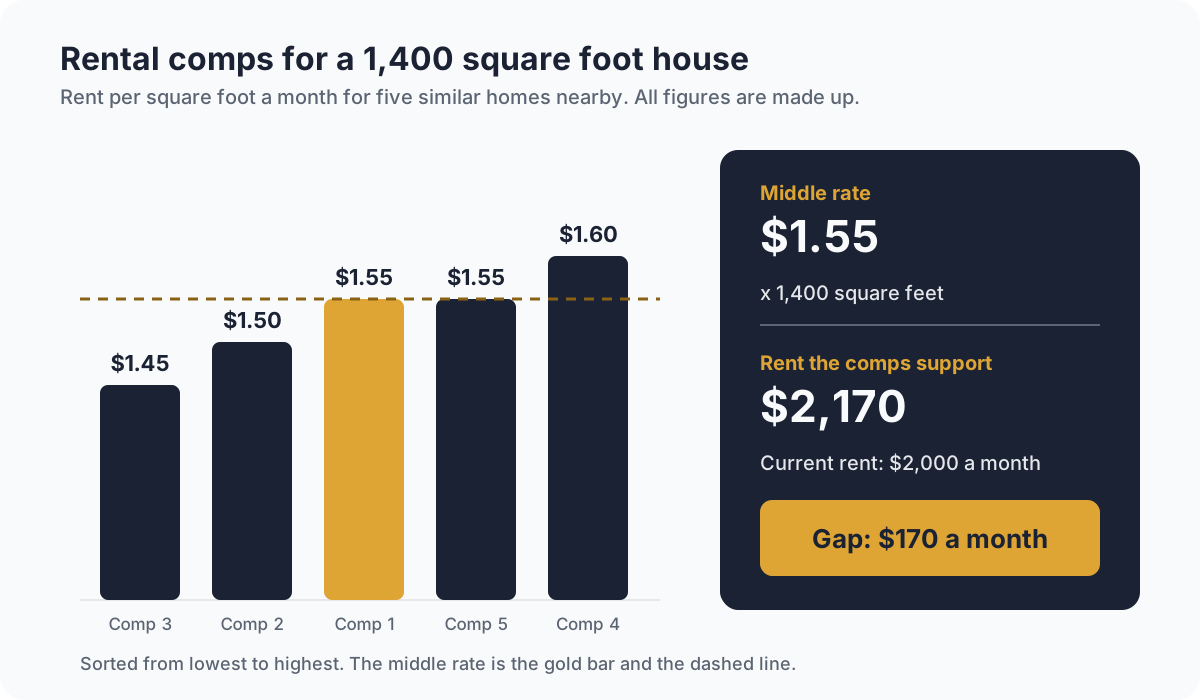
The comps support a rent of about $2,170 for the renewal. Raising $2,000 to $2,170 is an increase of $170 / $2,000 = 8.5%. The rent increase calculator shows the new rent, the yearly difference and any cap you enter. The owner can also weigh a smaller increase to keep a good tenant, since a turnover brings cleaning, repairs and empty weeks of its own.
Adjusting for differences
Few comps match exactly. When a comp has a feature your unit lacks, take some rent off its figure before you compare; when your unit has a feature the comp lacks, add some on. Common adjustments cover:
- Bedrooms and bathrooms. An extra bedroom or bathroom usually makes a clear difference in rent.
- Parking and garages. A garage or a dedicated space is worth more where street parking is scarce.
- Laundry. In-unit laundry is often worth more to tenants than a shared machine or none.
- Outdoor space. A fenced yard matters to tenants with children or pets.
- Utilities. If a comp's rent includes water or trash and yours does not, its rent covers more than yours does.
- Condition. New kitchens and floors raise what a home can charge; dated ones lower it.
There is no fixed price for each feature. Look for pairs of comps that differ on one point, such as two similar homes where only one has a garage, and use the gap between their rents as your guide. Keep adjustments small; if a comp needs several large ones, it is probably not a comp.
Using comps when a lease comes up for renewal
Comps are worth checking every time a lease nears its end, before you decide on the renewal rent. If the comps have moved up, they support an increase, and the notice you give must follow your lease and local rules; the rent increase notice guide covers typical notice periods. If they have moved down, a rent above the market risks a move-out and a vacancy, and a rent concession or a smaller increase can keep the unit full.
Some cities limit how much or how often rent can rise, and some states require a set amount of notice. Rules vary by state and city. Check your local law or an attorney.
Common mistakes with rental comps
- Pricing from asking rents alone. A listing that has sat for six weeks shows a rent tenants did not take.
- Comparing homes of different types. A three-bedroom apartment and a three-bedroom house rarely rent for the same.
- Mixing up size measures. Use livable square feet for every home, or the rates will not compare.
- Ignoring what the rent includes. Utilities, parking and pet terms change what a rent buys.
- Using old comps. Rents from a year ago may say little about today.
- Keeping no record. Write down your comps and the date, so you can show how you set the rent.
Frequently asked questions
What are comps in rental property?
Comps, short for comparables, are rentals near yours that match it on type, size, bedrooms, bathrooms, condition and features. Their current asking rents and recent lease rents show what your unit can likely charge.
How many rental comps do I need?
Three to six close comps are usually enough. Fewer close matches are more useful than many weak ones, and recent leases count for more than listings when you can find them.
How do I compare rentals of different sizes?
Divide each rent by the home's livable square feet to get a rent per square foot, then multiply the middle rate by your own square feet. Smaller homes often rent for more per square foot, so compare homes of a similar size where you can.
How often should I check rental comps?
Check them before you list a unit, before each lease renewal and whenever a unit sits empty longer than you expected. In a fast-moving market, a check every few months keeps your figures current.
Are online rent estimates accurate?
They are a useful starting point, built by models from listing data, but they can miss condition, features and local differences. Check any estimate against real comps near your property before you set a rent.
Keep each lease, its rent and its end date together
Comps tell you what to charge; the next step is keeping track of what each lease actually says. In KeyRing, you can create a lease for each unit, attach documents such as a signed agreement or a notice to the lease, and rent-due and lease-expiry reminders go out by email and push automatically. KeyRing sends automatic lease-expiry reminders by email and push to you and the tenant 30 days before the end date, so the renewal conversation starts on time. See what KeyRing does or how plans are priced.
Free calculators and templates
- Rent increase calculatorA new rent from a percentage or dollar increase, with the yearly difference.
- Rent per square foot calculatorMonthly rent over square feet, and the rent the market rate supports.
- Vacancy rate calculatorThe share of the time units sat empty, and the rent it cost.
Browse all rental property calculators and free templates.