What is a rent concession? Types, examples and how to record them
By Claire Navarro -

A rent concession is a discount or benefit a property owner gives a tenant to sign a lease or renew one. The most familiar is a free month, but a concession can also be a lower rent for the first few months, a waived fee or a smaller deposit. The rent written in the lease stays the same; the concession lowers what the tenant actually pays over the term.
This guide covers the common types of concession, how to work out net effective rent, a worked example for an invented unit, what to write into the lease and how to record a concession in your books. It is general information and is not tax or legal advice. Rules on lease terms and fees are set by each state, so check your state's rules, and ask a tax professional how a concession affects your return.
Common types of rent concession
- Free rent. One or more months with no rent due, often the first month or a month partway through the lease.
- Reduced rent for a period. A lower rent for the first few months, then the full lease rent.
- Waived fees. No application fee, amenity fee or parking charge for part or all of the term.
- A smaller security deposit. Less cash up front for the tenant, within your state's rules on deposits.
- Renewal concessions. A credit, an upgrade or a smaller increase offered to keep a good tenant for another term.
Why property owners offer them
A unit that sits empty earns nothing, and every vacant month costs a full month of rent plus the utilities and upkeep you still pay. A concession can fill a unit faster in a slow season or a competitive market, and it often costs less than another month of vacancy.
A concession also keeps the rent written in the lease, often called the face rent, at the market level. That matters at renewal, when the next increase is usually measured from the face rent, and for anyone valuing the property from its rent roll. The rent roll guide shows where concessions sit next to the lease rent.
Net effective rent, with a worked example
Net effective rent is the average monthly rent after the concession. Add up the rent the tenant pays over the lease and divide by the number of months:
Net effective rent = (lease rent x months in the lease - total concession) / months in the lease
An invented one-bedroom at Linden Court has a lease rent of $1,800 a month. To fill it before the winter, you offer one month free on a 12-month lease.
| Line | Amount |
|---|---|
| Lease rent | $1,800 a month |
| Rent over 12 months at the lease rent | $21,600 |
| Concession (one month free) | ($1,800) |
| Rent the tenant pays over the lease | $19,800 |
| Net effective rent | $1,650 a month |
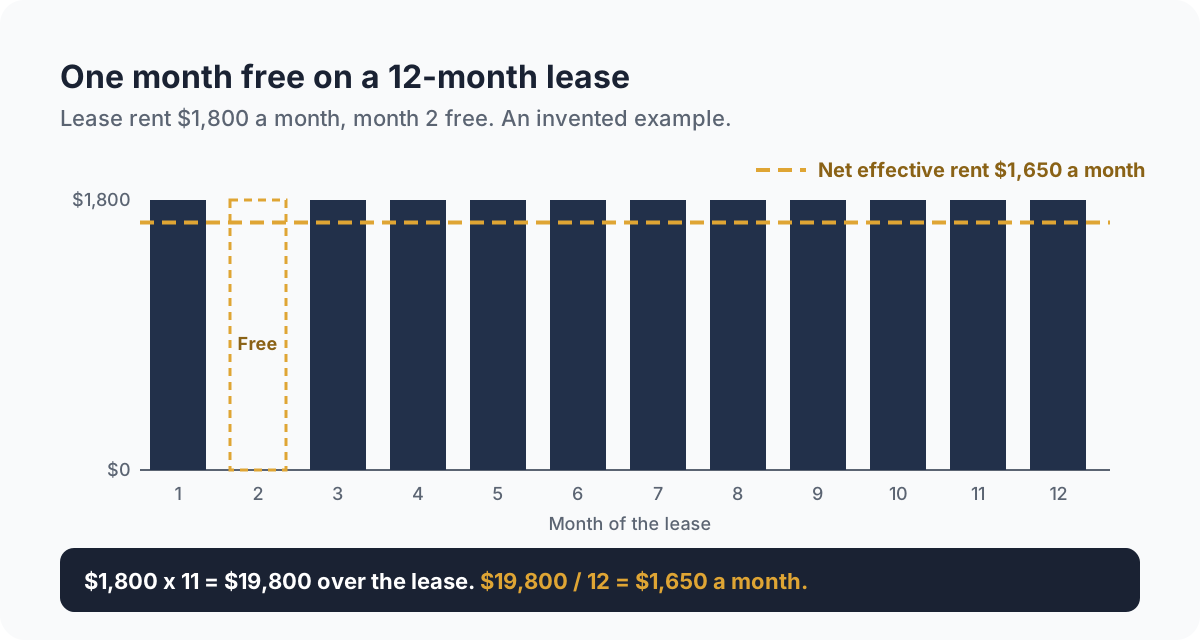
The arithmetic: $1,800 x 12 = $21,600, less the $1,800 free month is $19,800, and $19,800 / 12 = $1,650 a month. The same $19,800 could come from a lease rent of $1,650 with no concession. The difference shows up a year later. A 3% increase at renewal on the $1,800 face rent is $54 a month, for $1,854, while 3% on $1,650 is $49.50, for $1,699.50. The rent increase calculator runs that math for any rent.
Weigh the concession against the vacancy it saves. If the free month fills the unit one month sooner, it costs about what the empty month would have cost, and the tenant starts paying sooner. The rental cash flow calculator shows how vacancy changes a property's monthly cash flow.
Put the concession in the lease
Write the concession into the lease or a signed addendum so both sides read the same terms:
- What the concession is. The amount, or the month or months that are free or reduced.
- When it applies. For example, the second month of the lease, or the first three months at a set lower rent.
- The lease rent. The full monthly rent the lease sets, so the face rent is on record.
- What happens if the lease ends early. Some leases ask the tenant to repay the concession if they break the lease. Whether that term can be enforced depends on state law, so check your state's rules before you include one.
- Renewal. Whether the concession carries into a renewal. Most do not, and saying so up front avoids a surprise in month 13.
Offer the same concession on the same terms to every applicant for similar units at the same time, and keep a note of what you offered and when.
How to record a concession in your books
Record the concession so the ledger shows both the full rent and the discount:
- Charge the full lease rent each month as usual.
- Add a credit for the concession in the month it applies, so the balance due that month is the reduced amount.
- Note the concession on the lease and on the rent roll, so anyone reading them sees the face rent and the discount together.
For the Linden Court example, month 2 shows a $1,800 rent charge and an $1,800 credit, for a balance of $0. The rent ledger guide shows how charges, credits and payments sit on a tenant ledger, and the rent ledger template has the columns ready.
For taxes, most individual owners report rent on the cash basis, as rent received. A free month is rent you never receive, so there is no income to report for it, and the IRS does not let a cash-basis owner deduct rent that was never collected. Owners who keep accrual books under GAAP generally spread the total rent over the lease term, so each month shows the net effective rent. Ask your tax professional which applies to you, and see IRS Publication 527 for how rental income is reported.
Frequently asked questions
What is a rent concession?
It is a discount or benefit a property owner offers to sign or renew a lease, such as a free month, a lower rent for a few months, a waived fee or a smaller deposit. The lease rent stays the same; the concession lowers what the tenant pays over the term.
What is net effective rent?
It is the average monthly rent after concessions: the total rent the tenant pays over the lease divided by the number of months. One month free on a 12-month lease at $1,800 gives $19,800 / 12 = $1,650 a month.
Is a free month of rent a deductible expense?
Generally no for an owner who reports on the cash basis. A free month is rent you never receive, so you report no income for it and have nothing to deduct. Ask a tax professional how it applies to your return.
Can I ask the tenant to repay a concession if they break the lease?
Some leases include that term, but whether it can be enforced depends on state law and how the lease is written. Check your state's rules, and have an attorney review the clause if you plan to rely on it.
Does a concession carry into a lease renewal?
Only if the lease says so. Most concessions apply to the first term alone, and the renewal starts from the full lease rent. State that in the lease so the tenant knows what to expect at renewal.
Keep the full rent and the discount side by side
KeyRing lets you add one-off and recurring charges and credits to a lease, so a free or reduced month sits next to the rent charge it discounts. Rent invoices are drafted each month for you to approve before they are sent, and the rent summary shows what was billed, paid and overdue. See what KeyRing does or how plans are priced.
Free calculators and templates
- Rental cash flow calculatorMonthly cash flow line by line, per unit, with the break-even rent.
- Rent to income ratio calculatorRent as a share of gross income, and the income needed at your target.
- Rent increase calculatorA new rent from a percentage or dollar increase, with the yearly difference.
- Rent ledger templateTrack one tenant's charges, payments and running balance, in a spreadsheet or on paper.
- Rent roll templateEvery unit, lease, rent and balance in a property on one page, as of one date.