Lease violation notice: what to include and how to send it
By Maya Ellison -

A lease violation notice is a written notice that tells a tenant they have broken a term of the lease. It names the term, describes what happened, says what the tenant needs to do to fix it and by when, and explains what may follow if the problem continues. Sent early and worded calmly, it often settles the problem before it grows.
This guide covers common lease violations, the difference between a friendly warning and a formal notice, what to put in a notice, how to deliver it, a sample you can adapt and a worked timeline. It is general information and is not legal advice. Rules vary by state and city. Check your local law or an attorney.
When to send a lease violation notice
Send one when a tenant breaks a term of the lease and a conversation has not fixed it, or when the problem is serious enough that you want a written record from the start. Common examples:
- An unauthorized pet in a unit whose lease allows none, or more pets than the lease allows.
- Unauthorized occupants, such as someone living in the unit who is not on the lease.
- Noise or disturbance that breaks a quiet hours or nuisance clause.
- Damage to the property beyond normal wear and tear.
- Subletting or short-term rentals without the consent the lease requires. The sublease guide covers what to ask for when a tenant wants to sublet.
- Smoking, parking, trash or common-area rules that the lease sets out.
Unpaid rent is a lease violation too, but most states set out a separate notice for it, often called a pay or quit notice, with its own period and wording. The late fee calculator works out the fee your lease allows; the notice itself follows your state's rules for unpaid rent. If a guarantor backs the lease, the guarantor guide covers when and how to ask them to pay.
A warning letter or a formal notice?
Lease violation notices come in two broad kinds, and it helps to know which one you are sending:
- An informal warning. A short, polite letter or email that points out the problem and asks the tenant to fix it. No law sets its form, and it is often all a first, minor problem needs.
- A formal notice to cure or quit. A notice that gives the tenant a set number of days to fix the violation or move out. In many states this is the step that has to come before ending a tenancy for a lease violation, and state law can set what it says, how it is delivered and how many days it gives.
Many owners send the informal warning first and move to the formal notice only if the problem continues. If you think the tenancy may end over the violation, talk with an attorney before you send the formal notice, because a notice with the wrong period or wording can mean starting over.
How long does a tenant have to fix a violation?
The time to fix, often called the cure period, is set by state law and sometimes by the lease. Cure periods in many states fall somewhere between 3 and 30 days, depending on the state and the kind of violation. Some states give no chance to cure for serious violations, such as illegal activity or severe damage, and some limit how many times a tenant can cure the same violation in a year. Rules vary by state and city. Check your local law or an attorney.
What to put in a lease violation notice
- The tenant's name, the property address and the unit.
- The date of the notice and how you delivered it.
- The lease term that was broken, with its section number and, ideally, its wording.
- What happened: the facts, with dates and times, written plainly and without labels or opinions.
- What the tenant needs to do to fix it, such as removing the pet or ending the noise after quiet hours.
- The deadline to fix it, counted the way your state and your lease require.
- What may happen if the violation continues, stated as the next step the lease and the law allow.
- A name and a phone number or email for questions.
- Your name and signature.
Keep the tone factual and even. A notice may later be read by a mediator or a judge, and a calm, specific notice reads better than an angry one.
How to deliver a lease violation notice
Common ways to deliver a notice are handing it to the tenant, leaving it at the unit, mailing it, and email where the lease allows notices by email. For a formal notice, many states set the delivery methods they accept, and some add days to the deadline when a notice is mailed. Whichever way you use, keep proof: a dated copy, a note of when and how you delivered it, and any mailing receipt.
A sample lease violation notice
Adapt this to your state's rules and your lease. It is written as an informal first notice:
Notice of lease violation
To: [tenant names], [property address and unit]
Date of this notice: [date]. Delivered by: [in person, at the unit, mail or email, as your state and lease allow].
Section [number] of your lease, dated [lease date], says: "[the lease wording]."
On [dates], [what happened, for example a dog was seen in the unit and heard barking in the evenings].
To fix this, please [what the tenant needs to do, for example remove the dog from the unit or contact us about adding it to the lease] by [deadline].
If the violation continues after that date, we may take the next steps the lease and the law allow.
If you have questions, contact [name] at [phone or email].
[Your name and signature]
Before you send a formal notice to cure or quit, check what your state requires it to say and how many days it has to give.
A worked timeline
A tenant in unit B of an invented duplex has a dog, and the lease allows no pets. On October 5 you see the dog through the window and hear it barking in the evenings. On October 6 you hand the tenant a notice that gives 10 days to fix the violation, the period this example assumes the state and the lease allow.
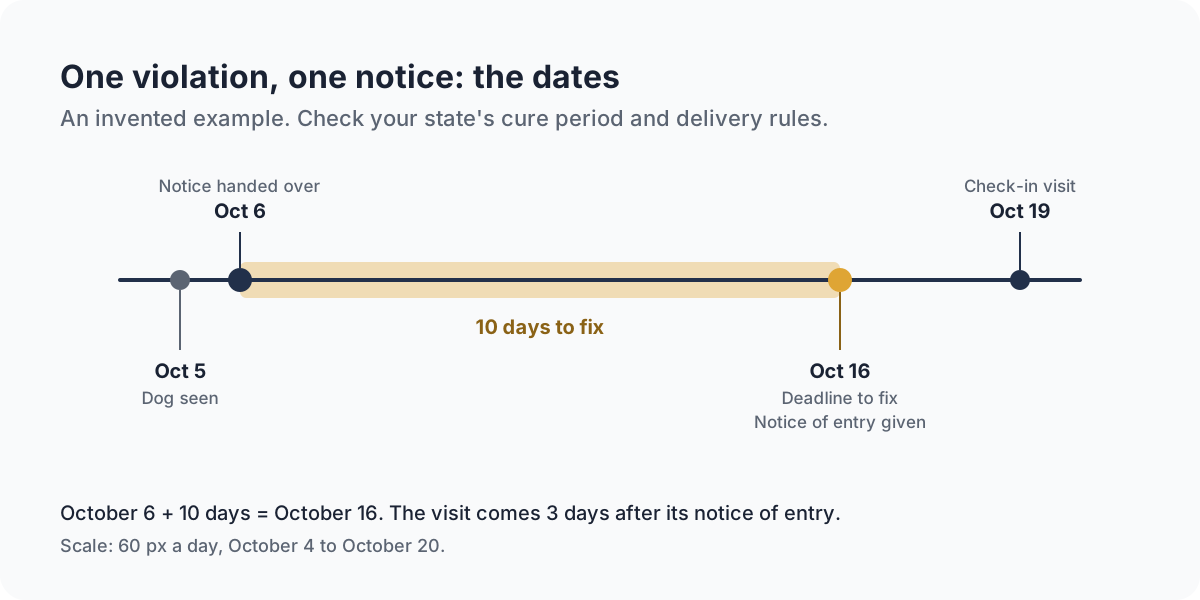
The arithmetic: October 6 plus 10 days is October 16, so the deadline is October 16. A visit to check that the dog is gone needs notice too; the notice of entry guide covers how much is typical. Here you give notice on October 16 for a visit on October 19, three days later. Had you mailed the violation notice, the count could start later, so check whether your state adds days for mail before you pick the deadline.
The fix can also be an agreement. If you are willing to allow the dog, a signed pet addendum can add it to the lease, often with pet rent or a pet deposit; the pet rent, deposit and fee guide compares the three charges.
What happens after the notice
- The tenant fixes it. Confirm in writing that the matter is closed, and keep the notice and the reply with the lease.
- The tenant asks for more time. A short, written extension is often quicker than the next formal step.
- The violation continues. The next step is usually a formal notice to cure or quit, in the form your state requires. If the tenant still does not fix it, ending the tenancy goes through the court process, and an attorney can tell you how it works where the property is.
- You would rather part on agreed terms. A cash for keys agreement is one way to end a tenancy by agreement.
- The lease is ending soon anyway. Choosing not to renew can be simpler than a dispute; the holdover tenant guide covers what to do if a tenant stays past the end date.
Keep every step lawful. Changing the locks, removing belongings or shutting off utilities to push a tenant out is illegal in virtually every state and can leave you owing the tenant damages.
Good practice for lease violations
- Treat every tenant the same way. Send notices for the same violations on the same terms to every tenant. Uneven enforcement can raise fair housing concerns.
- Watch the timing after a complaint. Many states bar retaliation, such as a notice sent soon after a tenant reports a repair problem or contacts a housing agency. Make sure the record shows the violation came first.
- Write the rules into the lease. A clear, specific term is easier to point to than a general one.
- Keep a file. Copies of each notice, proof of delivery, dated photos and the tenant's replies.
- Keep it professional when you live on site. Owners who live in one unit of a duplex, a setup the house hacking calculator runs the numbers on, see problems first-hand; a written notice keeps a neighborly relationship on clear terms.
Frequently asked questions
What is a lease violation notice?
A written notice that tells a tenant they have broken a term of the lease, what the term is, what happened and what they need to do to fix it by a deadline. It can be an informal warning or a formal notice to cure or quit.
How long does a tenant have to fix a lease violation?
It depends on your state, the kind of violation and your lease. Cure periods in many states fall somewhere between 3 and 30 days, and some serious violations allow no cure at all. Rules vary by state and city. Check your local law or an attorney.
Can I evict a tenant for a lease violation?
In many states, yes, for a material violation the tenant does not fix after proper notice. The notice usually comes first, and ending the tenancy goes through the court process. Talk with an attorney before you take that step.
Does a lease violation notice have to be in writing?
A formal notice to cure or quit is usually in writing, and many states set how it is delivered. An informal warning can be a conversation, but a written notice gives you a record of what you said and when.
What should I do if the tenant ignores the notice?
Check that the notice was delivered the way your state and lease require, then decide on the next step: a formal notice to cure or quit, an agreement to end the tenancy, or not renewing the lease. An attorney can advise on the right step where the property is.
Keep notices with the lease they belong to
A violation is easier to resolve when the paper trail is in one place. In KeyRing, you can attach documents to a lease and file each notice, photo and reply to the property, unit, lease or tenant it belongs to, next to the signed lease. Automatic lease-expiry reminders by email and push, sent 30 days before the end date, give you time to decide on a renewal. See what KeyRing does or how plans are priced.