What is a squatter? Squatters' rights and what property owners can do
By Jenna Whitfield -

A squatter is someone who moves into and lives in a property without the owner's permission and without a lease or any other right to be there. Squatters most often turn up in homes that sit empty: a rental between tenants, a house waiting for renovation or sale, or a property whose owner lives far away.
This guide covers what a squatter is, how a squatter differs from a trespasser and a holdover tenant, what "squatters' rights" usually means, the signs to watch for, what to do if you find someone living in your property and how to make it less likely. It is general information and is not legal advice. Rules vary by state and city. Check your local law or an attorney.
What is a squatter?
Squatting means occupying a property as a place to live without the owner's consent. A squatter may have broken in, slipped in through an unlocked door, or stayed on after being let in for a short visit. Some show a lease or a rental agreement that turns out to be fake, or one "signed" by someone who never had the right to rent the home out.
What sets a squatter apart is that nobody with the right to grant permission ever gave it. That one fact shapes most of what follows: who can remove the person, how fast and through which process.
Squatter vs trespasser vs holdover tenant
Three kinds of unwanted occupant get mixed up, and each one is usually handled differently:
| Squatter | Trespasser | Holdover tenant | |
|---|---|---|---|
| How they got in | Without permission | Without permission | With a lease that has since ended |
| Are they living there | Yes, often with belongings and sometimes mail | Usually not; they entered or are passing through | Yes |
| Who usually handles it | The police in some states; a court in others | Usually the police | The court eviction process |
| What the owner usually serves | The notice the state requires, if any | Usually nothing; a report to the police | The written notice the state requires |
A trespasser is anyone who enters or stays on property without permission. A squatter is a trespasser who has settled in. Once a person is living in the home, many police departments treat the dispute as civil and send the owner to court, especially when the occupant shows any kind of paperwork.
A holdover tenant is different again: they came in legally under a lease and stayed after it ended. A subtenant who stays on after a sublease ends can fall somewhere in between, which is one more reason to know who is living in each unit.
What are squatters' rights?
"Squatters' rights" usually refers to adverse possession, a legal doctrine that can, in rare cases, let a person who occupies land for long enough become its legal owner. It exists so that land that has been openly used and plainly neglected for many years ends up with a clear owner.
The requirements differ by state, but a claim generally needs the occupation to be:
- Hostile: without the owner's permission.
- Actual: the person really uses the property, such as living in it or keeping it up.
- Open and notorious: visible enough that an owner paying attention would notice.
- Exclusive: the person holds it as their own and does not share it with the owner or the public.
- Continuous: without a break, for the full period the state sets.
That period ranges from a few years in some states to 20 years or more in others, and some states also require the occupant to have paid the property taxes during that time. A successful claim also usually means going to court. For an owner who inspects the property, pays the taxes and acts when someone moves in, an adverse possession claim is very unlikely to succeed.
The more common problem is the time and cost of getting a squatter out. In some states a person living in a home can only be removed through the court process, even without a lease. Since 2024, a number of states have passed laws that let owners ask law enforcement to remove unauthorized occupants faster, often with a sworn statement that the person has no right to be there. Because these laws are new and differ from state to state, check what applies where your property is.
Signs that someone is living in a vacant property
Squatting is easier to stop early, so it pays to know what to look for when you visit or when a neighbor calls:
- Lights or noise at night in a unit that should be empty.
- Utility use on accounts in your name, such as a jump in the water or electric bill.
- Mail or packages addressed to people you do not know.
- New locks, covered windows or a changed door, or signs of forced entry.
- Belongings, furniture or trash that were not there on your last visit.
- A car parked there regularly or people coming and going.
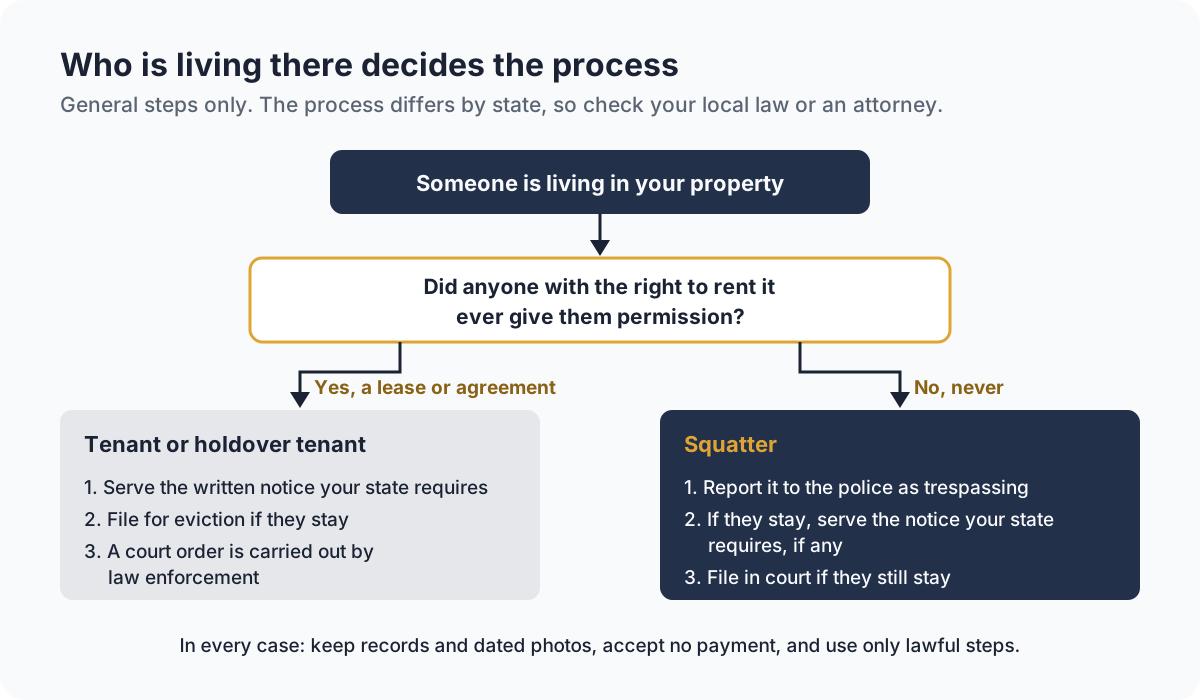
What to do if you find a squatter
- Keep your distance. Do not confront the occupants or go in alone. Note what you see from outside and leave.
- Gather proof that the property is yours and that the person has no right to be there: the deed, recent property tax bills, utility accounts, your last lease and move-out records, and dated photos of the property.
- Find out who they are, if you can. A former tenant, a tenant's guest or a subtenant is handled differently from a stranger. If they show a lease, check whether you or your property manager signed it.
- Report it to the police. Ask them to remove the person for trespassing. Depending on your state, the evidence and the department, they may do so on the spot or tell you it is a civil matter for the court.
- Serve the written notice your state requires, if the police do not remove them. Some states require a notice to vacate before you can file.
- File in court if they stay. The eviction or unlawful detainer process ends with a court order that law enforcement carries out. A local attorney can tell you which process fits a squatter in your state.
- Secure the property once it is empty. Change the locks, repair any damage and check your state's rules before you dispose of anything the occupants left behind.
While you wait, do not accept money from the occupants. Taking a payment can look like an agreement to rent and, in some states, can turn a squatter into a tenant with the full protection that brings. Keep every step lawful as well: changing the locks while they are inside, removing their belongings or shutting off utilities to force them out can be illegal even against a squatter in many states, and can leave you owing damages.
In some cases a negotiated exit is quickest. Paying an occupant to leave by a set date, as in a cash for keys agreement, can cost less than months in court. Get legal advice before you offer one to someone with no right to be there.
How to protect a vacant rental from squatters
Most of the work is in keeping a vacant property looking cared for and checking it often:
- Visit on a schedule and write down what you find. A rental inspection checklist gives each visit the same record, with the date and the condition of each room.
- Lock every door and window, and secure basements, garages and sheds.
- Keep the outside tidy. Mow the lawn, clear snow and leaves, and have someone collect the mail and any flyers so the home does not look abandoned.
- Use lights on timers and, if it suits the property, cameras or a monitored alarm.
- Keep the utilities in your name and watch the bills for use you cannot explain.
- Post no-trespassing signs where your state allows them. In some states a posted sign makes it easier for the police to act.
- Pay the property taxes on time, since some adverse possession claims depend on the occupant paying them.
- Put any short stay in writing. A relative, a contractor or a house sitter who stays over should have a signed agreement with an end date.
- Keep vacancies short. The fewer weeks a unit sits empty, the smaller the window. The vacancy rate calculator shows how much empty time is costing you.
- Ask a neighbor to call you if they see anything unusual.
Frequently asked questions
What is a squatter in simple terms?
A squatter is a person living in a home or on land without the owner's permission and without a lease. They are occupying a property that nobody with the right to rent it ever let them use.
Is squatting illegal?
Entering or staying in someone else's property without permission is generally trespassing, and a growing number of states have made squatting a crime of its own. Even so, removing a squatter who is already living there can require the court process in some states. Rules vary by state and city. Check your local law or an attorney.
How long does a squatter have to live in a home to claim it?
Through adverse possession, the period ranges from a few years in some states to 20 years or more in others, and the occupation has to be continuous, open and without permission for that whole time. Some states also require the occupant to have paid the property taxes. A claim also has to be proven in court.
Can the police remove a squatter?
Sometimes. In some states the police can remove a person who has no right to be there, especially under the newer laws that let an owner file a sworn statement. In others, once the person is living in the home, the police treat it as a civil matter, and the owner has to go through the court.
Is a former tenant who stays after the lease ends a squatter?
Usually not. A tenant who stays past the end of the lease is a holdover tenant, because they came in with permission. Most states require the eviction process to remove them. The holdover tenant guide covers the options.
Know who is living in each unit
Squatting is hardest to stop when nobody is sure who is supposed to be in a unit. In KeyRing, you create a lease for each unit and attach documents to it, such as the signed lease and the move-in inspection, so you can show who has a right to be there. You can schedule a move-out or end the lease when a tenant leaves, and lease-expiry reminders go out by email and push automatically. See what KeyRing does or how plans are priced.
Free calculators and templates
- Vacancy rate calculatorThe share of the time units sat empty, and the rent it cost.
- Rental inspection checklistA room by room check of an occupied rental, with the repairs it turns up.
Browse all rental property calculators and free templates.