Split rent payments: how property owners handle roommates who pay separately
By Jenna Whitfield -
Read a summarized version with:

Split rent payments are what happens when the people sharing a rental each pay their own part of the rent, so one month's rent reaches the property owner as several payments. Roommates often prefer it, and it can work well for owners too, as long as the lease says who owes what and every share is recorded against the same month. In the invented example below, four roommates share a $2,800 apartment: three shares arrive by March 3, the last $616 arrives on March 9, and the lease's late fee is $50.
This guide covers how split payments work, how the type of lease decides who owes the rent, how to set up payment rules, how to track each share, what to do when one share is late or short, and what changes when a roommate leaves. It is general information and is not legal or tax advice. Rules vary by state and city. Check your local law or an attorney.
What are split rent payments?
A split rent payment is one month's rent paid in parts by the different people who live in the unit. The rent itself stays one figure: the lease sets it for the whole unit, or for each room. The split is how the household divides it.
Households split rent in two common ways:
- Equally. Each person pays the same share. It suits rooms of about the same size.
- By room size. The shared space (kitchen, living room, hallways) is split equally and each private room pays for its own floor area. The rent split calculator works out both methods and adds each room's share of the utilities.
For the owner, the questions are practical: who is responsible for the full rent, which payments count toward which month, and what happens when one person falls behind.
Who owes the rent: joint lease or room-by-room leases
The lease decides how split payments work, so start there.
A joint lease. All the roommates sign one lease for the whole unit. In many places that makes them jointly and severally liable: each tenant can be held responsible for the whole rent, whatever split they agree among themselves. The owner usually receives several payments, applies them all to the one unit's rent and treats the month as paid only when the full amount has arrived. A guarantor or co-signer usually backs the whole lease too.
Room-by-room leases. Each tenant signs a separate lease for a room, with shared use of the common areas. Each lease sets its own rent, deposit and due date, so a split payment is really several separate rents. This setup is common in shared housing and in house hacking, where an owner lives in one room and rents the others.
| Joint lease | Room-by-room leases | |
|---|---|---|
| Who signs | Every roommate signs one lease | Each tenant signs a lease for one room |
| Rent the lease sets | One rent for the whole unit | One rent for each room |
| Who can owe the full rent | Often every tenant, jointly | Each tenant owes their own room's rent |
| Security deposit | Usually one deposit for the unit | Usually one deposit per room |
| When one share is late | The unit's rent is short | Only that room's rent is late |
| Records | One ledger for the unit | One ledger for each room |
Neither is right for every property. Which one fits depends on the property, how well the roommates know each other and the rules where the property sits. Some places set specific rules for rooming houses or shared housing, so check before you rent room by room.
Setting up the payment rules
Whatever the lease type, a short written payment policy prevents most disputes. Cover these points in the lease or a signed addendum:
- The amount and the due date. State the full rent, and the share each person pays if the lease is room by room. Give every share the same due date to keep the month simple.
- Who may pay. Say whether each roommate may pay their own share, or whether one person collects and pays the whole rent. Several payers mean several receipts and more records; one payer means one payment but a single point of failure.
- Accepted methods. List the ways rent can be paid, such as ACH bank transfer, card or certified funds, and any fees that apply to each.
- Partial payments. Say whether you accept a share before the full rent arrives, and how you apply it. In some places, accepting part of the rent can affect a later notice for unpaid rent, so check the local rule before you set a policy.
- Late fees. State the grace period and the fee, and say whether a fee on a joint lease falls on the unit's rent as a whole. The late fee calculator shows what a given rule produces.
- Moves in and out. Say how a new roommate is added and how a departing one is released, and how a partial month is worked out. The prorated rent entry explains the usual methods.
Tracking each share
A split rent is easy to lose track of when four payments arrive on four different days. The fix is one record that shows the full rent charged and every payment against it, with the payer's name on each line.
- On a joint lease, keep one rent ledger for the unit. Post the full rent as one charge on the due date, then post each payment as its own line with the payer and the method. The running balance shows at a glance what is still owed.
- On room-by-room leases, keep one ledger for each room, the same way you would for separate units.
- Send a receipt for each payment. A rent receipt that names the payer, the amount and the month it applies to answers most questions before they come up.
The guide to rent ledgers and tenant ledgers explains how a unit ledger and a ledger for each tenant fit together.
A worked example: four roommates on a joint lease
All the figures here are made up. Four roommates sign a joint lease for a $2,800 a month apartment, due on the 1st. They split the rent by room size, with 40 percent of the rent paying for the shared space. The rooms measure 180, 150, 120 and 150 square feet, so the rent split calculator gives:
- Shared space: $2,800 x 40 percent = $1,120, or $280 a room.
- Room space: $1,680 over 600 square feet = $2.80 a square foot.
- Room 1 pays $784, Room 2 $700, Room 3 $616 and Room 4 $700, which adds back to $2,800.
The lease sets a late fee of $50 if the rent is not paid in full within a 5-day grace period. In March the payments arrive like this:
| Date | Entry | Amount | Balance |
|---|---|---|---|
| March 1 | March rent charged | $2,800 | $2,800 |
| March 1 | Payment, Room 1 | $784 | $2,016 |
| March 2 | Payment, Room 2 | $700 | $1,316 |
| March 3 | Payment, Room 4 | $700 | $616 |
| March 9 | Late fee, rent not paid in full by March 6 | $50 | $666 |
| March 9 | Payment, Room 3 | $616 | $50 |
By March 3 the owner has $2,184 of the $2,800. Room 3's $616 arrives on March 9, 8 days after the due date and past the 5-day grace period, so the lease's $50 fee applies, and the month closes once the $50 is paid. On a joint lease the fee belongs to the unit's account; how the roommates share it is their decision.
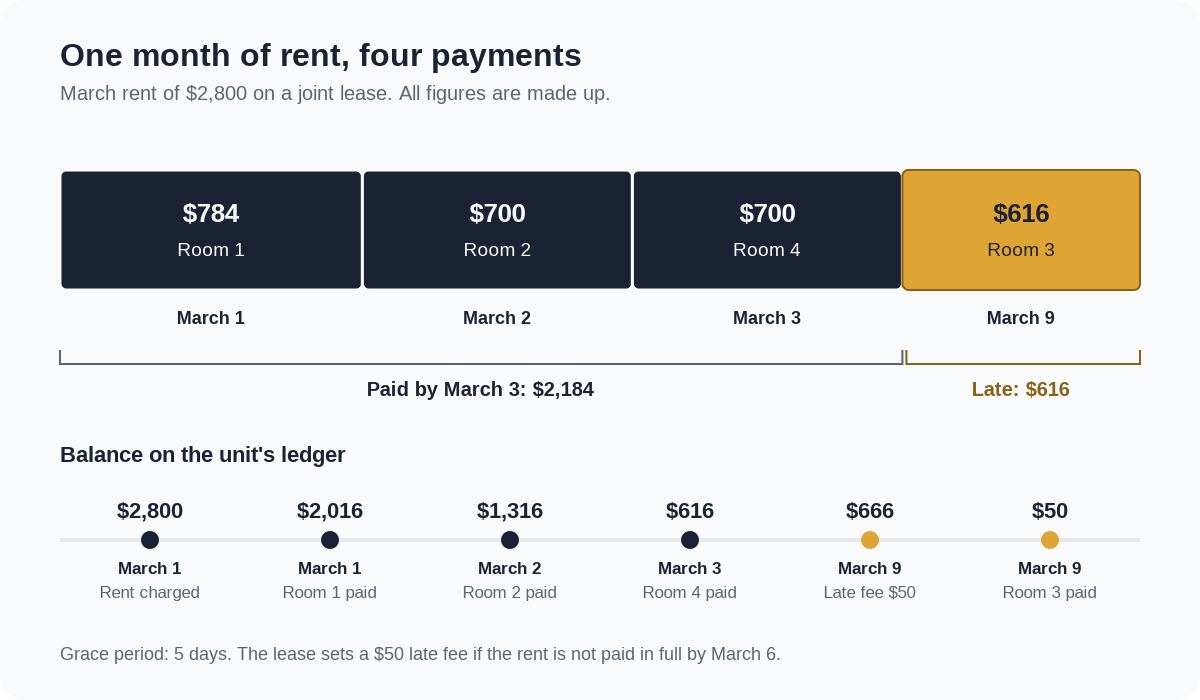
On room-by-room leases the same month looks different. Rooms 1, 2 and 4 are paid in full on time, and only Room 3's rent is late. Any late fee would come from Room 3's own lease and would apply to that room's rent.
When one share is late or short
A late share is the most common problem with split payments. A steady routine helps:
- Check the balance on the day after the grace period ends and see whose share is missing.
- Contact the household in writing. On a joint lease, many owners write to every tenant on the lease, since the rent is owed by the unit. On room-by-room leases, write to the tenant whose rent is late.
- Apply the late fee the lease sets, once, and record it on the ledger.
- Keep notes of every message and payment.
- Escalate the same way you would for any unpaid rent if the share stays unpaid. A lease violation notice covers other breaches of the lease; unpaid rent has its own notice rules in most places.
Avoid sorting out the roommates' private arrangements yourself. Who covered whose share, or who owes whom for the internet bill, is between them; your concern is whether the rent the lease sets has been paid.
When a roommate moves out
When one roommate leaves before the lease ends, the options depend on the lease type.
- On a joint lease, the departing tenant usually stays on the lease until the owner agrees in writing to release them. The remaining roommates may ask to bring in a replacement, which may be done through a new lease, an amendment, a sublease or a lease assignment, depending on what the lease allows.
- On room-by-room leases, the departing tenant's room lease ends on its own terms, and the room can be re-let without changing the other leases.
Work out who holds which part of the security deposit before anyone moves, and put it in writing. A partial month for a new roommate can be worked out with the prorated rent calculator.
Frequently asked questions
Can roommates pay rent separately?
Yes, in general, when the owner accepts it. On a joint lease the owner applies every share to the one rent for the unit. On room-by-room leases each tenant pays their own room's rent anyway. Put the payment rules in writing either way.
Is each roommate responsible only for their share?
It depends on the lease. On a joint lease, each tenant is often responsible for the whole rent, so if one roommate does not pay, the others may have to cover it. A separate lease for each room usually limits each tenant to their own room's rent. Rules vary by state and city. Check your local law or an attorney.
How should a property owner record split rent payments?
Post the full rent as one charge and each share as its own payment line with the payer's name, on one ledger for the unit, or on one ledger per room for room-by-room leases. In the example, three payments of $784, $700 and $700 left a $616 balance until Room 3 paid.
Does a late fee apply if only one roommate pays late?
On a joint lease the rent is not paid in full until every share arrives, so a fee in the lease usually applies to the unit's rent. In the example, Room 3's share arrived on March 9 and the lease's $50 fee applied. On room-by-room leases only the late room's lease applies.
How do roommates decide how to split the rent?
Most split it equally when the rooms are similar, or by room size when they differ. The rent split calculator does both. In the example, the split by size ran from $616 for the smallest room to $784 for the largest.
Collect every share on one rent
Every share is easier to follow when it lands against the same lease. KeyRing drafts each month's rent invoices for you to approve, adds recurring charges such as parking or a pet fee, and lets tenants pay online by bank transfer or card. In KeyRing, each lease keeps its rent charges, payments and balance, you can record cash and check payments, including partial ones, and overdue invoices are flagged automatically. See what KeyRing does or how plans are priced.
Free calculators and templates
- Rent split calculatorEach room's share of the rent and utilities, equally or by room size.
- Rent ledger templateTrack one tenant's charges, payments and running balance, in a spreadsheet or on paper.
Browse all rental property calculators and free templates.