What are certified funds? How they work for rent and move-in money
By Jenna Whitfield -

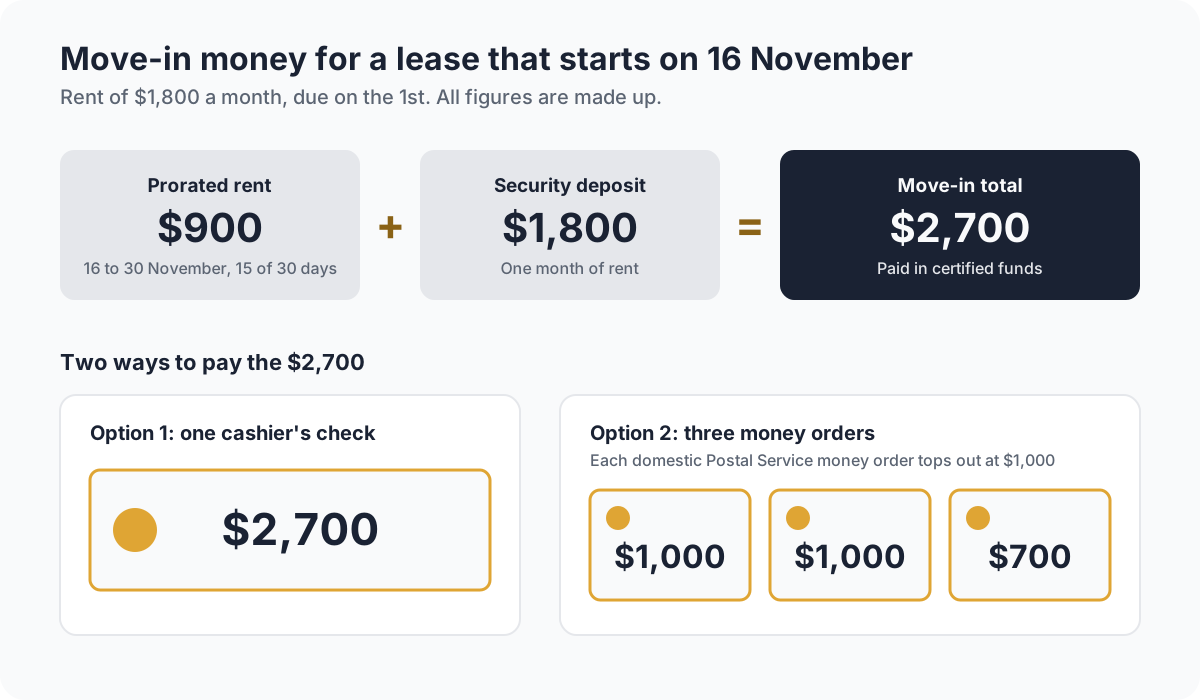
Certified funds are payments whose money is guaranteed by a bank or another issuer, or has already been moved, at the moment you receive them. The usual forms are a cashier's check, a certified check, a money order and a wire transfer. Property owners often ask for certified funds for move-in money, such as a tenant's first rent and security deposit, because a personal check can be returned days after the keys are handed over. A tenant moving in on 16 November at $1,800 a month might bring $2,700 in certified funds: $900 of prorated rent plus a $1,800 deposit.
This guide covers what counts as certified funds, how each type works, a worked move-in example, how certified funds compare with personal checks and online payments, how to spot a fake cashier's check and how to record what you receive. It is general information and is not legal or financial advice. Rules vary by state and city. Check your local law or an attorney.
What are certified funds?
"Certified funds" is a label for payments a bank or issuer stands behind. With a personal check, the money stays in the writer's account until the check clears, and the check can bounce if the account comes up short. With certified funds, the money is set aside or paid in advance before the payment reaches you.
| Type | Who stands behind it | Where a tenant gets one | Good to know |
|---|---|---|---|
| Cashier's check | The issuing bank, from its own funds | A bank or credit union, at the counter or online | Made out to you by name; often used for larger amounts |
| Certified check | The writer's bank, which sets the money aside | The writer's own bank | A personal check the bank has certified and marked |
| Money order | The issuer, paid in full up front | Post offices, banks and many stores | Domestic US Postal Service money orders top out at $1,000 each |
| Wire transfer | The sending bank, once the wire is sent | The tenant's bank | Usually arrives the same day and is hard to reverse |
The US Postal Service lists the $1,000 limit for domestic money orders on its money orders page. Other issuers set their own limits, so a tenant paying a larger amount by money order may need several.
Why owners ask for certified funds
- Move-in money. The first payment usually comes before the tenant has a payment history with you. Certified funds let you hand over keys knowing the money is backed.
- After a returned payment. A lease can let the owner ask for certified funds for a period after a check bounces or a bank transfer is returned. A returned payment can also make rent late, so check what your lease says about late fees; the late fee calculator shows how a lease's fee works out.
- Large one-time amounts. Several months paid ahead, a deposit top-up or a payment at the end of a lease.
- No bank account. Some tenants pay rent by money order every month because they have no checking account.
Whether you can require certified funds, and when, depends on where the property is. Some states and cities limit which payment methods an owner can insist on, or require the owner to offer at least one method other than cash. Rules vary by state and city. Check your local law or an attorney before you add a certified funds clause to a lease or change how a tenant pays.
A worked example: move-in money for 16 November
All the figures here are made up. A tenant signs a lease at $1,800 a month that starts on 16 November. Rent is due on the 1st, so the first payment covers 16 to 30 November, and the lease asks for a security deposit of one month's rent.
- Days covered in November: 16 to 30 November = 15 days of 30
- Prorated rent: $1,800 x 15 / 30 = $900
- Security deposit: $1,800
- Move-in total: $900 + $1,800 = $2,700
The prorated rent calculator works out the first partial month from your own dates, and the prorated rent guide compares the ways to count the days.
The tenant has two simple ways to pay the $2,700 in certified funds:
- One cashier's check for $2,700, made out to the owner or the owner's company.
- Three money orders, because each domestic Postal Service money order tops out at $1,000: $1,000 + $1,000 + $700 = $2,700.
From 1 December the tenant pays the full $1,800 each month by whatever method the lease allows. Record the deposit separately from rent: it is money held for the tenant, and many states set rules on where it is kept and when it goes back. The security deposit guide covers the basics.
Certified funds compared with other ways to pay
| Method | Can it be reversed or returned? | When the money is yours | Paper to keep |
|---|---|---|---|
| Personal check | Yes, it can bounce if the account is short | After it clears | Check number and deposit record |
| Cashier's or certified check | Rarely, though a fake one is returned | Usually soon after deposit; verify it first | Check number and issuing bank |
| Money order | Rarely, though a fake one is returned | After deposit; verify it first | Serial number and issuer |
| Bank transfer (ACH) | Yes, it can be returned for a few days | After it settles | Payment confirmation |
| Card payment | Yes, the cardholder can dispute it | After the processor pays out | Payment confirmation |
| Wire transfer | Very rarely | When it arrives | Wire confirmation |
An online bank transfer is convenient for monthly rent but sits outside the certified funds group, because it can be returned. The ACH payment guide explains how bank transfers settle, and the eCheck guide covers checks that are turned into electronic payments.
How to spot a fake cashier's check or money order
Fake cashier's checks and money orders are a common scam, and a bank can make the money available before it finds out the item is fake. When that happens, the deposit is reversed and the person who deposited it owes the bank the money. A few habits protect you:
- Verify with the issuer. Look up the bank's or issuer's phone number yourself and call to confirm the check or money order is real. Skip any number printed on the item.
- Wait before handing over keys. Ask your bank when the item has fully cleared, which can take longer than the funds showing as available.
- Never refund an overpayment. A payment for more than you asked for, followed by a request to send the difference back, is a well-known pattern. Return the whole item and ask for the right amount.
- Prefer items bought in person. Some owners ask the tenant to buy the cashier's check at a branch and hand it over at the lease signing, or to meet at the owner's own bank.
How to record certified funds
Treat certified funds like any other payment: record the date, the amount, what it covers and how it was paid. Note the check or serial number of each cashier's check or money order, and keep a copy or photo until the funds have cleared.
- Give a receipt. A tenant paying by money order or cashier's check has no bank statement that shows who received it. The rent receipt template has a line for the payment method and reference number.
- Post it to the tenant's ledger. Split the move-in payment into its parts, prorated rent and deposit, so each one lands on the right line. The rent ledger template keeps charges, payments and the running balance for each tenant.
- Keep deposits separate. Hold the deposit in its own account if your state requires it, and record it as money held for the tenant.
Frequently asked questions
What counts as certified funds?
Cashier's checks, certified checks, money orders and wire transfers are the usual forms. Some owners also accept a bank's teller check. Personal checks, bank transfers (ACH) and card payments are usually outside the group because they can be returned or disputed.
Is a money order certified funds?
Usually yes. A money order is paid for in full when it is bought, so the issuer stands behind it. Domestic US Postal Service money orders top out at $1,000 each, so larger amounts take several.
Can a cashier's check bounce?
A real cashier's check is backed by the bank's own funds, so it rarely comes back. A fake one does, sometimes after the money has shown as available. Call the issuing bank on a number you looked up yourself before you rely on it.
Can I require a tenant to pay rent in certified funds?
Often, if the lease says so, especially for move-in money or after a returned payment. Some states and cities limit which payment methods an owner can require. Rules vary by state and city. Check your local law or an attorney.
Is a bank transfer the same as certified funds?
No. A bank transfer (ACH) can be returned for a few days after it is sent, for example when the account is short. A wire transfer is much harder to reverse, which is why it is usually counted as certified funds.
Keep every payment on the lease it belongs to
Certified funds are only as useful as the record you keep of them. In KeyRing, each lease keeps its rent charges, payments and balance, you can record cash and check payments, including partial ones, and overdue invoices are flagged automatically. Tenants can also pay rent online by bank transfer (ACH) or by debit or credit card, and they see the fee before they pay. Each payment sends the tenant a receipt by email with a PDF. See what KeyRing does or how plans are priced.
Free calculators and templates
- Prorated rent calculatorRent for a partial first or last month, by actual days or a 30-day month.
- Late fee calculatorA rent late fee as a flat amount or a percentage, with a grace period.
- Rent receipt templateA printable rent receipt, two to a page, and a CSV log for every payment you receive.
- Rent ledger templateTrack one tenant's charges, payments and running balance, in a spreadsheet or on paper.
Browse all rental property calculators and free templates.