What is an ACH payment? How ACH rent payments work
By Claire Navarro -

An ACH payment is an electronic transfer from one US bank account to another over the Automated Clearing House network. When a tenant pays rent online from their checking account, that payment almost always travels by ACH. It is the same network that carries direct deposit paychecks and the bills people pay from their bank's website.
This guide covers what an ACH payment is, ACH debits and credits, how an ACH rent payment moves step by step, how long it takes, what it costs, what happens when one is returned and how to set up ACH rent for your properties.
What is an ACH payment?
ACH stands for Automated Clearing House. It is a US network that moves money between banks and credit unions in batches, several times each business day. The rules for the network are set by Nacha, a nonprofit association of financial institutions, and the payments themselves are processed by two operators: the Federal Reserve and The Clearing House.
Every ACH payment needs the same few details: the bank's routing number, the account number, the amount and the authorization of the person whose account is charged. Because the money moves straight between bank accounts, an ACH payment skips paper checks, card networks and cash.
For a rental property, ACH is the usual way to collect rent electronically. The tenant pays from their own bank account, and the money lands in the bank account you use for the property.
ACH debit vs ACH credit
An ACH payment moves in one of two directions, and the difference matters when you collect rent:
- ACH debit: the person being paid pulls the money from the payer's account, with the payer's permission. A tenant who pays through a rent payment portal, or who signs up for automatic payments, authorizes an ACH debit.
- ACH credit: the payer pushes the money to the person being paid. A tenant who sends rent from their own bank's bill pay, or an employer paying wages by direct deposit, sends an ACH credit.
Most online rent collection uses ACH debits, because the tenant authorizes the payment once and the payment portal handles the routing and account numbers. With a credit, the tenant needs your account details, and the payment often arrives with little information about which unit or month it covers.
ACH vs card, check and wire
Here is how ACH compares with the other common ways tenants pay rent:
| ACH bank transfer | Debit or credit card | Paper check | Wire transfer | |
|---|---|---|---|---|
| How it moves | Bank account to bank account, in batches | Over the card networks | Deposited, then cleared between banks | Bank to bank, one payment at a time |
| Typical time to clear | 1 to 3 business days | Approved at once, paid out in a few days | A few business days after deposit | The same day, often within hours |
| Typical cost | Low, often a percentage with a cap or a flat fee | Higher, often around 3% | A stamp and a trip to the bank | Often $15 to $35 for the sender |
| Can it come back | Yes, a returned payment or a dispute | Yes, a chargeback | Yes, a bounced check | Rarely, once sent |
For monthly rent, ACH usually costs the least of the electronic options, and it saves you depositing checks by hand. Cards cost more but are convenient for tenants who want to pay by card. Wires are fast and hard to reverse, which is why they suit one-off large payments, such as a home purchase, better than rent.
How an ACH rent payment works, step by step
- The tenant links a bank account. In a payment portal, the tenant either signs in to their bank to verify the account at once or enters the routing and account numbers and confirms two small test deposits.
- The tenant authorizes the payment. The tenant agrees to the amount and the date, for one payment or for a recurring one. That authorization is what lets the portal debit the account.
- The payment is sent in a batch. The payment processor sends the debit to its bank, which passes it into the ACH network with the day's other payments.
- The tenant's bank settles it. The tenant's bank sends the money, usually within one to three business days.
- The money is paid out to you. The processor pays the rent out to the bank account you chose for the property, on its payout schedule.
Weekends and federal bank holidays do not count as business days. A payment a tenant starts on a Friday evening before a holiday Monday can take until Wednesday or Thursday to clear, so a due date on the 1st may need a payment started a few days before.
How long does an ACH payment take?
Standard ACH payments usually settle in one to three business days. Same-day ACH exists too: banks can send payments that settle the same business day, for payments under a per-payment limit, often for an extra fee.
For rent, two dates matter: the day the tenant starts the payment and the day the money clears. Your lease can say which one counts as "paid on time." Many property owners count the date the tenant starts the payment, as long as it later clears, which is fair to tenants who pay on the due date.
What ACH costs, and who pays it
An ACH payment costs far less to process than a card payment. Payment processors often charge a percentage of the payment with a cap, or a flat fee per payment. Banks may charge for sending a same-day ACH or a wire, while a standard ACH payment from a bank's bill pay is often free for the person sending it.
Who pays the fee depends on the service you use and on your lease. Some property owners absorb it as a cost of collecting rent. Others use a service that adds the fee to what the tenant pays, so the full rent reaches the owner. Some states and cities limit fees tied to a payment method, or require owners to offer at least one way to pay that has no fee, such as a check. Check the rules where your property is before you add a fee.
A worked example
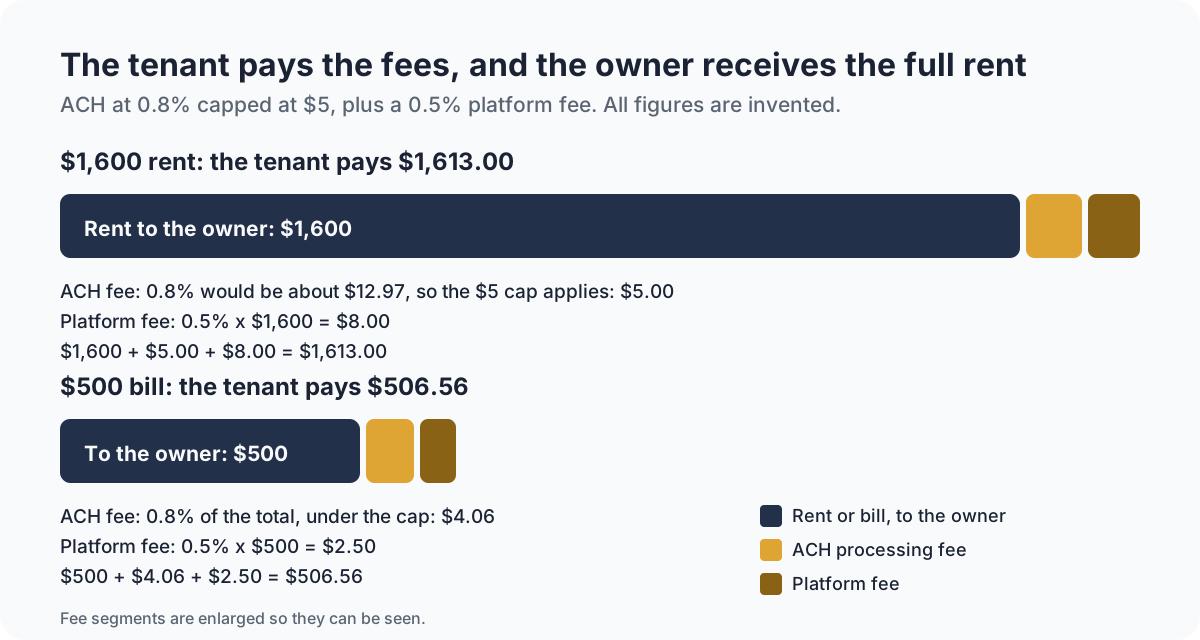
Take an invented one-bedroom unit with rent of $1,600 a month, paid through a service with these fees, all paid by the tenant: a 0.8% ACH processing fee capped at $5, and a 0.5% platform fee.
- Platform fee: 0.5% x $1,600 = $8.00.
- ACH fee: 0.8% of the payment would come to about $12.97, which is over the cap, so the fee is $5.00.
- The tenant pays: $1,600 + $8.00 + $5.00 = $1,613.00.
- The owner receives: the full $1,600.
A smaller payment shows the 0.8% before the cap kicks in. For a $500 bill, the platform fee is 0.5% x $500 = $2.50, and the ACH fee is worked out on the total the tenant pays, so the owner still receives the full $500. That total is $506.56, of which $4.06 is the ACH fee: $500 + $2.50 + $4.06 = $506.56. Once the bill and the platform fee together pass $620, the ACH part stays at $5, however large the rent.
The same $1,600 by card, at 2.9% + $0.30 plus the 0.5% platform fee, costs the tenant $56.34 in fees, against $13.00 by ACH.
When an ACH payment is returned
An ACH payment can come back after it looks paid. The most common reason is insufficient funds in the tenant's account. Other reasons include a closed account, a wrong account number or a tenant who tells their bank the payment was not authorized.
Returns for insufficient funds or a closed account usually arrive within two banking days. A consumer can dispute an ACH debit they did not authorize for up to 60 days after it settles, so a payment can, rarely, be reversed weeks later.
When a rent payment is returned, the rent is unpaid. Treat it the way your lease treats any unpaid rent:
- Record the return on the tenant's ledger, so the balance shows what is still owed.
- Tell the tenant in writing, with the amount due and how to pay it.
- Apply the lease terms. If your lease sets a returned payment fee or a late fee, the late fee calculator works out the amount, within any limit your state sets.
- Wait for the next payment to clear before you mark the month paid.
A rent receipt is best sent once the payment has cleared, so a returned payment never leaves a tenant holding a receipt for rent you did not receive.
How to set up ACH rent for your properties
A few documents keep ACH rent clear for you and your tenants:
- A payment clause in the lease. Say how rent may be paid, when a payment counts as on time, who pays any processing fee and what happens if a payment is returned.
- A written authorization. A payment portal records the tenant's authorization for you. If you take bank details yourself, get the tenant's signed permission for each payment or for a recurring one.
- A bill for each month. A rental invoice lists the rent and any other charges, with the due date and how to pay.
- A statement on request. A rent statement shows the charges, the payments and the balance for a period, which helps when a returned payment and a new one land in the same month.
In your books, the rent you receive is rent income, and the tenant's fees stay out of it when the tenant pays them. Over a year, that rent income is the top line of a rental property profit and loss statement.
Frequently asked questions
What does ACH stand for?
ACH stands for Automated Clearing House, the US network that moves money between bank accounts in batches. Direct deposit, online bill pay and most online rent payments travel over it.
Is an ACH payment the same as a wire transfer?
No. Both move money between bank accounts, but a wire is sent one payment at a time and usually arrives the same day, while ACH payments travel in batches and usually take one to three business days. Wires usually cost the sender more and are much harder to reverse.
How long does an ACH rent payment take to clear?
Usually one to three business days from when the tenant starts it. Weekends and federal bank holidays add time, and the service you use may take a little longer to pay the money out to your bank.
Can an ACH payment bounce?
Yes. A payment can be returned for insufficient funds or a closed account, usually within two banking days, and a consumer can dispute an unauthorized debit for up to 60 days after it settles. Until the payment clears, treat the rent as pending.
Is ACH safe for paying rent?
ACH payments run between regulated banks under the network's rules, and a payment portal keeps the tenant's account details off paper. As with any payment, use a service you trust, and never send your bank details by email.
Collect rent by ACH with KeyRing
In KeyRing, tenants pay rent online by bank transfer (ACH) or by debit or credit card, and they see the fee before they pay. The tenant pays the processing fee, so you receive the full rent: ACH is 0.8% capped at $5, card is 2.9% + $0.30, plus a 0.5% KeyRing platform fee. Rent goes straight to your own Stripe account and pays out to your bank, and you can see your payouts and get told if one fails. Each payment sends the tenant a receipt by email with a PDF. Tenants can turn on autopay today, and automatic charging on the due date is coming soon. See what KeyRing does or how plans are priced.
Free calculators and templates
- Late fee calculatorA rent late fee as a flat amount or a percentage, with a grace period.
- Rent receipt templateA printable rent receipt, two to a page, and a CSV log for every payment you receive.
- Rental invoice templateA printable rent invoice with line items and a total, and a CSV log of every invoice you send.
- Rent statement templateA tenant's charges, payments and balance for a period, from the opening balance to what is due now.
- Rent tracker templateEvery unit on one row and every month in a column, so a year of rent fits on one page.
Browse all rental property calculators and free templates.