What is house hacking? How it works with a duplex or a spare room
By Jenna Whitfield -

House hacking means buying a home with more space than you need, living in part of it and renting out the rest, so the rent pays some or all of your housing costs. The most common setups are a duplex, triplex or fourplex where you live in one unit, and a single-family house where you rent out spare rooms or a basement apartment.
This guide covers how house hacking works, the two common setups, how buyers usually finance it, a worked example for each, what changes when you move out and the trade-offs to weigh first.
What is house hacking?
House hacking is a way to start owning rental property while you live in it. You buy a property you can live in, you rent the parts you do not use, and the rent goes toward the mortgage, taxes, insurance and upkeep. Your own housing cost is what is left after the rent comes in.
When the rent covers more than the costs, you live there for free and keep the difference. When it covers less, you still pay something, usually less than you would pay to rent a similar home. Either way you build equity in a property you own, and when you move out later, the part you lived in becomes one more rental.
How house hacking works
The arithmetic is the same for every setup:
- Add up the monthly costs of the whole property: the loan payment, property taxes, insurance, repairs and reserves, any utilities you pay and HOA dues.
- Add up the rent from every unit or room except yours, less an allowance for the months a unit or room sits empty.
- Subtract the rent from the costs. The result is what living there costs you each month.
The house hacking calculator runs these steps for any price, loan, cost and rent, and shows the monthly saving against what you pay to live now.
House hacking with a duplex
A duplex is one building with two separate homes, each with its own entrance, kitchen and bathroom, on one deed. You live in one unit and lease the other. A triplex or fourplex works the same way with more units to rent, so more of the costs are covered.
A small multi-unit keeps your home and your tenant's home apart. Each unit has its own door and, often, its own utility meters, and the tenant has a standard lease for their unit.
House hacking with a spare room
In a single-family house, you rent out one or more bedrooms and share the kitchen and living space, or you rent a separate part of the house, such as a basement apartment or a unit over the garage. Rooms usually rent for less than a whole unit, so the rent covers a smaller share of the costs, and you share your home with the people who pay it.
Before you rent rooms, check your local zoning rules, any HOA rules, your insurance policy and your loan's terms. Some places limit how many unrelated people can share a house or need a permit for a separate unit.
How buyers usually finance a house hack
Because you live in the property, you can often use an owner-occupied mortgage. Many owner-occupied loan programs accept properties of one to four units and allow a smaller down payment than a loan for an investment property. These loans usually ask you to move in within a set time and live there for a period, often at least a year.
Lenders differ on how much of the expected rent counts toward qualifying. Ask yours early, and bring the current leases or a rent estimate for each unit you plan to rent. Five units or more usually need a commercial loan, which sits outside most owner-occupied programs.
A worked example: a duplex
A duplex costs $360,000 with 5% down. The loan is at 7% over 30 years, so the monthly loan payment on $342,000 is $2,275.33. Taxes and insurance come to $550 a month and repairs, utilities and other costs to $300. You live in one unit and rent the other for $1,800 a month, with a 5% vacancy allowance. You pay $1,750 a month to live where you are now.
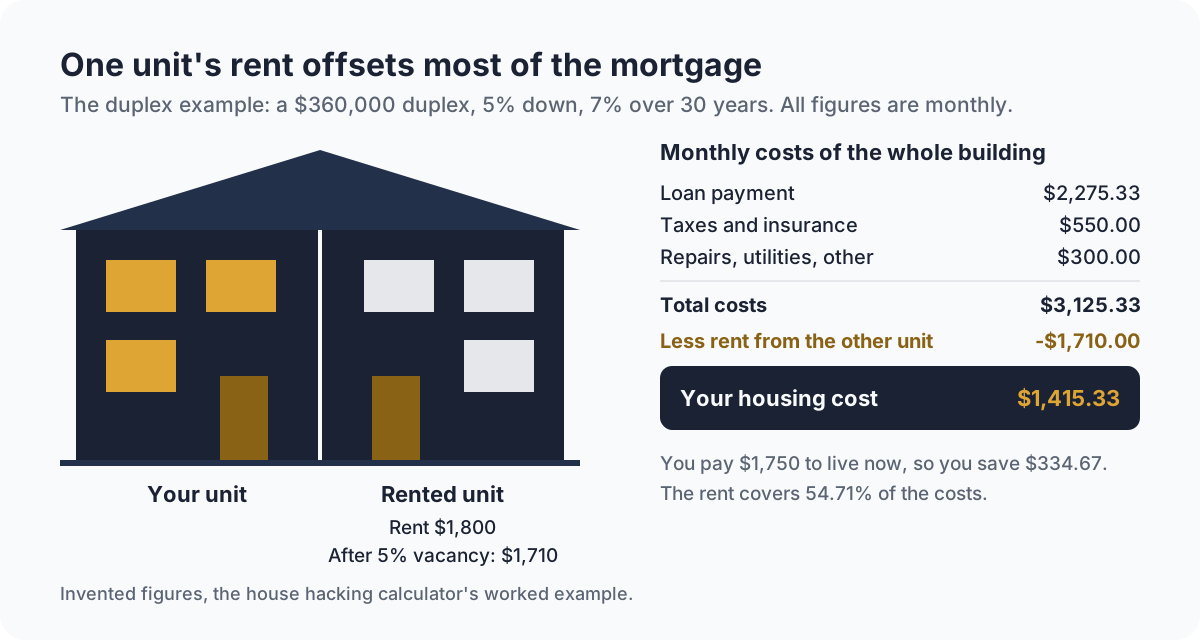
- Monthly costs: $2,275.33 + $550 + $300 = $3,125.33.
- Rent from the other unit: $1,800 x 95% = $1,710.
- Your housing cost after rent: $3,125.33 - $1,710 = $1,415.33 a month.
- Your saving: $1,750 - $1,415.33 = $334.67 a month against what you pay now.
The rent covers $1,710 / $3,125.33 = 54.71% of the costs. These are the house hacking calculator's own example figures, so you can open it and change any of them.
A worked example: two spare rooms
A three-bedroom house costs $2,400 a month in all: the loan payment, taxes, insurance and upkeep. You keep one bedroom and rent the other two for $750 each, with the same 5% vacancy allowance.
- Rent from the two rooms: 2 x $750 = $1,500, and $1,500 x 95% = $1,425.
- Your housing cost after rent: $2,400 - $1,425 = $975 a month.
The rooms cover $1,425 / $2,400 = 59.38% of the costs. That is a larger share than the duplex's, and your housing cost is lower because the house costs less. The trade is sharing the kitchen and living room with the people who rent the rooms.
When you move out
Most owner-occupied loans ask you to live in the property for a set period. After that, many owners move out and rent every unit, and the house hack becomes a full rental.
In the duplex example, renting both units brings ($1,800 + $1,800) x 95% = $3,420 a month. Less the same $3,125.33 of costs, that is $294.67 a month of cash flow before management, which you would add if you hire a property manager. The rental cash flow calculator breaks a full rental's cash flow down line by line, with management and other income. Check your loan's occupancy terms before you move.
Some owners repeat the move every year or two: buy the next small multi-unit with an owner-occupied loan, move in, and keep renting the last one. Others buy a property that needs work, live in it while they fix it up, then refinance and rent it out. That second path is close to the BRRRR method (buy, rehab, rent, refinance, repeat), and the BRRRR calculator shows how much cash stays in the deal after the refinance.
Running the rental side
Even with one tenant, you are a property owner with a lease to run:
- Use a written lease for each unit or room, with the rent, the due date, the deposit and the house rules for shared space.
- Keep a ledger per tenant. A rent ledger records every charge, payment and credit with a running balance. The rent ledger vs tenant ledger guide explains the two setups.
- Send a statement when a balance needs explaining. A rent statement sums up a tenant's account for a period, from the opening balance to what is due now.
- Keep your own costs apart. Track the property's expenses in full, so you know what the whole building costs and what share the rent covers.
Ask a tax professional how to split the costs between the part you live in and the part you rent. The rented share is usually treated as a rental and the rest as your home.
Pros and cons of house hacking
- Lower housing costs. In the duplex example, you pay $334.67 a month less to live there.
- A smaller down payment. Owner-occupied loans often ask for less than an investment property loan.
- You learn to run a rental up close. You see repairs and tenant requests as they happen.
- You live next to your tenant. A late-night repair or a noise complaint is next door.
- Less privacy, especially when you rent rooms in your own home.
- Vacancy hits your budget directly. When the other unit sits empty, you cover its share of the mortgage.
Frequently asked questions
What is house hacking?
House hacking is buying a property with more space than you need, living in part of it and renting out the rest, so the rent pays some or all of your housing costs. A duplex, triplex or fourplex with one unit for you is the common setup, and renting spare rooms in a single-family house works the same way.
Is house hacking worth it?
It often is for buyers who can live with a tenant close by. In the duplex example, the other unit's rent cuts the owner's housing cost from $3,125.33 to $1,415.33 a month. Run your own numbers with the house hacking calculator before you buy.
Can you house hack with a single-family home?
Yes. You can rent spare bedrooms or a separate part of the house, such as a basement apartment. Check your local zoning, HOA rules, insurance and loan terms first.
How long do you have to live in a house hack?
Owner-occupied loans usually ask you to move in within a set time and live there for a period, often at least a year. Your loan documents set the exact terms, so ask your lender before you plan a move.
What happens to a house hack when you move out?
It becomes a full rental: you lease your unit too, and its rent joins the rest. In the duplex example, two rents of $1,800 after a 5% vacancy allowance bring $3,420 a month, which leaves $294.67 a month after the $3,125.33 of costs.
Run the units you rent out in one place
House hacking makes you a property owner from the first lease. In KeyRing, you create a lease for each unit or room you rent, each month's rent invoices are drafted for you to approve before they are sent, and tenants pay online by bank transfer or card. You can record cash and check payments too, including partial ones, and tenants file maintenance requests with photos on the web. See what KeyRing does or how plans are priced.
Free calculators and templates
- Rental cash flow calculatorMonthly cash flow line by line, per unit, with the break-even rent.
- BRRRR calculatorCash in, cash back at the refinance and cash left in a buy, rehab, rent, refinance deal.
- House hacking calculatorWhat living in your own rental costs you each month after the other units' rent.
- Rent statement templateA tenant's charges, payments and balance for a period, from the opening balance to what is due now.