What is a room rental agreement? Renting one room in a shared home
A room rental agreement is an agreement to rent one private room in a home, along with the use of shared spaces such as the kitchen, bathroom and living room. It is common when an owner lives in the home and rents out spare bedrooms, and when an owner rents a shared house room by room. Each tenant signs for their own room and owes their own rent, so one person's late payment or move-out does not change anyone else's agreement. In the worked example below, an owner sets a target of $2,700 a month for three rooms, splits it by room size, and the room rents come to $1,008, $886.50 and $805.50.
This page covers what a room rental agreement is, who it suits, how it compares with a joint lease and a sublease, what it usually includes, how rent and utilities are usually split, deposits, ending the arrangement and a worked example. It is general information and is not legal or tax advice. Rules vary by state and city. Check your local law or an attorney.
What is a room rental agreement?
A room rental agreement is a rental agreement for part of a home. The tenant gets exclusive use of one bedroom, sometimes with a private bathroom, and shares the rest of the home with other people who live there. Those other people may be the owner, other tenants with their own room rental agreements, or both.
The agreement does the same job as a lease for a whole unit. It names the parties, the space, the rent, the term and the rules. What sets it apart is the shared living. A whole-unit lease rarely needs to say who cleans the kitchen or when the living room gets quiet, and a room rental agreement usually does.
Names vary. The same document may be called a room lease, a room rental contract, a lodger agreement or a roommate agreement. A roommate agreement can also mean something different: a private arrangement between co-tenants who already share one lease, setting how they split chores and bills between themselves. The owner is usually not a party to that kind of roommate agreement.
Who a room rental agreement suits
Room rentals work well in a few common situations.
- An owner who lives in the home. An owner who rents out spare bedrooms in the home they live in is the classic case. This is one form of house hacking, where rent from part of the home helps cover the mortgage. The house hacking calculator shows how much of the monthly cost the rooms could cover.
- A shared house rented by the room. An owner who does not live there can rent each bedroom of a larger house to a different tenant. Each room has its own agreement, its own rent and its own start and end dates, so one room can turn over while the others stay let.
- Tenants who want a lower rent or a shorter commitment. A single room usually costs less than a whole unit, and many room rentals run month to month. Students, people new to a city and people between homes often look for this kind of arrangement.
Room rental agreement, joint lease and sublease compared
Three arrangements often get mixed up when people share a home. The difference comes down to who signs with whom, and who owes the rent.
| Arrangement | Who signs | Who owes the rent | What each person rents |
|---|---|---|---|
| Room rental agreement | Each tenant signs their own agreement with the owner | Each tenant owes only the rent for their own room | One private room, plus shared use of the common spaces |
| Joint lease | All the tenants sign one lease with the owner | Usually all of them together, so the owner can ask any of them for the full rent | The whole unit, shared between them |
| Sublease | The original tenant signs with a subtenant, usually with the owner's consent | The subtenant pays the original tenant, who still owes the owner the full rent | Part or all of the original tenant's unit, for part of their term |
The practical difference shows up when something goes wrong. Under a joint lease, many leases make the tenants jointly responsible for the whole rent, so if one moves out, the others may have to cover the gap. Under room rental agreements, each tenant is responsible for their own room, and a vacancy is the owner's to fill. Under a sublease, the original tenant stays on the hook to the owner and takes on the risk of the subtenant. The guide to split rent payments covers how shared rent is usually collected under a joint lease.
What a room rental agreement usually includes
Exact contents depend on the home, the owner and local rules. An attorney can draft or review the agreement. In general, a room rental agreement covers:
- The parties. The owner or property manager and the tenant, with contact details.
- The room. Which room the tenant rents, any private bathroom or storage, and any furniture that comes with it.
- The shared spaces. Which areas the tenant may use, such as the kitchen, living room, laundry, yard and parking, and any areas that are off limits, such as the owner's own rooms.
- The term. A fixed term with an end date, or a month-to-month arrangement that continues until someone gives notice.
- Rent. The amount, the due date, how to pay and any late fee the agreement and local rules allow.
- Utilities. Whether utilities are included in the rent, split between the rooms or billed separately, and how the split works.
- The security deposit. The amount, what it can be used for and how it comes back. The security deposit entry covers the general rules.
- House rules. Guests and overnight stays, quiet hours, cleaning of shared spaces, kitchen and fridge space, smoking, pets and noise.
- Access and privacy. When the owner may enter the tenant's room, and with what notice. A tenant's right to quiet enjoyment of the room still applies in a shared home.
- Ending the agreement. How much notice each side gives and how the move-out works.
- Signatures of the owner and the tenant.
Where an owner screens applicants for a room, the written criteria must be applied the same way to every applicant. A co-signer can help a tenant with a thin rental or credit history, and the same co-signer policy should be offered to every applicant who needs one. Where an agreement covers pets, assistance animals for people with disabilities are generally treated differently from pets, so pet rent, pet deposits and pet fees usually do not apply to them. Fair housing rules can apply differently to an owner who lives in a small home, so check the local rules or ask an attorney before setting criteria.
How rent and utilities are usually split
An owner who rents several rooms has to decide what each room costs. Most use one of two approaches.
- Equal rent. Every room pays the same. This is simple and works well when the rooms are close in size and quality.
- Rent by room size. Part of the target rent covers the shared spaces and is split equally between the rooms. The rest is split by each room's floor area, so a larger room pays more. A private bathroom, a better view or a parking space can justify a further adjustment.
Utilities are usually included in each room's rent, split equally between the rooms each month, or billed by actual use where meters allow it. Many shared homes split them equally, since the rooms share one kitchen, one heating system and one internet connection. Some places have rules about how an owner may bill utilities to tenants, so check before passing on a shared bill.
The rent split calculator works out both approaches, and the worked example below uses it.
Deposits in a room rental
Each room's agreement usually has its own security deposit. Many owners set it at an amount tied to that room's rent, within any cap that local law sets. Keeping the deposits separate makes a move-out simpler: when one tenant leaves, only their deposit comes into the settlement, and the other tenants are not affected.
Shared spaces make deductions harder. If the kitchen is damaged and three tenants use it, it can be hard to say whose deposit should cover it. A move-in inspection of both the room and the shared spaces, with dated photos, helps. A rental inspection checklist keeps the notes in order. Deductions are generally limited to unpaid rent and damage beyond normal wear and tear, and should be itemized for the tenant who caused them.
Ending a room rental agreement
A room rental agreement ends the same general ways a whole-unit lease does. A fixed term ends on its end date, and a month-to-month agreement ends when one side gives written notice. The notice to vacate entry covers how that notice usually works, and the lease termination entry covers the other ways an agreement can end.
The rules for ending a room rental can depend on who lives in the home. Some places treat a lodger who rents a room in a home the owner also lives in differently from a tenant who rents a whole unit, for example with a shorter process for ending the arrangement. Other places give a room tenant the same protections as any other tenant. Where a tenant has no written term at all, the arrangement may be a tenancy at will. Rules vary, so check local law or ask an attorney before ending a room rental, and never use self-help steps such as changing the locks or removing a tenant's belongings.
A worked example: three rooms split by size
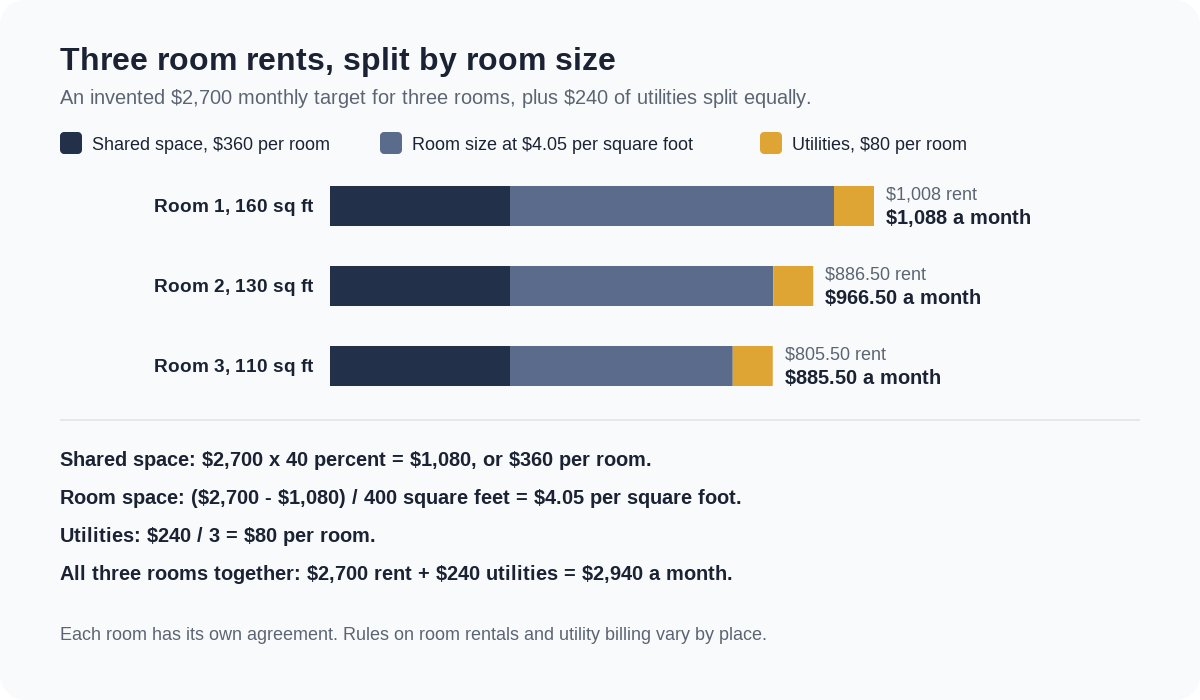
All the figures here are made up. An owner buys a four-bedroom house, lives in the main bedroom and rents out the other three rooms, each on its own month-to-month room rental agreement. To cover the mortgage and costs, the owner sets a target of $2,700 a month for the three rooms together. Utilities, including internet, average $240 a month, and the owner splits them equally between the three rented rooms.
The rooms differ in size:
- Room 1: 160 square feet
- Room 2: 130 square feet
- Room 3: 110 square feet
That is 400 square feet of private room space in total. The owner decides that 40 percent of the target rent pays for the shared spaces, which every tenant uses equally, and the rest is split by room size. Using the site's rent split calculator with the size method:
- Shared-space part: $2,700 x 40 percent = $1,080, or $1,080 / 3 = $360 per room
- Rent per square foot of room space: ($2,700 - $1,080) / 400 = $4.05
- Room 1: $360 + 160 x $4.05 = $1,008
- Room 2: $360 + 130 x $4.05 = $886.50
- Room 3: $360 + 110 x $4.05 = $805.50
The three room rents add back to $2,700. Utilities add $240 / 3 = $80 per room, so each tenant's monthly total is:
- Room 1: $1,008 + $80 = $1,088
- Room 2: $886.50 + $80 = $966.50
- Room 3: $805.50 + $80 = $885.50
Together, the three rooms pay $2,940 a month, rent and utilities included. Each amount goes into that room's own agreement, so if Room 2 turns over, only Room 2's agreement changes.
A rent receipt for each tenant each month keeps the record clear when everyone pays a different amount. The rent receipt template covers what one usually shows.
Mistakes that cause problems
- No written agreement. A handshake room rental leaves the rent, the rules and the notice period open to argument. Put each room's terms in writing.
- Vague house rules. "Keep the kitchen clean" means different things to different people. Spell out cleaning, guests and quiet hours.
- One deposit for several rooms. Pooling deposits makes each move-out harder to settle. Keep a deposit and a record for each room.
- Unclear utility splits. Say in the agreement how utilities are split and when they are billed, so a high winter bill does not become a dispute.
Frequently asked questions
What is a room rental agreement?
It is an agreement to rent one private room in a home, with the use of shared spaces such as the kitchen and living room. Each tenant signs their own agreement with the owner and owes only the rent for their own room.
How is a room rental agreement different from a joint lease?
Under a joint lease, all the tenants sign one lease for the whole unit and are usually responsible for the full rent together. Under room rental agreements, each tenant signs separately for one room and owes only that room's rent.
Can an owner who lives in the home rent out a room?
In many places, yes, and it is a common way to house hack. Zoning, HOA rules, the mortgage and local rental rules can all set limits, and some places treat a lodger in an owner's home differently from other tenants. Check local rules or ask an attorney first.
How should rent be split between rooms?
Equally when the rooms are similar, or by room size when they differ. In the example, a $2,700 target split by size gives room rents of $1,008, $886.50 and $805.50, and utilities add $80 per room.
How does a room rental agreement end?
A fixed term ends on its end date, and a month-to-month agreement ends when one side gives written notice. The notice required, and the process if a tenant stays, depend on the agreement and local law, which can treat a lodger in an owner's home differently.
Keep every room on its own lease
Renting by the room means several rents, several deposits and several move-in dates under one roof. In KeyRing, you create a lease for each unit or room you rent, and each month's rent invoices are drafted for you to approve before they are sent. Each lease keeps its rent charges, payments and balance, you can record cash and check payments, including partial ones, and overdue invoices are flagged automatically. Each lease keeps a deposit ledger: what was received, deductions, interest credited to the tenant, refunds, the balance held and the date it is due back. See what KeyRing does or how plans are priced.
Free calculators and templates
- House hacking calculatorWhat living in your own rental costs you each month after the other units' rent.
- Rent receipt templateA printable rent receipt, two to a page, and a CSV log for every payment you receive.
- Rental inspection checklistA room by room check of an occupied rental, with the repairs it turns up.
Browse all rental property calculators, free templates and the glossary.
From the blog
- What is house hacking? How it works with a duplex or a spare roomHouse hacking means living in part of a property and renting out the rest. How it works with a duplex or spare rooms, the loans, the math and the trade-offs.
- Split rent payments: how property owners handle roommates who pay separatelyWhen roommates pay rent separately: joint or room-by-room leases, who owes what, tracking each share and late payments, with a four-room example.
- What is a sublease? What property owners should put in writingA sublease is a tenant renting their home to someone else for part of the lease. How it differs from an assignment, who owes the rent and what goes in writing.