What is quiet enjoyment? A tenant's right to use the home

Quiet enjoyment is a tenant's right to use and enjoy the home they rent without unreasonable interference from the property owner or anyone acting for the owner. It has little to do with noise: "quiet" here means undisturbed possession. Most leases carry the promise by implication even when they never mention it. When a repair takes part of a home out of use, some owners choose to give the tenant a rent credit for those days. In the worked example below, a unit renting for $1,800 a month loses six full days and four half days of use, and the owner's voluntary credit comes to $480.
This page covers what the covenant of quiet enjoyment means, what tends to interfere with it, how notice of entry fits in, a worked rent credit example, how owners keep records of a disruption and the general steps that help keep a tenancy undisturbed. It is general information and is not legal or tax advice. Rules vary by state and city. Check your local law or an attorney.
What is quiet enjoyment?
When an owner rents out a home, the tenant gets the right to possess it for the lease term. The covenant of quiet enjoyment is the owner's promise that the tenant can actually use that possession: live in the home, come and go, have guests and go about daily life without the owner, or people the owner controls, getting in the way.
A few points shape how it works in general:
- It is usually implied. Many written leases include a quiet enjoyment clause, and in most places the promise is read into a lease that says nothing about it.
- It runs against the owner. It covers what the owner does, fails to do, or allows people under the owner's control to do. A neighbor on a different property is generally outside it.
- It works alongside the owner's rights. The owner can still enter for repairs and inspections, collect rent and enforce the lease. The question is whether the owner's conduct is reasonable and follows the lease and local law.
- It is separate from the duty to repair. Many places also require owners to keep rentals fit to live in. The two often overlap when a repair problem is serious enough to stop the tenant using part of the home.
What counts as unreasonable, and what follows when the promise is broken, depends on local law and the facts. This page describes the general idea only.
What tends to interfere with quiet enjoyment
Problems usually fall into a handful of patterns.
Entry without notice. Letting yourself in whenever it suits you, turning up repeatedly or showing the unit at all hours can intrude on the tenant's possession. Most places set rules for when and how an owner may enter, and following them is the simplest way to stay on the right side of this covenant. The guide to notice of entry covers the usual reasons for entering, how much notice is common and what to put in the notice.
Repairs left undone. A broken heater in winter, a leak that ruins a bedroom or a toilet that stays out of order for weeks can take away the use of the home just as surely as a locked door. A slow response after the tenant reports a problem is often the heart of a complaint.
Noise and disturbance the owner controls. Constant noise from a unit the owner occupies, renovation work run late into the night, or a tenant in another unit who disturbs neighbors while the owner does nothing can all raise the issue. For a tenant who breaks the lease rules, a lease violation notice is the usual first written step.
Cutting off services or access. Shutting off utilities the owner is meant to provide, changing locks or removing doors to pressure a tenant are serious problems in most places and can carry penalties of their own.
Harassment. Repeated calls, threats or visits meant to push a tenant out interfere with possession and may break other laws too.
Where notice of entry fits
Entering a rental is often necessary: repairs, inspections, showings to new tenants or buyers, and emergencies. Notice is the tool that lets the owner do that work while the tenant keeps control of their home.
In general, a well run entry looks like this:
- Give written notice ahead of time, with the date, a reasonable time window and the reason. Many places set a minimum notice period, so check the rule where the property sits.
- Enter at reasonable hours and only for the stated reason.
- Keep visits short and few. Group repair visits where you can.
- Keep a record of the notice, how you delivered it and what was done.
Emergencies such as a fire, a burst pipe or a gas smell usually allow entry without the normal notice, though many owners still tell the tenant as soon as they can. A maintenance request form helps on both sides: the tenant describes the problem in writing and says whether you may enter when they are out.
A worked example: a voluntary rent credit after a repair
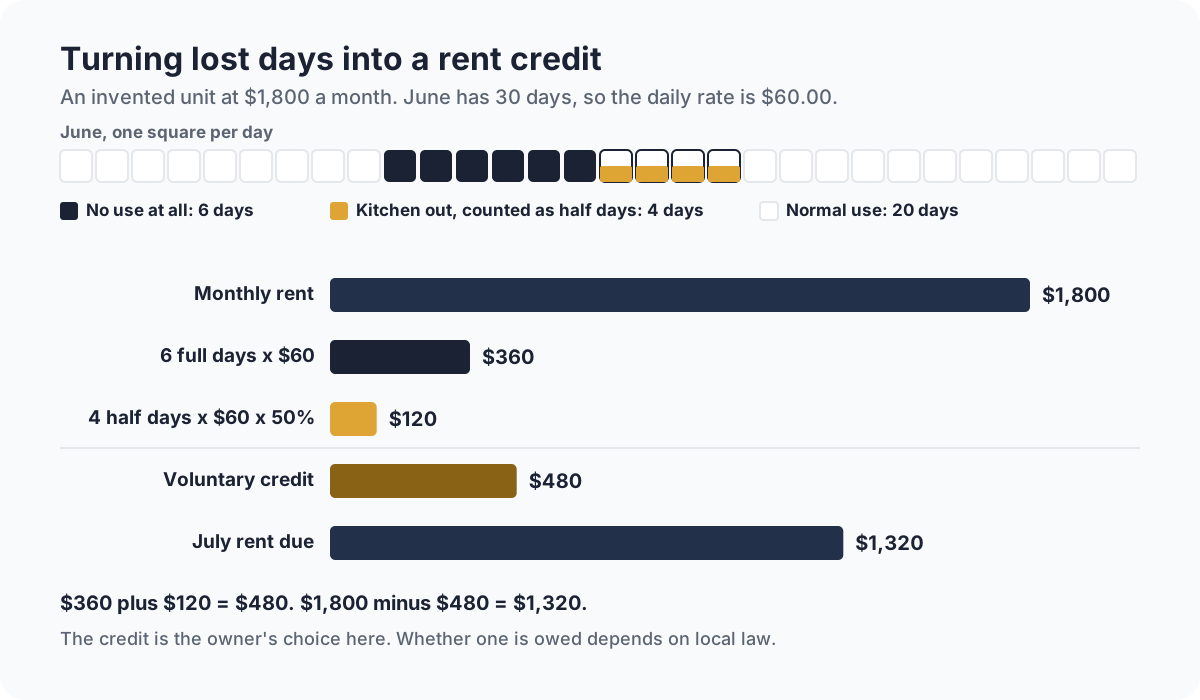
All the figures here are made up. A tenant rents a one-bedroom apartment for $1,800 a month. On June 10 a supply pipe bursts behind the bathroom wall. The water is shut off, the bathroom and kitchen floors are opened up, and the tenant stays with family while the work goes on.
- For 6 days the unit cannot be used at all.
- For the next 4 days the tenant moves back in, but the kitchen stays out of use while new flooring goes down. The owner treats those as half days.
The owner decides to offer a rent credit for the lost use. The lease does not call for one, and whether any credit is owed depends on local law and the facts. Here it is the owner's own choice, made to keep a good tenant and settle the matter simply.
The owner uses the days in the month as the basis, so the daily rate comes from dividing the monthly rent by 30, the days in June. That matches the actual-days method in the prorated rent entry and the site's prorated rent calculator.
- Daily rate: $1,800 / 30 = $60.00
- Full days: 6 x $60 = $360
- Half days: 4 x $60 x 50 percent = $120
- Total credit: $360 + $120 = $480
- July rent due after the credit: $1,800 minus $480 = $1,320
Some owners use a yearly daily rate: monthly rent x 12 / 365. That gives $1,800 x 12 / 365 = $59.18 a day, so the full days come to $355.07 and the half days to $118.36, a total of $473.42. The gap between the two methods is $6.58. Either way is reasonable for a voluntary credit; what matters most is picking one, writing it down and using the same method each time.
Put the credit in writing: the dates, the reason, the method and the amount, and show it on the tenant's statement as a credit against rent so both sides can see that July's rent was paid in full.
Keeping a record of a disruption
If a tenant later says their quiet enjoyment was disturbed, records are what show what happened. Owners generally keep:
- The tenant's request and the date it arrived, ideally on a written maintenance request.
- Every notice of entry and how it was delivered.
- Photos before and after the work, and a rental inspection checklist when the unit is checked.
- Invoices and contractor notes with dates, so the timeline is clear.
- Any rent credit and the letter explaining it.
These records help tell normal living from damage, too. The guide to normal wear and tear versus damage explains the difference.
Good practice for keeping a tenancy undisturbed
Most quiet enjoyment problems are avoidable with steady habits.
- Answer repair requests quickly and tell the tenant when work will happen.
- Follow the notice rules every time, even for short visits.
- Plan work in occupied buildings for reasonable hours and warn every affected tenant ahead of time.
- Act on complaints about another tenant you control, starting with a conversation and moving to written notice if it continues.
- Keep your own unit in check if you live in the building.
- Get local advice before you change locks, stop a service or take any step that limits a tenant's access.
Frequently asked questions
What does quiet enjoyment mean in a lease?
It means the tenant can use and enjoy the home for the lease term without unreasonable interference from the owner or people the owner controls. Most leases include the promise by implication, even when the words never appear.
Is quiet enjoyment about noise?
Only partly. "Quiet" here means undisturbed possession. Noise the owner causes or controls can be part of it, and so can entry without notice, repairs left undone and cut off services.
Can an owner enter a rental without breaking quiet enjoyment?
Yes, in general, when the entry is for a proper reason, at a reasonable time and with the notice that the lease and local law call for. Emergencies usually allow entry without the normal notice.
Does an owner have to give a rent credit when a repair disrupts a tenant?
That depends on local law and the facts. In the example on this page the credit was the owner's own choice: $480 for six full days and four half days at $60 a day.
How do you work out a rent credit for lost days?
Pick a daily rate, either the monthly rent divided by the days in that month or the monthly rent x 12 / 365, then multiply by the days lost. In the example, $1,800 / 30 = $60 a day, and 6 full days plus 4 half days gives $480.
Keep repair costs and rent credits on the right property
A disruption is easier to explain later when every repair bill and rent payment is already recorded against its property. In KeyRing, you connect your bank accounts securely through Plaid, and each transaction is matched to a property with suggestions you confirm. Income and expense records use categories you can edit, and you can export your transactions to Excel. See what KeyRing does or how plans are priced.
Free calculators and templates
- Maintenance request formA form tenants fill in to report repairs, and a log to track each one.
- Rental inspection checklistA room by room check of an occupied rental, with the repairs it turns up.
Browse all rental property calculators, free templates and the glossary.
From the blog
- Notice of entry: how much notice to give before you enter a rentalA notice of entry tells a tenant when you will enter their home and why. Typical notice periods, when entry without notice may be allowed and a sample notice.
- Lease violation notice: what to include and how to send itA lease violation notice tells a tenant which lease term was broken and how to fix it. What to include, how to deliver it, typical cure periods and a sample.
- What is normal wear and tear? How it differs from damageNormal wear and tear is the decline that comes from ordinary use. See how it differs from damage, common examples and how to work out a fair deposit deduction.