What are ACH return codes? R01, R02, R03 and more for rent

ACH return codes are short codes, the letter R followed by two digits, that a bank attaches to an ACH payment it sends back. Each one names the reason: R01 means the account did not have enough money, R02 means the account is closed, R03 means the bank could not find the account, and R10 means the account holder told their bank the debit was not authorized. For a property owner whose tenants pay rent by ACH, the code on a returned payment tells you whether to ask for the money again, check the bank details or ask for another way to pay. In the worked example below, a $1,650 rent payment comes back as R01, and with the lease's returned payment fee and late fee the tenant owes $1,767.50.
This page covers what ACH return codes are, a table of the common codes with their meaning, their usual return window and what owners typically do next, a worked example of a returned rent payment on the ledger and how to keep returns from catching you out. It is general information and is not legal or tax advice. Some states and cities limit returned payment fees and late fees. Rules vary by state and city. Check your local law or an attorney.
What are ACH return codes?
When a tenant pays rent by ACH, the payment usually travels as a debit: the payment service asks the tenant's bank to send the money. The tenant's bank can refuse or reverse that debit and send it back through the network as a return. Every return carries a code that starts with the letter R and two digits, set by the network's operating rules. Nacha, the organization that writes the rules for the ACH network, publishes the full list, with dozens of codes. Most of them deal with technical file errors between banks, and a property owner sees only a handful.
The code tells you two useful things:
- Why the payment failed. Some codes mean a temporary problem, such as a low balance. Others mean the account details are wrong or the account is gone, and a few mean the tenant has disputed the payment.
- How late it can arrive. Most returns must come back within 2 banking days after the payment settles. A consumer who says a debit was not authorized has a much longer window, about 60 days, so a payment can look complete for weeks and still come back.
If you are new to the network itself, the ACH payment guide explains how ACH works, how long it takes and what it costs. An eCheck is usually an ACH debit under another name, so the same codes apply.
Common ACH return codes for rent payments
The windows below follow Nacha's rules: "2 banking days" means the return must reach the payee's bank by the opening of business on the second banking day after the payment settled, and "60 days" means the banking day after the 60th calendar day. A payment service may show you the return a day or two later than that.
| Code | What it means | Usual return window | What an owner typically does next |
|---|---|---|---|
| R01 | Insufficient funds: the available balance did not cover the payment | 2 banking days | Tell the tenant, ask them to pay again once the money is there or by another method, and apply any fee the lease allows |
| R02 | Account closed by the tenant or the bank | 2 banking days | Ask the tenant for a new account or another payment method, and remove the old account from any repeat payments |
| R03 | No account or unable to locate account: the number does not match an open account for that person | 2 banking days | Confirm the routing and account numbers with the tenant, ideally from a check or bank statement |
| R04 | Invalid account number structure | 2 banking days | Ask the tenant to enter the account number again, checking for a missing or extra digit |
| R05 | Unauthorized debit to a consumer account using a business payment code | 60 days | Rare for rent; ask your payment service how the debit was set up and get a fresh written authorization |
| R06 | Returned at the request of the sending bank, often for an error | Agreed between the two banks | Ask your payment service why it asked for the return before collecting again |
| R07 | Authorization revoked: the tenant told their bank they withdrew permission for this debit | 60 days | Talk to the tenant, collect the rent by another method and do not debit the account again without a new authorization |
| R08 | Payment stopped: the tenant placed a stop payment on the debit | 2 banking days | Ask the tenant why and arrange another payment; a stop payment does not cancel the rent owed under the lease |
| R09 | Uncollected funds: the balance is there on paper but not yet available, often from a recent deposit | 2 banking days | Treat it like R01 and ask the tenant to pay again once the deposit clears |
| R10 | The tenant told their bank they do not know the payee or did not authorize the debit | 60 days | Contact the tenant, check your signed or online authorization and collect by another method |
| R11 | The debit was authorized but did not match its terms, such as the wrong amount or an early date | 60 days | Check the amount and date against what the tenant agreed, correct it and confirm the next payment with the tenant |
| R16 | Account frozen, or returned on a government sanctions instruction | 2 banking days | Ask the tenant for another payment method; a frozen account will not pay until the bank releases it |
| R17 | The bank could not process the entry, or believes it was set up under questionable circumstances | 2 banking days | Confirm the tenant's details directly with the tenant and watch for signs that someone else used the account |
| R20 | Non-transaction account, such as a savings account that limits withdrawals | 2 banking days | Ask the tenant to pay from a checking account |
| R23 | A credit, such as a refund to the tenant, was refused by the tenant | 2 banking days | Ask the tenant how they want the money, for example when you send back part of a security deposit |
| R29 | A business account holder says the debit was not authorized | 2 banking days | Common when a company pays rent from its own account; get a fresh authorization from someone who can sign for the business |
Nacha changes the rules from time to time, so codes and windows can shift. Your payment service's return notice is the best record of what happened to a given payment.
Which codes matter most
- Money problems (R01, R09). The tenant usually means to pay, and a second payment once the money is there often works. Network rules limit how many times a debit can be retried, so check what your payment service allows.
- Account detail problems (R02, R03, R04, R20). Retrying the same details will fail again. Get new or corrected details first.
- Disputes (R07, R08, R10, R11, R29). The tenant, or their bank, has pushed back on the debit itself. A debit returned as unauthorized should not be sent again under the old authorization, and a conversation with the tenant comes before anything else.
A worked example: a returned rent payment on the ledger
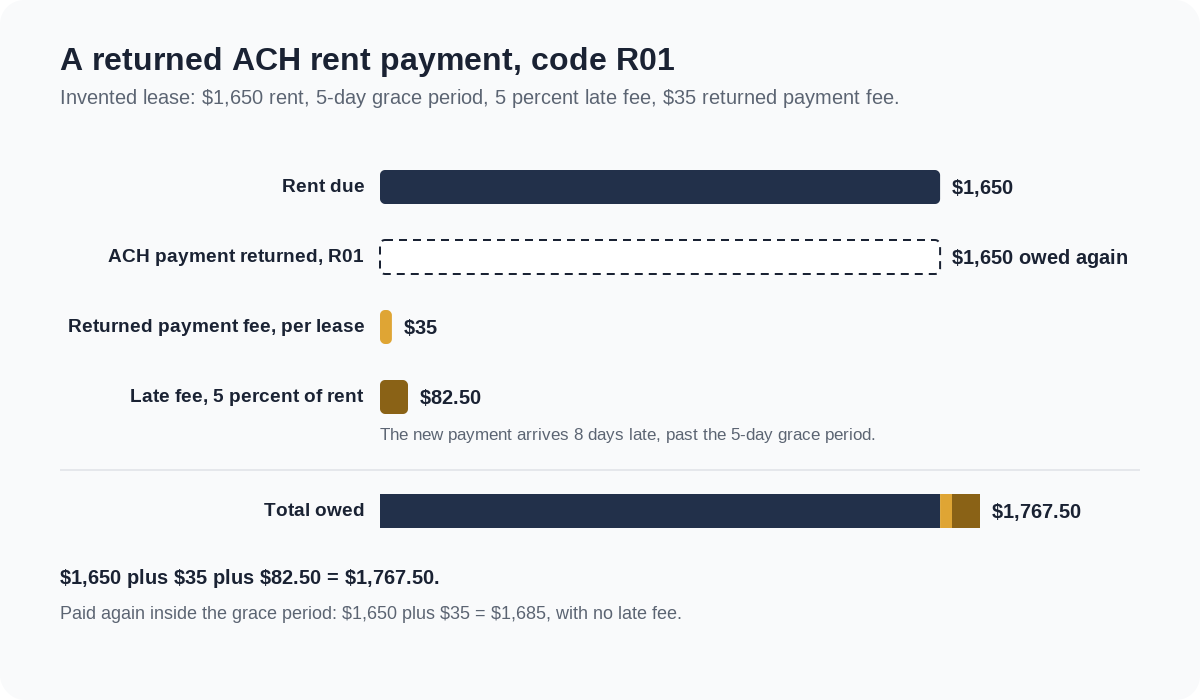
All the figures here are made up. A tenant's rent is $1,650, due on the 1st. The lease allows a 5-day grace period, then a late fee of 5 percent of the rent, and it sets a returned payment fee of $35. The tenant pays by ACH on the 1st. On the 3rd the payment comes back with code R01, insufficient funds.
The owner tells the tenant the same day. Under this lease, a returned payment counts as rent unpaid, so the grace period still runs from the 1st. The tenant pays again on the 9th, 8 days after the due date.
- Rent put back on the balance after the return: $1,650.00
- Returned payment fee from the lease: $35.00
- Late fee: 8 days late is past the 5-day grace period, so 5 percent x $1,650 = $82.50
- Total owed on the 9th: $1,650 + $35 + $82.50 = $1,767.50
If the tenant had paid again on the 5th, inside the grace period, there would be no late fee, and the total would be $1,650 + $35 = $1,685.00. The late fee calculator works out the late fee for any rent, grace period and fee type.
On the ledger, record the return as its own line with the date and the code, and keep the original payment line too:
| Date | Entry | Charge | Payment | Balance |
|---|---|---|---|---|
| 1st | Rent | $1,650.00 | $1,650.00 | |
| 1st | ACH payment | $1,650.00 | $0.00 | |
| 3rd | ACH payment returned, R01 | $1,650.00 | $1,650.00 | |
| 3rd | Returned payment fee, per lease | $35.00 | $1,685.00 | |
| 9th | Late fee, 5 percent of rent | $82.50 | $1,767.50 | |
| 9th | Replacement payment | $1,767.50 | $0.00 |
A rent ledger has room for each of these lines, and the rent ledger vs tenant ledger guide explains where each one belongs. Whether you can charge both a returned payment fee and a late fee, and how much, depends on the lease and local law.
How owners handle returned ACH rent payments
- Read the code first. It tells you whether to ask for the same payment again, new account details or a conversation about a dispute.
- Tell the tenant quickly and in writing. Say which payment came back, the code's plain meaning, what they owe now and the deadline in the lease.
- Keep the paper trail. Keep the tenant's payment authorization for as long as the lease runs, and the return notice from your payment service. For a 60-day return, the authorization is your best evidence.
- Hold the receipt until the money clears. A rent receipt sent before an ACH payment clears can end up covering rent that came back.
- Use certified funds after repeated returns, if the lease allows. Some leases let the owner require a cashier's check or money order after a set number of returned payments. The guide to certified funds explains the options, and a lease addendum can add the clause to a signed lease. Some places limit which payment methods an owner can require.
Frequently asked questions
What does R01 mean on an ACH return?
R01 means insufficient funds: the tenant's available balance did not cover the payment when the debit arrived. It usually comes back within 2 banking days. The tenant can often pay again once the money is in the account or pay another way.
What is the difference between R02, R03 and R04?
R02 means the account existed but has been closed. R03 means the account number looks valid but does not match an open account for that person. R04 means the account number itself is not in a valid format. All three call for new or corrected bank details before you try again.
How long can an ACH rent payment be returned?
For most codes, within 2 banking days after the payment settles. When a consumer tells their bank a debit was not authorized, as with R05, R07, R10 and R11, the return can come up to about 60 days later. A business account, coded R29, has the shorter 2-day window.
What does R10 mean, and what should an owner do?
R10 means the account holder told their bank they do not recognize the payee or did not authorize the debit. Contact the tenant, check the authorization you hold and collect the rent another way. Do not debit the account again under the old authorization.
Can an owner charge a fee for a returned ACH payment?
Often, if the lease names the fee and it is within any local limit. Some states and cities cap returned payment fees or set rules on late fees. Rules vary by state and city. Check your local law or an attorney.
Collect rent by ACH or card and see what is overdue
Returned payments are easier to follow up when every charge and payment sits on the right lease. In KeyRing, each lease keeps its rent charges, payments and balance, you can record cash and check payments, including partial ones, and overdue invoices are flagged automatically. Tenants can also pay rent online by bank transfer (ACH) or by debit or credit card, and they see the fee before they pay. The tenant pays the processing fee, so you receive the full rent: ACH is 0.8% capped at $5, card is 2.9% + $0.30, plus a 0.5% KeyRing platform fee. Rent goes straight to your own Stripe account and pays out to your bank. See what KeyRing does or how plans are priced.
Free calculators and templates
- Late fee calculatorA rent late fee as a flat amount or a percentage, with a grace period.
- Rent receipt templateA printable rent receipt, two to a page, and a CSV log for every payment you receive.
- Rent statement templateA tenant's charges, payments and balance for a period, from the opening balance to what is due now.
Browse all rental property calculators, free templates and the glossary.
From the blog
- What is an ACH payment? How ACH rent payments workAn ACH payment moves money between US bank accounts over the ACH network. How ACH rent payments work, how long they take, what they cost and when they bounce.
- What are certified funds? How they work for rent and move-in moneyCertified funds are payments backed by a bank or issuer: cashier's checks, certified checks, money orders and wires. How they work for rent, with an example.
- Rent ledger vs tenant ledger: what to track and whyA lease ledger, or tenant ledger, records one lease's charges, payments and balance. A rent ledger can cover a whole property. See both with worked examples.
- What is a lease addendum? Common addenda and how to add oneA lease addendum adds new terms to a signed lease, such as a pet or a parking space. How it differs from an amendment, common addenda and how to add one.