What is a land lease? Ground leases for property owners
A land lease, also called a ground lease, is a long-term lease of land only. The tenant pays rent for the ground, called ground rent, and owns or builds the house or building that stands on it, while the owner of the land keeps the land. For a real estate investor who buys a rental on leased land, the ground rent is an operating expense that comes out of the rent every month. In the example on this page, $400 a month of ground rent takes a single-family rental from $14,078.40 of yearly net operating income down to $9,278.40.
This page covers how a land lease works, ground rent and escalations, what happens at the end of the term, where land leases show up for small owners, a worked example run through the site's rental cash flow calculator, what to check before you buy, and the other side: owning land and leasing it out. It is general information and is not legal or tax advice. Rules vary by state and city. Check your local law or an attorney.
What is a land lease?
In an ordinary purchase, you buy the land and the building together. In a land lease, the two are split. One party owns the land and leases it out. The other party, the ground tenant, holds the right to use the land for a long term and owns the building on it, or builds one.
Under a land lease the lessor owns the land and the lessee owns the building, as the lessor and lessee guide explains. The lessee's interest is often called a leasehold.
The key terms:
- The term. Land leases run long. Terms of several decades are typical, and some run close to a century. A long term is what lets a lessee build, borrow against the building and sell it.
- Ground rent. The rent paid for the land, monthly or yearly.
- Escalations. How the ground rent rises: a fixed percent each year, a fixed step every few years, an inflation index, or a reset to a new land appraisal at set dates.
- Who pays what. The lessee usually pays taxes, insurance and upkeep, much like a triple net lease.
- The end of the term. What happens to the building when the lease runs out.
What happens at the end of the term
This clause matters most to value. Common outcomes include:
- The building goes to the land owner. Under many ground leases, the improvements revert to the owner of the land when the term ends, often without payment.
- The lessee removes the building. Some leases require the lessee to take the building away and return the land as it was. This is common for manufactured homes.
- A renewal or extension. The lease may give options to extend, sometimes at a new ground rent.
- A purchase option. Some leases let the lessee buy the land, at a set price or at an appraised value.
So the remaining term drives what a leasehold is worth. Buyers and lenders treat a home with 70 years left on its lease very differently from the same home with 15 years left.
Where small owners run into land leases
Land leases are best known in commercial real estate, where a developer may lease a parcel and build a store, office or hotel on it. Small owners and real estate investors tend to meet them in residential settings:
- Manufactured homes on leased lots. In many manufactured home communities, the resident owns the home and pays lot rent to the community owner. The lot rent is the ground rent.
- Homes on leased land. Some houses, townhomes and condominiums sit on land owned by a third party, such as a trust, a university or a family that has held the land for generations.
- Some condo and resort communities. A whole development may sit on leased land, with each owner paying a share of the ground rent through the association.
If a listing price looks low for the area, ask whether the land is leased.
A worked example run through the rental cash flow calculator
All the figures here are made up. A real estate investor buys a single-family rental on leased land for $150,000. The ground rent is $400 a month, and it rises 3 percent each year. The investor puts 40 percent down and borrows $90,000 at 7 percent over 20 years, a monthly payment of $697.77.
The monthly numbers, the same way the rental cash flow calculator figures them:
- Rent: $1,800
- Vacancy allowance of 5 percent: $1,800 x 0.95 = $1,710 collected
- Management at 8 percent of rent collected: $1,710 x 0.08 = $136.80
- Property taxes on the home $150, insurance $100, maintenance $150 and ground rent $400
| Line | Without ground rent | With ground rent |
|---|---|---|
| Rent collected | $1,710 | $1,710 |
| Operating expenses | $536.80 | $936.80 |
| Net operating income, monthly | $1,173.20 | $773.20 |
| Net operating income, yearly | $14,078.40 | $9,278.40 |
| Mortgage payment | $697.77 | $697.77 |
| Cash flow, monthly | $475.43 | $75.43 |
| Cash flow, yearly | $5,705.17 | $905.17 |
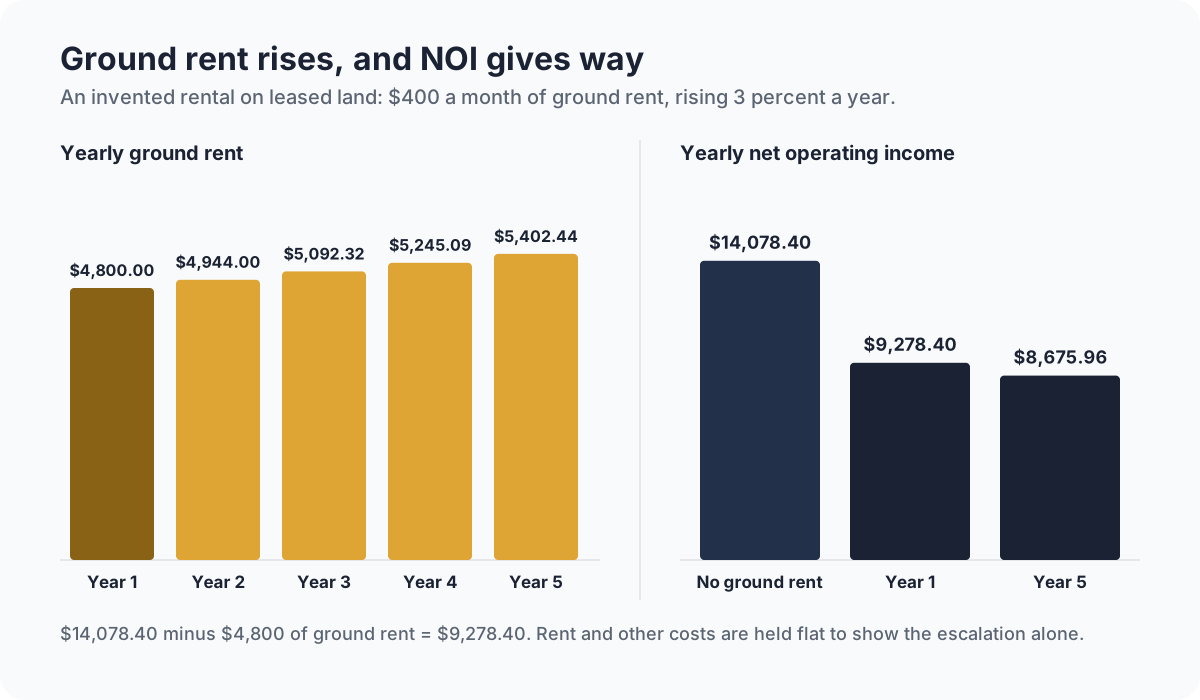
The ground rent is $400 x 12 = $4,800 a year, and it lowers yearly NOI by exactly that amount: $14,078.40 minus $4,800 = $9,278.40. The operating expenses guide and the NOI guide explain why it belongs above the NOI line.
The escalation keeps working after you buy. At 3 percent a year, the ground rent runs:
| Year | Monthly ground rent | Yearly ground rent |
|---|---|---|
| 1 | $400.00 | $4,800.00 |
| 2 | $412.00 | $4,944.00 |
| 3 | $424.36 | $5,092.32 |
| 4 | $437.09 | $5,245.09 |
| 5 | $450.20 | $5,402.44 |
Over five years the investor pays $25,483.85 of ground rent. If the rent and the other costs stayed flat, year 5 NOI would be $9,278.40 minus $602.44 = $8,675.96, and cash flow would fall to $25.23 a month, or $302.73 a year. Rents and costs move too in practice. The point is that a fixed escalation is a cost increase you know about in advance, and your rent needs to keep pace.
Ground rent also shows up in value. Investors often price a rental from its NOI with a cap rate, as the cap rate guide explains. At a 7 percent cap rate, $4,800 of yearly ground rent accounts for $4,800 / 0.07 = $68,571.43 of value. The cap rate calculator shows the same effect with your own numbers.
What to check before you buy a rental on leased land
- Read the whole ground lease. Ask for the lease, every amendment and any assignment to the current owner.
- Remaining term. Compare the years left on the lease with how long you plan to hold, and with the loan term. Many lenders want the lease to run well past the end of the loan, and some will not lend on a short remaining term at all.
- Financing. Fewer lenders make loans on leasehold properties, and those that do may ask for a larger down payment or charge more. Check with a lender before you make an offer. The loan to value guide and the DSCR guide cover the ratios a lender will run, with ground rent already counted in the expenses.
- The escalation clause. A fixed percent is easy to model. A reset to a new land appraisal can bring a large jump at a set date, so find out when the next one falls.
- Transfer and consent. Some leases require the land owner's consent to sell, rent out or mortgage the leasehold. Confirm that renting the home out is allowed, and who pays the taxes on the land.
- The end of the term. Know whether the building reverts, must be removed, or can be renewed or bought.
- Status of the lease. Before closing, buyers often ask the land owner for a statement that the ground rent is current and the lease is in effect, much like an estoppel certificate.
A title company and a real estate attorney can review these points.
Owning land and leasing it out
The other side of a land lease suits some owners who hold land they want to keep. The owner collects ground rent for decades, keeps the land, and leaves the building, its upkeep and much of the operating risk with the lessee. If the building reverts at the end of the term, the owner may also receive it.
The tradeoffs are a very long commitment, income that grows only as fast as the escalation clause allows, and less control over the land. Owners who lease land out usually have an attorney draft the lease. The tax treatment of ground rent and of a building that reverts can be complex, so ask a tax professional.
Frequently asked questions
What is a land lease in simple terms?
It is a long-term lease of land only. You pay ground rent to the owner of the land, and you own the home or building that sits on it for as long as the lease runs.
Is a land lease the same as a ground lease?
Yes. Ground lease is the more common term in commercial real estate, and land lease is more common for homes and manufactured home lots.
What happens to my house when a land lease ends?
It depends on the lease. The house may go to the owner of the land, you may have to remove it, or you may be able to renew the lease or buy the land. Read the end-of-term clause before you buy.
Is ground rent an operating expense?
For a rental property, yes. Ground rent is a cost of running the property, so it is subtracted before net operating income. In the example on this page, $400 a month of ground rent lowers yearly NOI from $14,078.40 to $9,278.40.
Is it harder to get a mortgage on a home on leased land?
Often it is. Fewer lenders make leasehold loans, and many require the lease to run well past the end of the loan. Ask a lender about a specific property before you make an offer.
Keep the ground rent on the right property
Ground rent and every other cost are easier to track when each one is already filed under its property. In KeyRing, you connect your bank accounts securely through Plaid, and each transaction is matched to a property with suggestions you confirm. Income and expense records use categories you can edit, and you can export your transactions to Excel. See what KeyRing does or how plans are priced.
Free calculators and templates
- Rental cash flow calculatorMonthly cash flow line by line, per unit, with the break-even rent.
- Cash on cash return calculatorYearly cash flow as a share of the cash you put in.
- DSCR calculatorHow many times NOI covers the loan payments, and the loan a target ratio allows.
- Rental property balance sheet templateAssets, liabilities and equity for one property at year end, next to last year's.
Browse all rental property calculators, free templates and the glossary.
From the blog
- What is NOI? Net operating income for rental propertyNOI is a rental property's income after vacancy and operating expenses, before the mortgage. What goes in, what stays out, a duplex example and its uses.
- Lessor vs lessee: who is who in a leaseThe lessor grants the right to use a property and the lessee pays for it. Who is who in a rental lease, what each side usually owes, and sublessors.
- What is cap rate? How to calculate it for a rental propertyCap rate is net operating income divided by a property's price or value. How to calculate it, a worked fourplex example and what it leaves out.