What is an estoppel certificate? A tenant's signed lease facts

An estoppel certificate is a signed statement, usually from a tenant, that confirms the key facts of a lease as of a set date: the rent, the security deposit, the lease term, the documents that make up the lease and whether either side claims the other owes anything. Buyers and lenders ask for one before a property sells or is refinanced. Once a tenant signs it, the tenant generally cannot later claim facts that contradict it to the party that relied on it. That is the meaning of "estoppel."
This page covers what an estoppel certificate is, what it usually includes, who asks for one and when, a worked example from a small retail strip, how it differs from a rent roll and the mistakes that cause trouble at closing. It is general information and is not legal or tax advice. Rules vary by state and city. Check your local law or an attorney.
What is an estoppel certificate?
When a property changes hands, the buyer steps into the seller's leases. The buyer can read the lease file and the seller's rent roll, but both come from the seller. An estoppel certificate gets the same facts from the other side of the lease. The tenant reads a short form, corrects anything that is wrong, signs it and returns it.
The word comes from a legal idea: a person who states a fact that another person relies on can be stopped, or estopped, from denying that fact later. How far that protection reaches depends on the wording of the certificate and on the law where the property sits, so the buyer's attorney usually reviews each one.
Estoppel certificates are most common with commercial leases, such as retail, office and industrial space, and with larger apartment sales. Many commercial leases include a clause that requires the tenant to sign one within a set number of days after the owner asks. Residential leases may or may not include that clause, and some places limit what a residential tenant can be required to sign. Check your lease and your local law before you send one.
What an estoppel certificate usually covers
The buyer or lender usually supplies the form, and the owner fills in what the records show before sending it to the tenant. A typical certificate asks the tenant to confirm:
- The lease documents. The lease and every amendment, extension or side letter, listed by date. A lease addendum that the seller forgot to mention shows up here.
- The term. The start date, the end date and any options to renew, extend, expand or end the lease early.
- The rent. The current monthly rent, the date rent is paid through and any rent paid in advance. Rent paid ahead is money the buyer may need a credit for at closing.
- The security deposit. The amount held and any part of it applied to charges. The security deposit entry covers how deposits are held and returned.
- Shared costs. For a triple net lease or another lease where the tenant pays a share of taxes, insurance and upkeep, the current monthly estimate and whether last year's costs have been settled.
- Defaults and claims. Whether the tenant or the owner is in default, and whether the tenant claims any offset, credit or defense against paying rent.
- Rights to buy. Any right of first refusal or option to purchase the property.
The certificate is dated, and the facts in it are true as of that date. A buyer usually wants it signed close to closing, because rent paid and claims made after the date are outside it.
Who asks for one and when
- A buyer asks during due diligence, after the purchase contract is signed and before closing. The purchase contract often sets how many certificates the seller must deliver and what happens if a tenant does not return one.
- A lender asks on a purchase loan or a refinance, because the rent is what repays the loan. Lenders also review a trailing 12-month statement, and the T12 guide covers that report.
- A new owner of the lease may ask when a lease is assigned to a new tenant.
Lenders sometimes pair the estoppel with a subordination, non-disturbance and attornment agreement (SNDA). In that agreement the tenant accepts that the lease sits behind the new mortgage, the lender agrees to leave the tenant in place if it forecloses, and the tenant agrees to treat a new owner as its owner.
In some states, a condominium or homeowners association issues a document also called an estoppel certificate when a unit sells. It states the dues, special assessments and fees owed on the unit. The idea is the same, a signed statement others can rely on, with the association as the signer.
A worked example: a three-unit retail strip
All the figures here are made up. A real estate investor is selling a three-unit retail strip. The seller's rent roll lists Unit B at $4,500 a month with a $9,000 security deposit and a lease that ends June 30, 2029. The buyer sends an estoppel certificate to each tenant, filled in from the rent roll.
Unit B's tenant returns the certificate with three changes:
- Rent. The tenant writes in $4,200 a month. A second amendment, signed during a slow season, lowered the rent for the rest of the term, and the seller's rent roll was never updated.
- Lease documents. The tenant lists the lease and two amendments. The seller had listed the lease alone.
- Claims. The tenant says it paid $1,800 to repair the heating and cooling unit, a cost the lease puts on the owner, and plans to take it off next month's rent.
The deposit matches at $9,000.
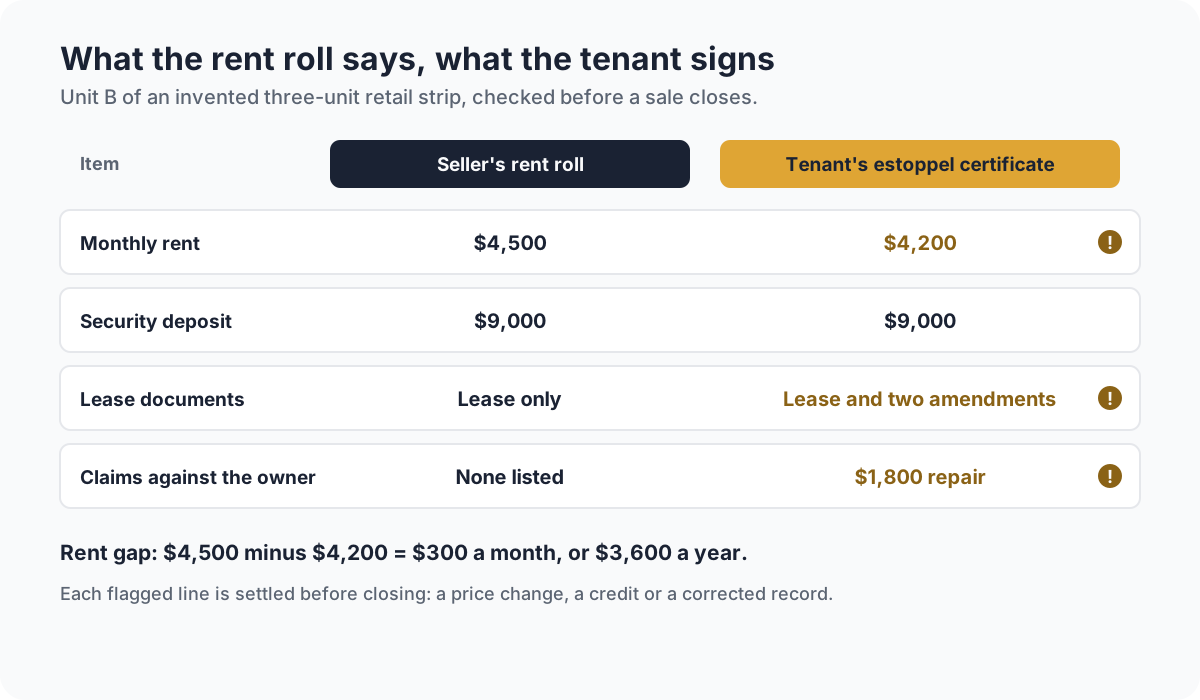
The gap in rent is $4,500 minus $4,200 = $300 a month, or $300 x 12 = $3,600 a year. A buyer who priced the strip on its income will often reprice it. At an invented 7 percent capitalization rate, $3,600 less income a year is $3,600 / 0.07 = $51,428.57 less value. The cap rate guide and the cap rate calculator show how income turns into value.
The buyer and seller now have choices: lower the price, give the buyer a credit at closing for the $1,800 claim, have the seller settle the repair with the tenant before closing, or correct the rent roll and move ahead. Without the certificate, the buyer would likely have learned about the amendment after closing.
Estoppel certificate vs rent roll
| Rent roll | Estoppel certificate | |
|---|---|---|
| Who prepares it | The owner or manager | The owner fills it in, the tenant corrects and signs |
| What it covers | Every unit in one list | One lease in detail |
| When it is made | Any time, often monthly | Usually once, before a sale, loan or assignment |
| What it shows that the other may miss | Vacant units and the whole property's income | Amendments, side deals, claims and offsets |
A buyer usually compares the two line by line. Keeping a current rent roll template makes the certificates faster to fill in and leaves fewer surprises.
How to prepare estoppel certificates as an owner
- Read each lease clause. Note how many days the tenant has to respond and whether the lease sets the form.
- Fill in the form from the lease file. Use the lease and every amendment, and include the deposit, the paid-through date and any rent paid ahead.
- Check your own records first. A rent statement for each tenant shows charges and payments by date. The rent statement template lays one out.
- Send it with a clear return date. Give the tenant a contact for questions.
- Read every change the tenant makes. A change is a fact to resolve, either with the tenant or with the buyer.
- Keep a copy. File the signed certificate with the lease.
Common mistakes
- Sending a blank form. A tenant who has to fill in every line may leave lines blank, and blanks protect no one. Fill it in and ask the tenant to correct it.
- Working from an old rent roll. An amendment or a rent change that never reached the rent roll becomes a dispute at closing.
- Leaving out side letters. A rent credit agreed in an email can still bind the owner, depending on the lease and local law.
- Signing too early. A certificate dated months before closing misses later payments and claims.
- Tenants signing without reading. A tenant who signs a wrong statement may be held to it. Tenants should read the form and correct it before signing.
Frequently asked questions
What is an estoppel certificate in simple terms?
It is a short form a tenant signs to confirm the facts of its lease, such as the rent, the deposit, the lease dates and any disputes, as of a set date. A buyer or lender relies on it, and the tenant generally cannot later contradict it with them.
Who signs an estoppel certificate?
Usually the tenant signs it, after the owner fills it in from the lease file. In some states, a condominium or homeowners association signs a similar certificate stating the dues owed on a unit when it sells.
Does a tenant have to sign an estoppel certificate?
It depends on the lease and on local law. Many commercial leases require the tenant to sign within a set number of days after the owner asks. Some residential leases include a similar clause and some do not. Check the lease and your local law.
What happens if the estoppel certificate does not match the rent roll?
The buyer, the seller and often the tenant work out which is right before closing. The usual results are a price change, a credit at closing, a fix made by the seller before closing or a corrected rent roll.
Is an estoppel certificate the same as an SNDA?
No. An estoppel certificate confirms the facts of a lease. An SNDA sets the order of the lease and a mortgage and what happens to the tenant if the lender forecloses. Lenders often ask for both at the same time.
Keep each lease's terms and deposits on record
An estoppel certificate is only as quick to fill in as the lease records behind it. In KeyRing, each lease keeps its rent charges, payments and balance, and each lease keeps a deposit ledger: what was received, deductions, interest credited to the tenant, refunds, the balance held and the date it is due back. See what KeyRing does or how plans are priced.
Free calculators and templates
- Rent roll templateEvery unit, lease, rent and balance in a property on one page, as of one date.
- Rent statement templateA tenant's charges, payments and balance for a period, from the opening balance to what is due now.
Browse all rental property calculators, free templates and the glossary.
From the blog
- What is a rent roll (with a free template)A rent roll lists each unit, tenant, lease and rent in a property as of one date. See what it includes, a fourplex example and the numbers you can pull from it.
- What is a lease addendum? Common addenda and how to add oneA lease addendum adds new terms to a signed lease, such as a pet or a parking space. How it differs from an amendment, common addenda and how to add one.
- What is a T12 statement? How to build a trailing 12-month operating statementA T12 shows a rental property's income and expenses for each of the last 12 months and the NOI they add up to. What goes on one, how to build it and an example.