What is LTV? Loan to value for rental property loans

Loan to value, or LTV, is the size of a loan divided by the value of the property it is secured by, written as a percentage. A $360,000 mortgage on a rental worth $480,000 is an LTV of 75%. The other 25% is the owner's equity. Lenders use LTV to decide how much they will lend, and owners use it to see how much of a property they own outright.
This page covers how to work out LTV, how combined LTV (CLTV) differs, a purchase example and a refinance example, how LTV moves when the value or the loan changes, and why lenders cap it. It is general information and is not legal or tax advice. It is not financial advice either. Lenders set their own limits, so ask your lender for theirs. Rules vary by state and city. Check your local law or an attorney.
What is LTV?
LTV compares what you owe with what the property is worth:
LTV = loan balance / property value x 100
The value is usually the lender's appraisal. On a purchase, many lenders use the price or the appraised value, whichever is lower. The lower the LTV, the more equity sits between the loan and the value. The loan to value calculator works out LTV, combined LTV and equity from your own figures.
LTV and combined LTV (CLTV)
LTV usually counts the first mortgage alone. Combined loan to value, or CLTV, adds every loan secured by the property, such as a second mortgage or a home equity line, and divides the total by the value. Lenders look at CLTV when a property already has more than one loan, or when a new loan would sit behind an existing one.
| Measure | What it divides by the value | Used for |
|---|---|---|
| LTV | The first mortgage | A new purchase loan or a refinance of the first mortgage |
| CLTV | Every loan secured by the property | A second loan or line, or a refinance that pays off several loans |
| Equity share | The value less every loan | How much of the property the owner holds |
A purchase example: a duplex
A buyer agrees to pay $480,000 for an invented duplex and puts $120,000 down. All the figures here are made up, and the lender's 75% limit is for this example only.
- Loan: $480,000 minus $120,000 = $360,000.
- LTV against the price: $360,000 / $480,000 = 75.00%.
The appraisal comes in at $470,000. The lender uses the lower figure, so the same loan is $360,000 / $470,000 = 76.60%, over the 75% limit. At 75% of $470,000, the most the lender will lend is $470,000 x 75% = $352,500. The buyer adds $360,000 minus $352,500 = $7,500 to the down payment, $127,500 in all, or asks the seller to lower the price.
A buyer who plans to live in one unit may qualify for an owner-occupied loan with a smaller down payment, and so a higher LTV. The house hacking guide covers how those loans work.
A refinance example: taking cash out
An owner has an invented rental now worth $520,000. They owe $286,000 on the first mortgage and $26,000 on a home equity line.
- LTV: $286,000 / $520,000 = 55.00%.
- All loans: $286,000 + $26,000 = $312,000. CLTV: $312,000 / $520,000 = 60.00%.
- Equity: $520,000 minus $312,000 = $208,000, which is 40.00% of the value.
The owner asks about a cash-out refinance, and the lender quotes a 70% maximum, again for this example only. The new first loan can be up to $520,000 x 70% = $364,000. It pays off the $312,000 of loans and $7,000 of closing costs, leaving $364,000 minus $312,000 minus $7,000 = $45,000 in cash. After the refinance, the one loan is 70.00% of the value and the equity is $520,000 minus $364,000 = $156,000.
Investors who buy, renovate and refinance work out the same numbers against the after repair value. The ARV guide and the BRRRR calculator walk through that kind of deal.
How LTV moves with the value
The same loan is a larger share of a smaller value. Here is the $364,000 loan from the refinance at three values:
| Property value | LTV | Equity |
|---|---|---|
| $560,000 | $364,000 / $560,000 = 65.00% | $196,000 |
| $520,000 | $364,000 / $520,000 = 70.00% | $156,000 |
| $455,000 | $364,000 / $455,000 = 80.00% | $91,000 |
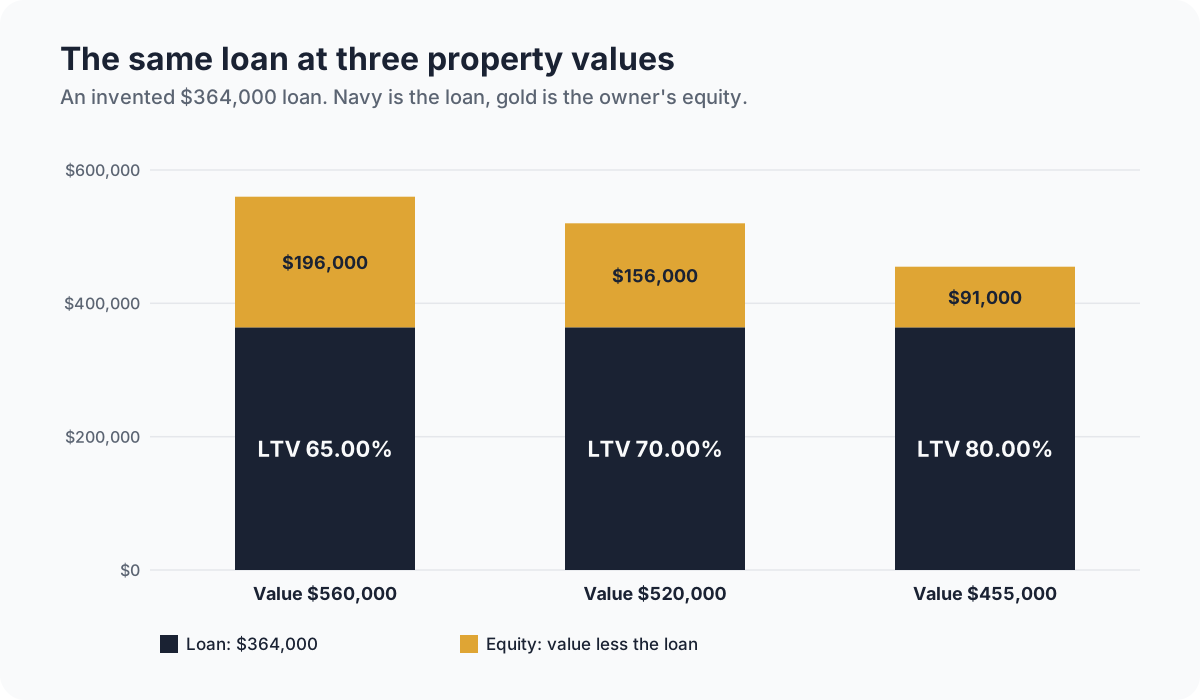
A falling value leaves the payments on an existing loan as they are, and it limits what you can borrow next: at $455,000 and an 80% LTV, the owner in the example would be over a 70% limit, with no room for a new loan.
LTV also falls as you pay the loan down. If the $364,000 loan is paid down to $338,000 and the value stays at $520,000, the LTV is $338,000 / $520,000 = 65.00%.
Why lenders cap LTV
A lower LTV leaves the lender more room if the property has to be sold for less than expected, so lenders set a maximum LTV for each loan. The maximum depends on the loan type, the property type, whether the borrower lives there and what the loan is for. A loan on an investment property often has a lower maximum than a loan on a home the borrower lives in, and a cash-out refinance often has a lower maximum than a purchase. On many conventional loans, an LTV above 80% means the borrower pays for mortgage insurance. Terms such as the rate can also change with the LTV, so ask your lender how its pricing works.
Lenders that finance rentals look at the property's income as well. Many compare the net operating income with the year's loan payments, the debt service coverage ratio, and the DSCR calculator works that out. For a refinance, lenders often ask for the current leases and a rent roll, and the lessor vs lessee guide explains what a refinance means for the leases.
Ways to lower your LTV
- Put more down. On a purchase, each extra dollar down lowers the loan and the LTV.
- Pay down the loan. Regular payments lower the balance over time, and extra principal payments lower it faster.
- Pay off a second loan. Clearing a home equity line lowers the CLTV, even when the first mortgage stays the same.
- Raise the value. Repairs and upgrades can raise the appraised value, though an appraisal reflects the market and may not move by what the work cost.
Frequently asked questions
What is LTV in simple terms?
LTV is how much of a property is borrowed. It is the loan divided by the value, as a percentage. A $360,000 loan on a $480,000 property is 75% LTV, and the owner holds the other 25% as equity.
How do you calculate loan to value?
Divide the loan balance by the property value and multiply by 100. In the refinance example, $286,000 / $520,000 x 100 = 55.00%. For CLTV, add every loan secured by the property first: $312,000 / $520,000 x 100 = 60.00%.
What is a good LTV for a rental property?
There is no single good figure. Each lender sets a maximum for each loan and property, and the terms can change with the LTV. A lower LTV leaves more equity if values fall, and a higher one leaves more of your cash free for other uses. Ask your lender for its limits.
What is the difference between LTV and CLTV?
LTV usually counts the first mortgage alone, and CLTV counts every loan secured by the property. In the refinance example, the first mortgage is 55.00% of the value and both loans together are 60.00%.
Does LTV change over time?
Yes. It falls as you pay the loan down or as the value rises, and it rises if the value falls or you borrow more against the property. Lenders usually work it out again, often with a new appraisal, when you apply for a new loan.
Show a lender clean numbers
A lender asks about the property's income and costs as well as its value. In KeyRing, you connect your bank accounts securely through Plaid, and each transaction is matched to a property with suggestions you confirm. Income and expense records use categories you can edit, and you can export your transactions to Excel. See what KeyRing does or how plans are priced.
Free calculators and templates
- Loan to value calculatorLTV, combined LTV and equity, with the room left under your lender's limit.
- DSCR calculatorHow many times NOI covers the loan payments, and the loan a target ratio allows.
- BRRRR calculatorCash in, cash back at the refinance and cash left in a buy, rehab, rent, refinance deal.
- Rent roll templateEvery unit, lease, rent and balance in a property on one page, as of one date.
Browse all rental property calculators, free templates and the glossary.
From the blog
- What is ARV? After repair value for BRRRR investorsARV is what a property should be worth once the repairs are done. How to estimate it from comparable sales, and how it sets a BRRRR refinance, with an example.
- What is house hacking? How it works with a duplex or a spare roomHouse hacking means living in part of a property and renting out the rest. How it works with a duplex or spare rooms, the loans, the math and the trade-offs.
- What is NOI? Net operating income for rental propertyNOI is a rental property's income after vacancy and operating expenses, before the mortgage. What goes in, what stays out, a duplex example and its uses.
- Lessor vs lessee: who is who in a leaseThe lessor grants the right to use a property and the lessee pays for it. Who is who in a rental lease, what each side usually owes, and sublessors.