What is a triple net lease? NNN and net leases explained

A triple net lease, often written NNN, is a lease in which the tenant pays three of the property's running costs on top of the base rent: property taxes, building insurance and maintenance. The owner collects the base rent, and the tenant carries those costs, including any increase in them. Triple net leases are most common for commercial property, such as a single-tenant store or office.
This page covers what a net lease is, how single, double and triple net leases compare with a gross lease, a worked example of the same building leased both ways, how the costs are billed and what to check before you sign one. It is general information and is not legal or tax advice. Rules vary by state and city. Check your local law or an attorney.
What is a triple net lease?
In a net lease, the tenant pays some or all of the property's operating costs in addition to rent. The "nets" are the three groups of costs a tenant can take on: property taxes, insurance and maintenance. A triple net lease passes all three to the tenant.
In a single-tenant building, the tenant often pays those bills directly or pays the owner back for them. In a building with several tenants, the owner usually pays the bills and charges each tenant its share, often in proportion to the space it leases. Upkeep of shared areas, such as the parking lot, hallways and landscaping, is often called common area maintenance, or CAM.
Gross, single net, double net and triple net leases
| Lease type | Tenant pays | Owner pays |
|---|---|---|
| Gross lease | Rent, and often some utilities | Property taxes, insurance and maintenance |
| Modified gross lease | Rent plus the costs the lease names | The other costs |
| Single net (N) | Rent plus property taxes | Insurance and maintenance |
| Double net (NN) | Rent plus property taxes and insurance | Maintenance |
| Triple net (NNN) | Rent plus property taxes, insurance and maintenance | Often the roof and structure, if the lease says so |
| Absolute net | Rent plus every cost, including the roof and structure | Little or nothing |
These labels are used loosely, and two leases both called triple net can split the costs differently. Large items such as a roof replacement or structural repairs may fall to the tenant or to the owner. What the signed lease says decides who pays for what.
Where triple net leases are used
Triple net leases are common for single-tenant commercial buildings, such as a restaurant, a pharmacy or a bank branch, and for shops and offices in shopping centers and office parks. Some owners of homes and small buildings put a few net terms in a residential lease, for example a tenant who pays the utilities and handles yard care. Most residential leases are gross or modified gross leases, where the owner pays the property taxes and insurance.
Residential tenancies come with their own state and local rules, such as the owner's duty to keep a home fit to live in, and those rules can limit which costs a lease may pass to a tenant. The lessor vs lessee guide covers who is who on any lease.
A worked example: the same storefront, two ways
An owner has an invented single-tenant storefront. All the figures are made up for this example, and the unit is leased all year. The property's running costs for a year are:
- Property taxes: $9,000.
- Insurance: $3,000.
- Maintenance: $4,800.
- Total: $9,000 + $3,000 + $4,800 = $16,800.
On a gross lease at $5,400 a month, the tenant pays 12 x $5,400 = $64,800 a year and the owner pays the $16,800. The owner's net operating income is $64,800 - $16,800 = $48,000.
On a triple net lease at a base rent of $4,000 a month, the tenant pays 12 x $4,000 = $48,000 to the owner plus the $16,800 of costs, so $48,000 + $16,800 = $64,800 in all. The owner's NOI is the $48,000 of base rent.
In year one the two leases come out the same. The difference shows when a cost changes. Say property taxes rise by $1,200 to $10,200, so the running costs are $16,800 + $1,200 = $18,000:
| Gross lease | Triple net lease | |
|---|---|---|
| Rent paid to the owner | $64,800 | $48,000 |
| Who pays the running costs | The owner | The tenant |
| Tenant's total cost, year one | $64,800 | $64,800 |
| Owner's NOI, year one | $48,000 | $48,000 |
| Tenant's total cost after the tax rise | $64,800 | $48,000 + $18,000 = $66,000 |
| Owner's NOI after the tax rise | $64,800 - $18,000 = $46,800 | $48,000 |
On the gross lease the owner absorbs the $1,200 increase. On the triple net lease the tenant does. A real lease may also raise the rent over time, and the example leaves that out to keep the comparison clear.
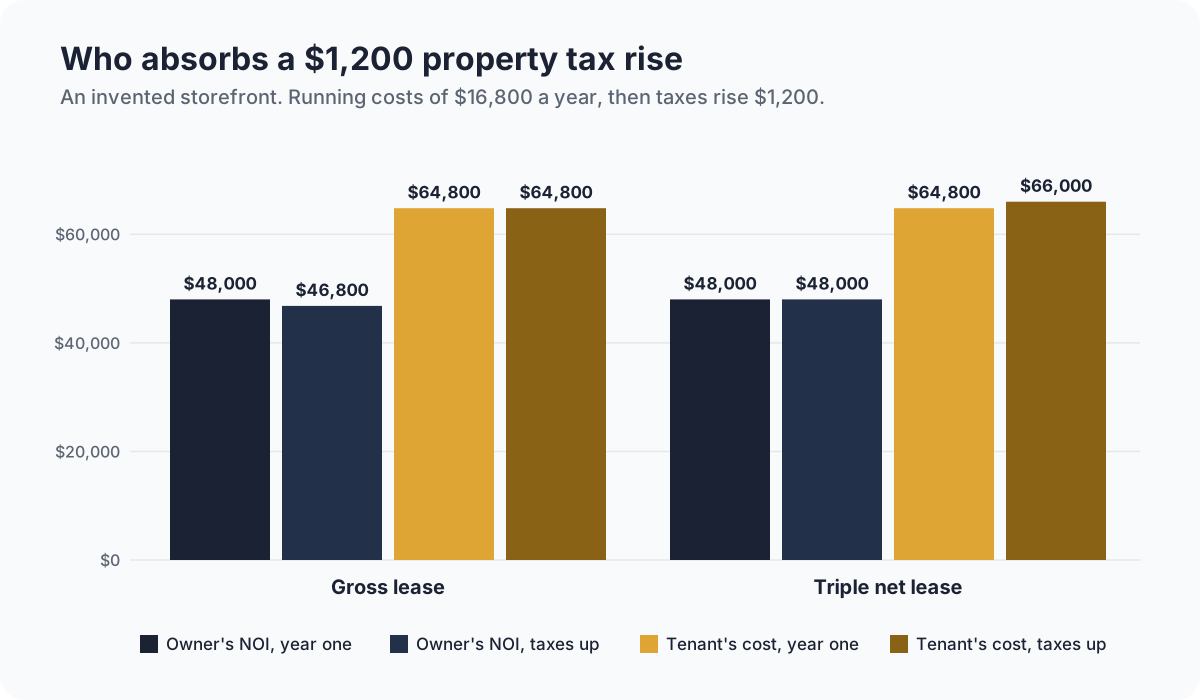
Buyers price income property on its NOI, so a steady NOI is part of the appeal of a net lease. The cap rate guide and the cap rate calculator show how NOI and price relate, and the NOI calculator works out NOI from your own figures.
How the costs are billed
In a building with several tenants, the owner usually estimates the year's costs, bills each tenant a monthly share and settles up after year end, a step often called reconciliation.
For example, a tenant leases 25% of an invented building, and the owner estimates the year's taxes, insurance and maintenance at $36,000. The tenant's share is 25% x $36,000 = $9,000, billed at $9,000 / 12 = $750 a month. The actual costs come to $38,400, so the tenant's share is 25% x $38,400 = $9,600, and the tenant owes $9,600 - $9,000 = $600 at reconciliation. Had the costs come in under the estimate, the tenant would get a credit.
Reconciliation depends on good records: every bill and receipt, sorted by property and by category. A rental property expense spreadsheet keeps the costs in one place, and the profit and loss template shows them against the rent. On a property with a property manager, the manager usually prepares the estimates and the reconciliation.
What to check in a triple net lease
- Which costs count. The lease should list what the tenant pays for and what it leaves out, such as the owner's loan payments, a new roof or the owner's own management costs.
- The roof, structure and major systems. Who repairs and who replaces them, and who decides when.
- Insurance. Which policies the tenant pays for or carries, the amounts of cover and who is named on them.
- Estimates and reconciliation. How often the estimate is set, when the reconciliation is due and how a balance is paid or credited.
- Caps. Whether increases in some costs are capped each year.
- Audit rights. Whether the tenant may review the owner's records for the costs it pays.
Frequently asked questions
What is a triple net lease in simple terms?
A triple net lease is a lease where the tenant pays the base rent plus the property's taxes, insurance and maintenance. The owner collects the base rent, and the tenant covers the running costs.
What are the three nets in a triple net lease?
Property taxes, building insurance and maintenance. A single net lease passes property taxes to the tenant, a double net lease adds insurance, and a triple net lease adds maintenance too.
What is the difference between a gross lease and a triple net lease?
On a gross lease, the tenant pays one rent and the owner pays the property taxes, insurance and maintenance out of it. On a triple net lease, the tenant pays a lower base rent plus those costs. In the example, both leases cost the tenant $64,800 in year one, and a $1,200 tax rise came out of the owner's NOI on the gross lease and out of the tenant's pocket on the triple net lease.
Who pays for the roof on a triple net lease?
It depends on the lease. Some triple net leases leave the roof and structure to the owner, and some pass them to the tenant. A lease that passes every cost, including the roof and structure, is often called an absolute net lease.
Are triple net leases used for residential rentals?
Rarely. Most residential leases are gross or modified gross leases, and state and local rules for residential tenancies can limit which costs a lease may pass to a tenant. Rules vary by state and city. Check your local law or an attorney.
Keep every cost on the right property
Net lease or gross, the numbers are only as good as the records behind them. In KeyRing, you connect your bank accounts securely through Plaid, and each transaction is matched to a property with suggestions you confirm. Income and expense records use categories you can edit, and you can export your transactions to Excel. See what KeyRing does or how plans are priced.
Free calculators and templates
- NOI calculatorNet operating income and the operating expense ratio for a year.
- Cap rate calculatorNet operating income as a share of the property's value.
- Rental property expense spreadsheetEvery bill for a property, one row each, sorted into categories that match Schedule E.
- Rental property profit and loss statement templateIncome, expenses, NOI and net income for one property, quarter by quarter and for the year.
Browse all rental property calculators, free templates and the glossary.
From the blog
- What is NOI? Net operating income for rental propertyNOI is a rental property's income after vacancy and operating expenses, before the mortgage. What goes in, what stays out, a duplex example and its uses.
- What is cap rate? How to calculate it for a rental propertyCap rate is net operating income divided by a property's price or value. How to calculate it, a worked fourplex example and what it leaves out.
- What is a property manager? What one does and when to hire oneA property manager runs rentals for an owner: tenants, rent, repairs and records. What one does, how fees work, when to hire one and what to ask first.
- Lessor vs lessee: who is who in a leaseThe lessor grants the right to use a property and the lessee pays for it. Who is who in a rental lease, what each side usually owes, and sublessors.